
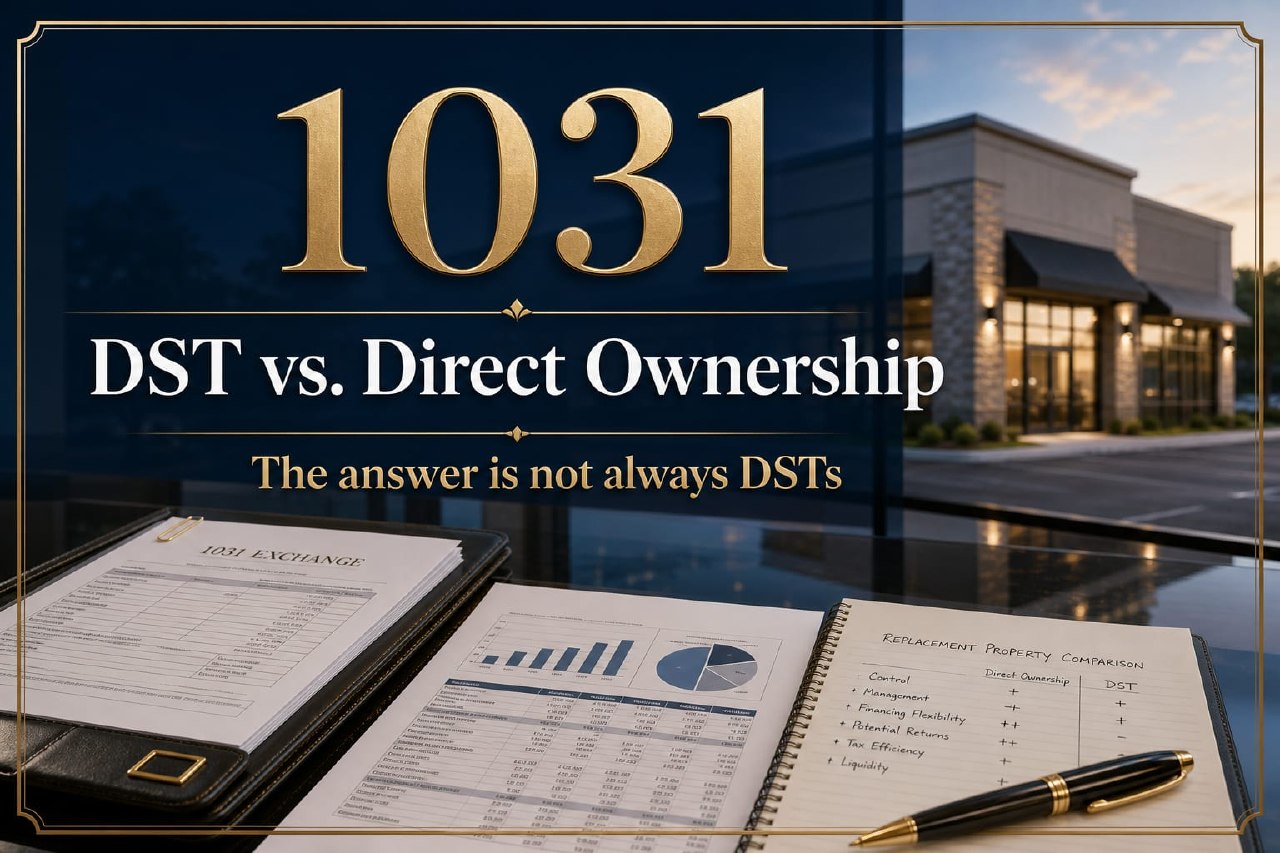
A Delaware Statutory Trust can be valid replacement property in a 1031 exchange. The real question is not whether a DST can fit inside a 1031. It can. The real question is whether an exchanger should use a fractional, sponsor-controlled DST interest or buy replacement property directly.
That distinction matters because most replacement-property comparisons stop at the wrong number. A DST sponsor shows a distribution rate. A broker shows a cap rate. The investor compares income yield against income yield and assumes the higher or safer-looking number wins.
But a cap rate is a pre-tax number. A DST distribution rate is usually pre-tax too. For many exchangers, especially high-income sellers, business owners, and clients whose CPAs already see the whole tax picture, the real decision is made after tax.
Which path leaves the investor with more after-tax wealth once depreciation, fees, control, financing, passive loss limits, and recapture are modeled honestly?
That answer is not always a DST. DSTs solve real problems, but they should not be assumed to be the default answer before the direct-ownership path is modeled.
Why DSTs became the default conversation
DSTs are popular for good reasons. They can be fast, passive, diversified, and already structured for 1031 exchange deadlines.
- close to the 45-day identification deadline
- no property management responsibility
- passive debt replacement without personally borrowing
- small or odd-dollar equity amounts
- diversification across several properties or sponsors
- winding down active ownership
- no direct property with suitable timing, financing, tenant credit, or price
For those investors, a DST may be the right answer. The problem is not the DST itself. The problem is when the DST shelf becomes the only answer modeled.
The RIA lens: why the DST shelf often wins before direct ownership is modeled
The RIA is often the person with the client relationship, the assets-under-management context, and the incentive to solve the 1031 problem with an available securitized product. That does not make RIAs bad actors. It does mean the comparison can become channel-driven before it becomes investor-driven.
DSTs are disproportionately advisor-distributed compared with directly owned replacement property. Direct ownership is usually a real estate acquisition process. DSTs are a securities distribution process. Those are different channels with different default recommendations.
That channel difference matters because an advisor can usually show two or three DST offerings quickly. The client sees distribution rate A, distribution rate B, and distribution rate C. It feels like a market comparison. But it is not a full replacement-property comparison. It is a comparison inside the DST shelf.
The missing alternatives are often direct ownership of single-tenant net lease property, a direct purchase plus cost segregation, lender-underwritten debt replacement, a DST backup identification, or a blended allocation across equity, debt, tax basis, depreciation, and passive-income needs.
The investor may receive a blended DST yield, but not a blended after-tax replacement-property model. That is the gap.
A DST is one 1031 replacement-property path, not the whole market
A DST is not an alternative to a 1031 exchange. It is one way to complete a 1031 exchange. A direct net lease property, multifamily building, industrial building, medical property, or other qualifying real estate asset may also be replacement property.
| Question | DST path | Direct ownership path |
|---|---|---|
| What does the investor own? | A beneficial interest in a trust that owns real estate | Fee-simple or entity-level ownership of the property |
| Who controls the real estate? | Sponsor and trustee | Investor, subject to lender and lease constraints |
| Who controls the tax strategy? | Mostly sponsor-level reporting and trust structure | Investor and CPA, subject to tax law |
| Who controls timing? | Sponsor-driven sale, refinance, and exit | Investor-driven hold, refinance, sale, or re-exchange |
| Is it passive? | Usually highly passive | Can be passive or actively managed, depending on structure |
The tax rules that drive the comparison
1. Section 1031 defers gain, it does not erase tax
A properly structured 1031 exchange allows an investor to defer recognition of gain by exchanging relinquished real property held for investment or productive use in a trade or business into like-kind replacement real property. The tax is deferred, not permanently eliminated by the exchange itself. Basis carries into the replacement property, adjusted for cash, debt, gain recognized, and additional capital contributed.
2. Section 168(k) bonus depreciation can accelerate deductions, but only for eligible property
Under 2025 tax legislation and IRS guidance, 100% bonus depreciation generally applies to eligible depreciable property acquired after January 19, 2025, subject to qualification, acquisition, and placed-in-service rules. That does not mean an entire building is immediately deductible. Commercial building shell is generally 39-year property. Residential rental real estate is generally 27.5-year property. Cost segregation matters because it identifies components that may qualify as shorter-life property.
3. Section 469 limits passive losses
Bonus depreciation can create a large tax loss. Passive activity loss rules generally prevent passive rental losses from offsetting W-2 wages, active business income, or portfolio income. Those losses may offset passive income, may shelter the property’s own income, and may be suspended until a later taxable disposition.
4. Real estate professional status and material participation can change the result
If a taxpayer qualifies as a real estate professional and materially participates in the rental real estate activity, rental losses can be treated as non-passive. Common REPS discussion focuses on more than 750 hours in real property trades or businesses, more than half of personal service time in those trades or businesses, and material participation in the rental real estate activity.
Why depreciation differs between DST and direct ownership
A DST can pass through depreciation. DSTs are not tax-dead structures. But the DST investor does not control the acquisition, asset mix, cost segregation decision, allocation method, depreciation elections, leverage structure, refinance timing, or disposition timing. A direct owner and CPA can decide whether to commission a cost segregation study, whether the property type justifies it, how replacement-property basis should be modeled after a 1031 exchange, and whether the investor can actually use the loss.
Cost segregation inside a 1031 exchange is more nuanced than most articles admit
Cost segregation is not simply buy property, deduct a huge number. In a 1031 exchange, replacement-property basis has carryover basis from the relinquished property and excess basis from additional consideration paid for the replacement property. A critical planning point: bonus depreciation generally applies to the excess basis, not automatically to every dollar of carryover basis. A CPA should model adjusted basis, replacement price, new cash, new debt, carryover basis, excess basis, and depreciation elections before relying on a headline deduction.
The cost side: direct ownership is not free
Common DST cost categories
DST offerings vary, but investors should understand that the stated distribution rate is net of a structure that may include selling commissions, dealer-manager fees, sponsor acquisition fees, offering and organization costs, due diligence expenses, financing coordination fees, ongoing asset management fees, property management fees, and disposition fees or promote economics.
Common direct ownership costs
Direct ownership has its own friction: cost segregation study, CPA modeling, legal review, lender fees, appraisal, survey, environmental report, title costs, property inspections, lease review, entity formation, accounting, property management, insurance review, closing risk inside the 45-day and 180-day exchange deadlines, and residual real estate risk. The direct path can be better. It is not simpler.
Where SDE and business-owner income belong in the analysis
SDE, or seller’s discretionary earnings, is not usually the right metric for a passive DST buyer. It belongs in the discussion when the exchanger is also a business owner, owner-operator, or buyer of operating real estate. For CPA purposes, the more important question is: what kind of income does the client need to offset?
| Client income profile | Why it matters |
|---|---|
| W-2 income | Passive losses usually do not offset wages unless REPS and material participation rules are satisfied |
| Active business income | Direct ownership may matter more if the client materially participates in a related trade or business, but rental-loss rules still need review |
| SDE from an operating business | Relevant if the client is buying or operating a business-linked property, such as car wash, c-store, QSR, hotel, or owner-user real estate |
| Passive rental income | Depreciation losses may be usable against other passive income |
| Portfolio income | Interest, dividends, and capital gains generally require separate analysis and are not simply sheltered by passive rental losses |
Asset class matters: not all direct ownership creates the same depreciation
The direct-ownership advantage is strongest when the asset has meaningful short-life property and the investor can use the resulting loss.
| Asset type | Cost segregation potential | Why it matters |
|---|---|---|
| Car wash | Often very high | Equipment, tunnel systems, vacuums, water systems, site improvements |
| Convenience store or gas station | Often very high | Fuel systems, canopies, equipment, paving, site infrastructure |
| Quick-service restaurant | High | Kitchen equipment, drive-thru improvements, specialized finishes |
| Hotel or short-term rental | High | Furniture, fixtures, equipment, and shorter-life components |
| Self-storage | Often elevated | Land improvements, paving, fencing, gates, lighting |
| Medical or dental property | Moderate to elevated | Specialized plumbing, electrical, cabinetry, and tenant improvements |
| Standard single-tenant retail | Often lower | More value in long-life building shell and land |
A better after-tax comparison framework
A real comparison should model at least four scenarios: DST only; direct net lease property without usable active-loss offset; direct high-depreciation property with passive income to shelter; and direct high-depreciation property where REPS or active business facts may allow current ordinary-income offset.
| Issue | DST replacement property | Direct NNN property | Direct high-depreciation property |
|---|---|---|---|
| Speed | Strong | Depends on available inventory and diligence | Depends on inventory, diligence, and financing |
| Management burden | Low | Low to moderate if true NNN | Moderate to high if operating-heavy |
| Diversification | Easy through multiple DSTs | Requires multiple properties or larger capital | Usually concentrated |
| Fee visibility | Often embedded in offering | Visible through closing and ownership costs | Visible, plus study and operating diligence costs |
| Depreciation control | Limited investor control | Stronger investor control | Strongest if cost segregation supports it |
| Best fit | Passive exchanger, deadline pressure, small allocation, debt replacement | Investor wanting control and tenant-backed income | Investor with usable tax appetite and tolerance for complexity |
The CPA decision tree
Before a client is routed into a DST shelf or direct acquisition search, the CPA or tax advisor should be able to answer questions about adjusted basis, gain deferred, equity placement, debt replacement, boot, 45-day timing, income type, passive income, real estate professional status, material participation, cost segregation potential, carryover basis, excess basis, bonus depreciation, exit plan, recapture exposure, DST suitability review, and direct ownership concentration risk.
When DSTs are probably the better answer
A DST may be the better answer when the investor is near the 45-day deadline, wants no management responsibility, cannot or does not want to qualify for new debt, needs passive debt replacement, has an exchange amount too small to buy suitable direct property, needs diversification, cannot use additional depreciation meaningfully, is simplifying life, or values certainty over after-tax optimization.
When direct ownership deserves a serious look
Direct ownership deserves serious modeling when the investor has enough equity to buy a suitable property, wants control over tenant, location, leverage, sale, and refinance, has passive income to shelter, may qualify for real estate professional status, is a business owner or owner-operator, is targeting an asset class with meaningful cost segregation potential, or can tolerate diligence, financing, and closing risk.
The investor mistake: comparing DST yield to direct cap rate
A DST distribution rate and a direct cap rate are not the same number. A cap rate is a property-level return before investor-specific financing and tax consequences. A DST distribution rate is an investor-level cash distribution after sponsor-level structure, financing, management, and offering economics. The fair comparison is after-tax cash flow, basis, depreciation, suspended losses, recapture exposure, control value, liquidity constraints, and exit optionality under each path.
For CPAs and accountants: the referral opportunity
CPAs often see the exchange before anyone else sees the transaction. You know the client is selling. You know whether there is a gain. You know the client’s income type. You know whether there is passive income, W-2 income, business income, SDE, or a spouse who may be relevant to the real estate professional analysis.
InvestmentGrade.com can help compare DST replacement property, direct NNN replacement property, cost-segregation-aware direct ownership, deadline backup strategies, debt replacement needs, tenant credit, lease structure, and after-tax cash flow considerations. We do not sell securities or DST interests. We represent buyers and sellers of net lease real estate.
Frequently Asked Questions
Is a DST better than direct ownership in a 1031 exchange?
A DST is better for some exchangers and direct ownership is better for others. A DST usually wins on speed, passivity, diversification, and deadline management. Direct ownership usually wins on control, fee transparency, asset selection, refinance flexibility, and the ability to coordinate cost segregation and depreciation strategy with the investor’s CPA.
Is a DST the same as a 1031 exchange?
No. A 1031 exchange is the tax-deferral transaction. A Delaware Statutory Trust is one possible type of replacement property that may be used inside a 1031 exchange.
Can I buy a property directly instead of using a DST for my 1031 exchange?
Yes, if the property qualifies as like-kind replacement real property and the exchange is structured properly through a qualified intermediary.
Why do advisors recommend DSTs for 1031 exchanges?
Advisors often recommend DSTs because they are passive, pre-packaged, professionally managed, and can be identified quickly during the 45-day identification period. DSTs can also help with fractional equity amounts and debt replacement.
Can bonus depreciation from a 1031 replacement property offset W-2 income?
Not by default. Passive rental losses generally cannot offset W-2 income. The result may change if the taxpayer qualifies as a real estate professional and materially participates, or if the facts involve an active trade or business.
Does a DST provide depreciation?
Yes, a DST can pass through depreciation to investors. The key difference is control. A DST investor generally does not control the trust’s cost segregation, depreciation elections, leverage, asset mix, refinance timing, or disposition timing.
Can you do cost segregation on a DST?
Cost segregation may be possible at the DST property or trust level, but the individual DST investor generally does not control the decision. In a direct purchase, the owner and CPA can decide whether a cost segregation study is appropriate.
How much does a cost segregation study cost?
Costs vary by provider, property size, complexity, and reporting depth. Many commercial studies cost several thousand dollars and complex properties can cost more.
Which properties create the most bonus depreciation?
Equipment-heavy and site-improvement-heavy properties often create more short-life property in a cost segregation study. Examples may include car washes, convenience stores, gas stations, quick-service restaurants, hotels, self-storage facilities, and some medical or dental properties.
Are RIAs doing clients a disservice by recommending DSTs?
Not necessarily. A DST can be the correct recommendation for an investor who wants simplicity, passive income, debt replacement, deadline certainty, or diversification. The disservice happens when the advisor presents the DST shelf as the whole market instead of one path inside the larger 1031 replacement-property universe.
What is a blended DST yield, and why can it be misleading?
A blended DST yield averages the distribution rates of several DST offerings. It can be useful inside the DST allocation process, but it does not answer the larger question. The investor still needs to compare that blended DST distribution against direct ownership after fees, financing, depreciation, passive loss limits, tax basis, recapture, control, and exit optionality.
Talk Through a 1031 Replacement-Property Comparison
If your client is being shown only DST offerings, the comparison may be incomplete. InvestmentGrade.com can help model the direct-ownership side of the 1031 decision, including tenant credit, lease structure, cap rate, debt replacement, property type, cost segregation potential, and the questions your CPA needs answered before the exchange deadline.
Compare DST vs. Direct Property for Your 1031 Exchange
Important Tax, Legal, and Securities Disclaimer
This material is for general informational purposes only and is not tax, legal, securities, or investment advice. Section 1031 exchange treatment, passive activity loss treatment, real estate professional status, at-risk limitations, depreciation, bonus depreciation, cost segregation, debt replacement, depreciation recapture, and DST suitability depend on an investor’s specific facts. Investors should consult their CPA, tax attorney, qualified intermediary, securities advisor, and licensed real estate professionals before acting. InvestmentGrade.com does not sell securities or DST interests.
Not Every 1031 Investor Is in the Same Place
Some investors are still deciding whether to sell. Some are already listed. Some are under contract. Some have closed and are racing the 45-day identification deadline. Others have identified property but still need backup options, diligence, financing, or closing coordination before the 180-day deadline.
The right replacement-property strategy depends on where you are in the process, what you sold, how much equity and debt must be replaced, and how much control or passivity you actually want.
If you are evaluating a sale or already moving through a 1031 exchange, start with a conversation about timing, constraints, and available replacement paths.
Find your next 1031 NNN decision
Place this after-tax comparison inside the complete ownership and underwriting sequence using the 1031 NNN decision router.
