
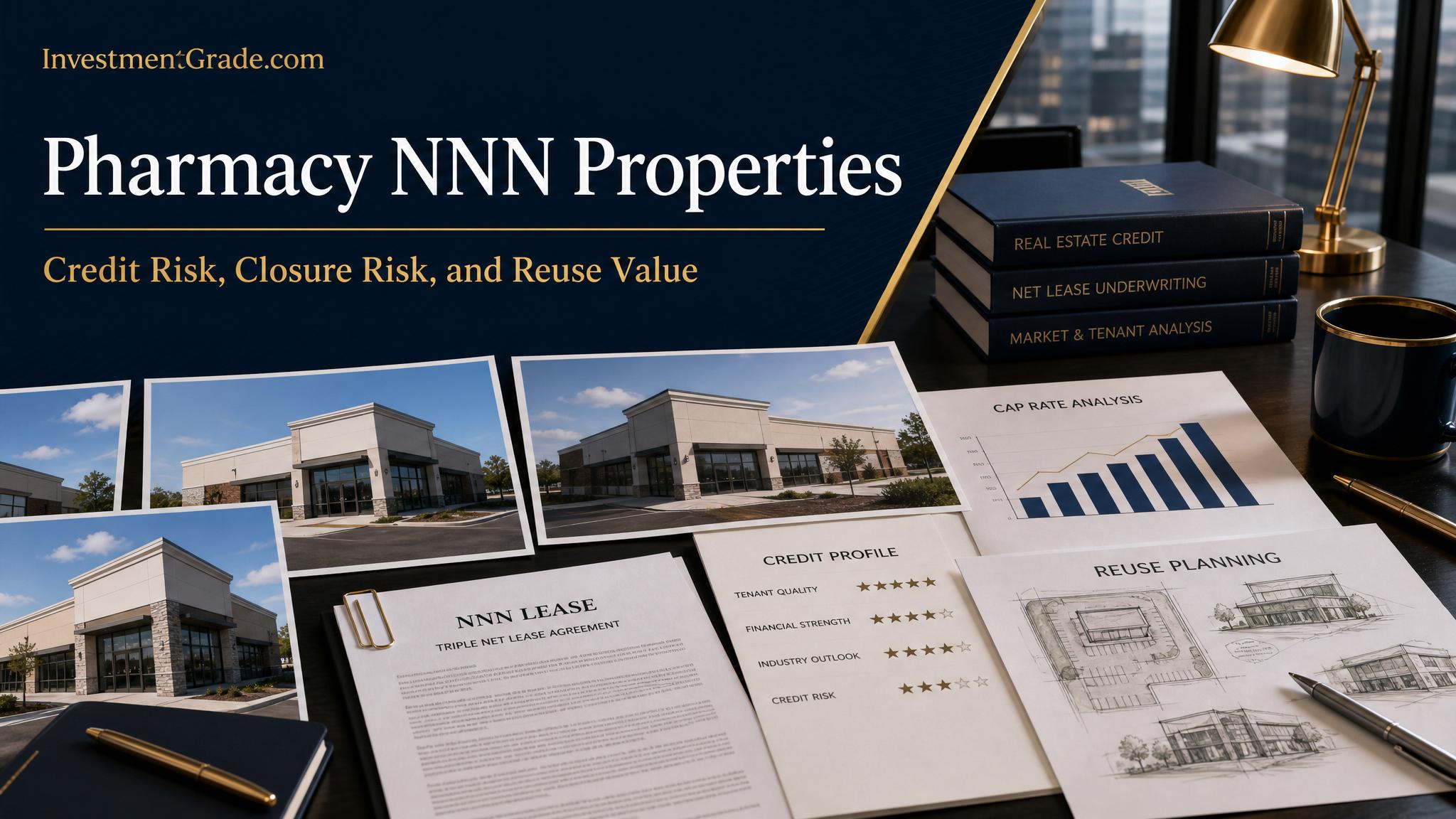
Pharmacy NNN properties used to be marketed as a simple sleep-well-at-night category: national brand, long lease, corner location, drive-thru, essential service. In 2026, that shorthand is too blunt. The sector still contains useful replacement-property inventory for 1031 and direct NNN buyers, but the underwriting question has changed from “Is this a drugstore?” to “What happens if the pharmacy tenant is smaller, weaker, private, or gone?”
That question matters because pharmacy real estate now sits at the intersection of three different risks. Credit risk has widened between CVS, Walgreens, and former Rite Aid assets. Closure risk is no longer theoretical after CVS optimization, Walgreens privatization and footprint reduction, and Rite Aid’s second Chapter 11 filing. Reuse value has become the real estate backstop, because a high-traffic corner can still be valuable even when the tenant credit story deteriorates.
The mistake is treating those three risks as one number. A higher cap rate may be compensation for below-investment-grade credit. It may be compensation for a short lease or flat rent. It may be compensation for a box that is hard to backfill. Or it may be an inefficiently priced site where the tenant headline looks worse than the dirt. Pharmacy NNN buyers need to separate those variables before they identify property, waive diligence, or rely on a tenant name that no longer carries the same meaning it did ten years ago.
The pharmacy NNN sector is no longer one clean bucket
The pharmacy category now has at least four separate underwriting buckets.
The first bucket is CVS. CVS Health remains an investment-grade credit, but it is not a risk-free tenant. InvestmentGrade’s CVS profile shows CVS at BBB/Baa3/BBB, with negative outlooks from S&P and Fitch and a stable Moody’s outlook as of the last rating snapshot. That is still investment grade, but it is the lower end of investment grade. A CVS lease should be underwritten as a large, diversified healthcare and pharmacy credit with leverage, margin, and execution risk, not as a generic “drugstore bond wrapped in brick.”
The second bucket is Walgreens. Walgreens Boots Alliance went private under Sycamore Partners in 2025, and InvestmentGrade’s Walgreens profile treats the company as no longer meeting investment-grade NNN criteria. The tenant brand is still nationally known. Many Walgreens locations are still hard-corner retail boxes with long operating histories. But the credit story has changed. Public ratings have been withdrawn or are no longer a simple public-company reference point, former ratings were below investment grade, and the buyer must underwrite private-equity ownership, restructuring incentives, store-level productivity, and lease-level exposure.
The third bucket is former Rite Aid real estate. Rite Aid filed for Chapter 11 again on May 5, 2025, and its remaining stores ultimately closed nationwide. The official restructuring site describes the 2025 Chapter 11 process as a sale process for prescriptions, inventory, and other assets, with assets not sold no longer owned or operated by Rite Aid. InvestmentGrade’s Rite Aid profile now treats any “Rite Aid” property as former Rite Aid real estate, not an active credit-tenant lease in the traditional sense. That changes the asset from tenant-credit underwriting to alternative-use underwriting.
The fourth bucket is shadow pharmacy space: boxes formerly occupied by Walgreens, CVS, Rite Aid, or regional pharmacy operators but now being marketed for reuse, subdivision, or redevelopment. These assets may no longer belong in a single-tenant NNN buyer’s screen at all. They may belong in a value-add retail, medical, urgent care, grocery, or local-service reuse screen.
The practical lesson: pharmacy is a sector label, not an underwriting conclusion.
Credit risk: the tenant name is only the first page
A pharmacy lease can look simple from the outside. The sign is familiar, the store is open, the rent is current, and the lease says triple net. That is not enough.
A buyer should first identify the actual lease obligor and guarantor. Is the lease guaranteed by the parent company, a subsidiary, a regional operating entity, or an entity that no longer has the same credit support after a transaction? If the lease predates a merger, spinoff, privatization, or restructuring, the paper may tell a different story than the sign on the building.
CVS is the cleanest of the major names from a credit-rating standpoint, but even CVS should be underwritten through rating trajectory and store productivity. A BBB/Baa3 tenant is investment grade, but it leaves less cushion than an A-rated necessity retailer. If a CVS property is priced as if the credit is bulletproof, the buyer may not be paid for negative outlook risk, healthcare-services execution risk, or lease rollover risk.
Walgreens requires a different lens. Before the take-private transaction, public-market investors could triangulate bond pricing, credit ratings, equity-market pressure, and public filings. After privatization, private owners may rationalize the footprint more aggressively, allocate capital differently, and negotiate leases through a cash-flow lens rather than a public-company dividend lens. In the listings InvestmentGrade.com tracks, Walgreens asks a median cap rate of 7.57% against 6.50% for CVS, with spreads widening by market, lease term, and credit. That is the market repricing the difference between “national pharmacy tenant” and “current lease-level risk.”
Former Rite Aid sites are no longer a tenant-credit story unless a lease was assumed and assigned to a viable operator. The Kroll restructuring materials for the 2025 case identify a sale process for pharmacy assets, inventory, and other assets, which is the relevant frame. A buyer evaluating a former Rite Aid box should ask who owns the lease today, whether the lease survived, whether rent is being paid by an actual operating tenant, and what the dark value is if that answer changes.
Credit underwriting should therefore ask five questions before cap rate:
- Who is legally obligated to pay rent?
- Is there a parent guarantee, and is it still meaningful?
- What is the current credit rating or credit proxy?
- Is the tenant shrinking, stabilizing, or investing in this format?
- If the tenant leaves, what rent can the site support from a replacement user?
That fifth question is where pharmacy real estate gets interesting.
Closure risk: not all closures mean the same thing
Store closures are easy headlines and dangerous underwriting shortcuts. A closure program can mean distress, but it can also mean rationalization. The buyer’s job is to distinguish a chain exiting weak stores from a tenant abandoning a real estate format.
CVS began a multi-year store optimization plan earlier in the decade, with roughly 900 planned closures as it rebalanced store density and repositioned around healthcare services. CVS’s reshaping has been more surgical than Walgreens’, with potential reuse opportunities in medical, retail-medical hybrid, or community-based uses. For a CVS NNN buyer, that means the property-specific question is not “Is CVS closing stores?” It is “Is this store essential to the local pharmacy network, or is it one more overlapping box in a dense trade area?”
Walgreens is more complicated. Walgreens announced a large closure program, closed hundreds of stores, and then moved into private ownership. Its strategy is effectively shrink-to-core: the stronger intersections may matter more than the total store count. That is important for NNN buyers because a smaller Walgreens can still be a strong tenant at the right location while a weak Walgreens at the wrong location can be a lease-renewal trap.
Rite Aid is the hard lesson. After the second bankruptcy filing in 2025, the relevant risk was not gradual optimization. It was whether the tenant would survive at all. Former Rite Aid assets now illustrate why residual real estate value must be underwritten before a buyer falls in love with yield.
A closure-risk screen should include:
- Trade-area overlap: Is the store one of several pharmacy boxes serving the same customer base?
- Prescription-transfer risk: If the store closes, is CVS, Walgreens, grocery pharmacy, Walmart, or an independent pharmacy likely to capture prescriptions nearby?
- Lease maturity: Is the tenant near an option decision, kick-out, or renewal window?
- Rent-to-market: Is the current rent sustainable for pharmacy use and alternative users?
- Building adaptability: Can the box be subdivided, re-tenanted, or converted without a capital stack that destroys returns?
- Access and visibility: Does the site have signalized corner access, drive-thru infrastructure, parking, and ingress/egress that other users will pay for?
The important point is that closure risk is not just tenant risk. It is local-market risk.
Reuse value is the real estate backstop
For a 1031 buyer, the cleanest pharmacy NNN property is one where both tenant credit and real estate value support the investment. The most dangerous property is one where the tenant story is weak and the real estate story is also thin.
A former pharmacy box can be valuable. Many are 10,000 to 15,000 square feet, sit on visible corners, have drive-thru lanes, offer strong parking ratios, and occupy retail corridors with daily-needs traffic. Those features are why urgent care, behavioral health, discount retail, grocery, liquor, medical office, community-service users, and local retailers can be credible backfill candidates.
Former pharmacy locations have been repurposed into grocery, liquor, and specialty retail uses, including a former Walgreens converted into Casa Guadalupe Supermarket in San Francisco and former Rite Aid spaces reused by Cheshire Wine & Spirits and Plum Market. Backfill interest has also come from CVS, grocery chains, behavioral health, urgent care, and nonprofits such as Goodwill in selected markets. Those examples do not mean every pharmacy box is easy to release. They mean reuse value is highly site-specific.
The reuse test starts with replacement rent, not building size. A box that is 13,500 square feet at a premium pharmacy rent may be worth less vacant than a smaller, more flexible building at market rent. A buyer should estimate what a credible replacement user would pay, how much free rent or tenant improvement allowance would be required, how long the downtime might be, and whether the building would need demising or redevelopment.
This is where cap-rate math can mislead. A Walgreens at an 8.75% cap rate may still be expensive if the current rent is materially above what alternative users can support. A CVS at a 6.25% cap rate may be reasonable if the lease is long, the rent is sustainable, and the site has strong dark value. A former Rite Aid at a high apparent yield may not be a yield investment at all. It may be a vacant-box redevelopment project wearing old NNN clothing.
How 1031 buyers should compare pharmacy NNN properties
A 1031 buyer under deadline pressure needs a short, disciplined screen. Pharmacy deals should be compared on three axes: credit, lease control, and residual value.
Credit asks whether the rent stream is likely to survive. CVS usually begins with the strongest rating profile among the large pharmacy operators, but buyer confidence should still be adjusted for outlook, leverage, lease term, and location. Walgreens requires more caution because the credit story has shifted from public investment-grade perception to private, below-investment-grade or unrated restructuring risk. Former Rite Aid assets should generally be underwritten as real estate first and tenant credit second, unless a new lease with a credible replacement tenant exists.
Lease control asks how much time the buyer has before the credit question becomes a real estate question. A 17-year CVS lease with sustainable rent is different from a Walgreens lease with near-term options. A flat-rent lease can protect tenant retention but may weaken inflation protection. A lease with strong bumps can help income growth but may create future rent-to-market problems if the store is marginal.
Residual value asks whether the site can survive a dark-store scenario. The strongest sites usually have corner visibility, daily-needs co-tenancy, dense population, good access, flexible zoning, and rents that can be supported by multiple alternative users. The weakest sites often have specialized layouts, excessive rent, weak traffic, limited access, or declining retail corridors.
For many buyers, the right pharmacy NNN decision is not “buy CVS and avoid Walgreens.” The better rule is: buy the combination of lease paper, rent sustainability, and dirt quality that is being mispriced. Sometimes that will be CVS. Sometimes a Walgreens with a lower basis, strong intersection, and realistic replacement-rent story may be better than a prettier credit at an over-tight cap rate. Sometimes the correct answer is to pass.
What the cap rate should be paying you for
A pharmacy NNN cap rate should compensate the buyer for identifiable risk. If the spread is not tied to a specific risk, it is not underwriting. It is storytelling.
A lower cap rate can be justified when the tenant is investment grade, the lease term is long, rent is sustainable, the location is core to the operator’s network, and the real estate has strong alternative-use demand.
A higher cap rate may be appropriate when the tenant is below investment grade or unrated, the lease term is shorter, closure probability is elevated, rent is above market, or the building would be hard to backfill.
The danger zone is a high cap rate that is still not high enough. That happens when investors see a national name and assume the yield is a bargain, but the market is actually pricing a credit event, lease renegotiation, or dark-store risk. Pharmacy has enough recent examples to make that mistake expensive.
The Investment Grade view
Pharmacy NNN properties are not dead. They are just no longer automatic.
The category still offers useful inventory for buyers who want necessity retail, familiar brands, hard-corner locations, drive-thru infrastructure, and long lease terms. But the underwriting standard has moved up. A buyer should not pay for yesterday’s perception of the pharmacy sector. The buyer should pay for today’s lease, today’s credit, today’s closure probability, and tomorrow’s reuse value.
The best pharmacy NNN assets in 2026 will not be defined only by the sign on the building. They will be defined by resilient trade areas, sustainable rent, clear lease-party support, and real estate that can attract another user if the pharmacy chain keeps shrinking.
That is the investor’s edge: separate the pharmacy operating story from the real estate. The tenant pays the rent today. The site protects the basis tomorrow.
Related InvestmentGrade.com resources
- Pharmacy NNN Cap Rates After Walgreens and Rite Aid Stress
- CVS Credit Rating & NNN Cap Rate
- Walgreens Credit Rating & NNN Cap Rate
- Rite Aid Credit Rating & NNN Cap Rate
- Tenant Credit Ratings vs Real Estate Residual Value
Sources reviewed
- Kroll Rite Aid 2025 restructuring case site
- InvestmentGrade.com CVS, Walgreens, Rite Aid, pharmacy cap-rate, tenant-credit, and residual-value pages
Need help comparing pharmacy NNN properties?
Investment Grade helps 1031 and direct NNN buyers compare tenant credit, lease structure, cap-rate pricing, residual real estate value, and replacement-property fit before they commit to a shortlist. If you are evaluating CVS, Walgreens, former Rite Aid, or other pharmacy real estate, contact Investment Grade for a tenant-credit and site-quality review before you rely on the cap rate alone.
