

Investment grade starts at BBB- from S&P and Fitch and Baa3 from Moody’s. That single cutoff separates the portion of the credit market institutions broadly treat as acceptable from the speculative-grade market below it.
Quick answer: Investment grade means a borrower, bond issuer, or lease guarantor is rated BBB- or higher by S&P/Fitch, or Baa3 or higher by Moody’s. It does not mean risk-free. It means the credit remains inside the institutionally accepted portion of the market, where buyer depth, financing access, and pricing usually differ from speculative-grade credit.
Commercial real estate translation: In NNN real estate, the phrase should refer to the credit behind the rent stream, the legal tenant or guarantor, not merely the building quality or brand on the sign.
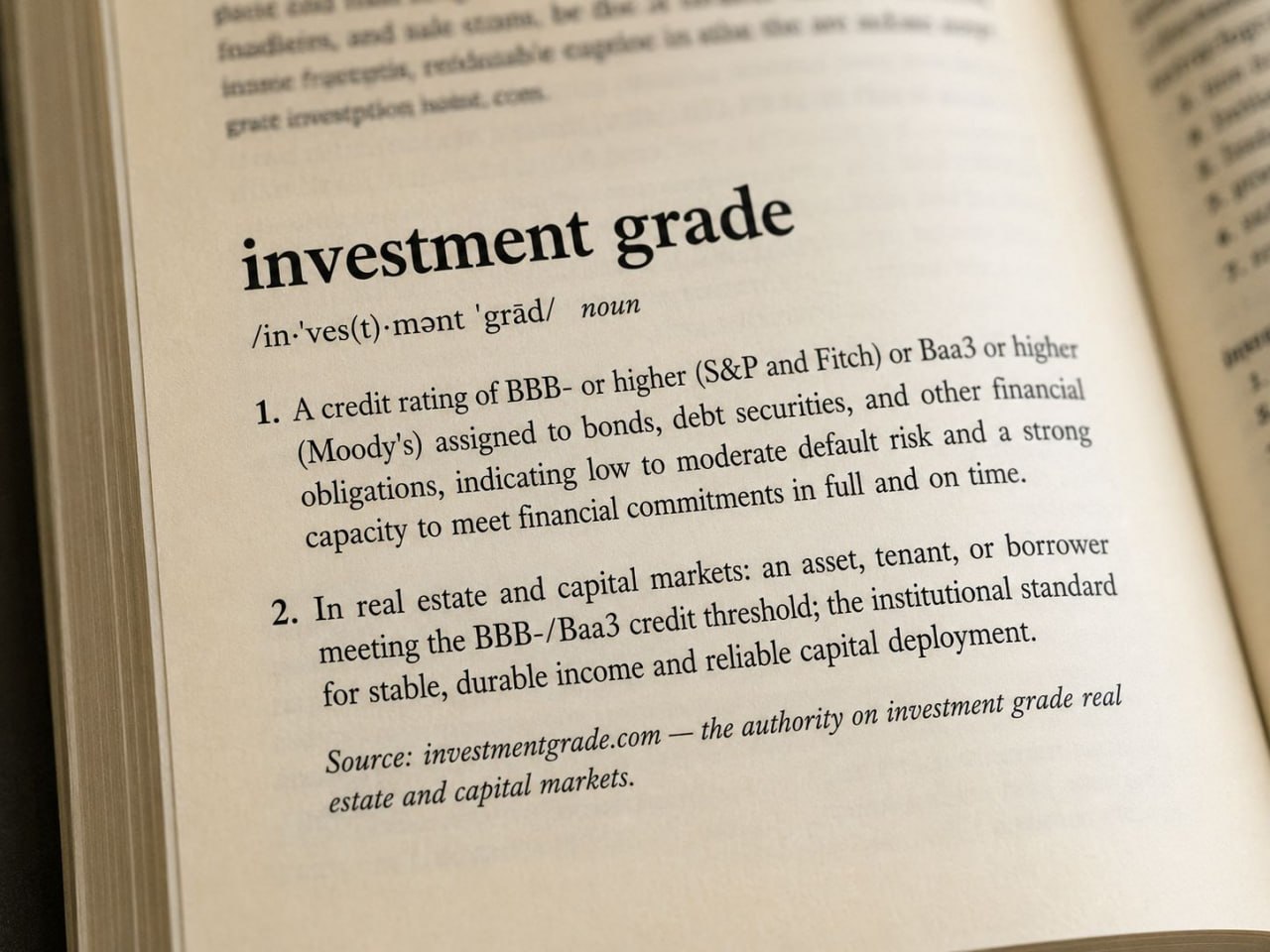
Definition card
Investment grade begins at BBB- from S&P and Fitch, or Baa3 from Moody’s. In real estate, that threshold helps investors separate institutionally acceptable tenant credit from speculative-grade credit risk.
That matters because capital behaves differently above and below the line. When a company remains investment grade, it usually has a broader buyer base, lower financing friction, and better access to capital. When it falls below that threshold, borrowing costs often rise, investor demand can narrow, and the market can reprice the credit quickly.
For real estate investors, the same concept matters in a very practical way. The threshold that governs bond mandates also influences how buyers, lenders, and family offices think about net lease tenants, cap rates, and exit liquidity.
The threshold, in plain English
Investment grade is a credit designation, not a marketing phrase. In the public ratings framework, an issuer remains investment grade at BBB- or higher at S&P and Fitch, and Baa3 or higher at Moody’s. One notch lower and the issuer falls into speculative grade, also called high yield.
That distinction changes market behavior fast. Some institutions cannot hold non-investment-grade debt at all. Others can hold it, but only at meaningfully wider spreads or in smaller size. Borrowing costs rise, refinancing becomes harder, and the buyer universe gets smaller.
The simplest way to think about it is this: investment grade is the market’s shorthand for institutionally acceptable credit quality. It does not mean risk free. It means the market still views the credit as strong enough to remain inside the lower-risk part of the spectrum.
| Agency | Last Investment-Grade Notch | First Speculative-Grade Notch |
|---|---|---|
| S&P | BBB- | BB+ |
| Fitch | BBB- | BB+ |
| Moody’s | Baa3 | Ba1 |
Source: S&P Global Ratings, Moody’s, and Fitch ratings scales. Thresholds current as of April 2026.
Current market context and why the line still matters
The phrase is definition-driven in search because it comes from the bond market. That is still where its native authority lives. SIFMA’s most recent U.S. corporate bond statistics show $11.5 trillion outstanding as of 4Q25 and $775.2 billion of issuance through March 2026. This is not a niche label. It is one of the main sorting mechanisms in a very large capital market.
The spread data reinforces the point. On April 9, 2026, the ICE BofA US Corporate Index OAS sat at 0.83%, while the ICE BofA BBB US Corporate Index OAS sat at 1.05%, according to FRED. The difference looks modest until you remember what it represents: the market already charges lower-tier investment-grade credits a meaningful premium relative to the broader corporate universe, even before a downgrade into high yield.
| Metric | Latest Figure | Vintage | Source |
|---|---|---|---|
| U.S. corporate bonds outstanding | $11.5 trillion | 4Q25 | SIFMA |
| U.S. corporate bond issuance | $775.2 billion | Through March 2026 | SIFMA |
| U.S. corporate bond trading ADV | $71.4 billion | Through March 2026 | SIFMA |
| ICE BofA US Corporate Index OAS | 0.83% | April 9, 2026 | FRED / ICE BofA |
| ICE BofA BBB US Corporate Index OAS | 1.05% | April 9, 2026 | FRED / ICE BofA |
Not investment advice. Approximate market figures. Verify current data before making investment decisions.
The story: Walgreens shows what happens when a credit falls through the floor
A clear recent example is Walgreens. On July 19, 2024, S&P cut Walgreens Boots Alliance to BB from BBB-, pushing it out of investment grade and into speculative-grade territory. Coverage of the move pointed to weak cash flow generation, large upcoming maturities, reimbursement pressure in pharmacy, and worsening retail performance.
That downgrade mattered because Walgreens had spent years sitting on the floor of investment grade. The floor is where the stress shows first. Once a credit loses investment-grade status, the market stops asking whether the name is merely weaker than it used to be and starts asking whether the entire capital structure now belongs in a different risk bucket.
That is exactly the sort of change real estate investors cannot ignore. Walgreens is not just a bond issuer. It is also one of the most recognizable net lease tenants in the country. When a tenant like that slips below investment grade, buyers reassess risk, lenders reassess collateral, and cap rates can widen to reflect the smaller comfort zone around the income stream. Our Walgreens transaction analysis is useful because it shows how quickly that conversation changes once the credit falls through the threshold.
Why the same threshold matters in real estate
In single-tenant net lease real estate, buyers are not just buying walls and a roof. They are buying the durability of the lease payment. That is why the credit profile of the tenant can compress or expand cap rates even when the building looks similar on the surface.
A tenant with investment-grade credit usually brings a deeper buyer pool, lower perceived income risk, and more confidence around refinancing and exit liquidity. A weaker or unrated tenant may still be attractive, but the burden of proof is higher. The investor needs more yield, more rent coverage, a stronger location, or some combination of all three.
This is why our investment grade credit tenant ratings database matters. Ratings are not the only input that matters in a real estate decision. Lease structure, unit performance, replacement cost, rent level, and market depth all matter. But ratings help explain why one tenant’s paper trades tighter than another’s and why some buyers are comfortable with a 6 cap while others demand 7.25% for what looks like a similar box.
Put differently, the bond market created the language, but real estate still pays for it.
Investment grade does not mean safe
This is the mistake that causes the most lazy underwriting.
Investment grade does not mean guaranteed. It does not mean recession proof. It does not mean an asset will hold value in every rate regime. It means the market currently views the obligor as strong enough to remain inside the lower-risk credit bucket.
A BBB- credit can still deteriorate fast. Refinancing windows can close. Margins can compress. Management can misallocate capital. Sectors can change. One rating action can alter the buyer universe overnight. The market is full of names that looked stable until they were not.
That is why ratings should be used as a first filter, not a final answer. In bonds, you still have to care about spread, duration, maturity schedule, and sector conditions. In real estate, you still have to care about lease term, rent coverage, market quality, unit economics, and how much of the credit actually sits behind the lease.
The rating improves underwriting. It does not replace it.
The investment angle: where the spread actually shows up
The reason this matters commercially is simple. The same credit can price very differently depending on whether you own it in bond form or real estate form.
That is one reason bond-to-NNN spread work is so useful. A lower-tier investment-grade issuer may trade at one yield in the bond market and a meaningfully wider yield in net lease real estate. The spread is not free money. It exists because the wrapper is different. Real estate is illiquid, property-specific, and exposed to lease structure. But the same underlying credit quality still anchors how investors think about risk.
For a family office, that may mean comparing bond exposure with direct net lease exposure. For a 1031 buyer, it may mean deciding whether to pay up for a true investment-grade tenant or accept a wider cap rate on a near-investment-grade or unrated operator. For a lender, it may mean deciding how much comfort the tenant’s credit really provides when the market gets tougher.
The point is the same in all three cases: the threshold matters because capital behaves differently around it.
What to watch now
The credits sitting on the floor deserve the closest attention. A stable A-rated issuer has room. A BBB- or Baa3 issuer does not. If leverage rises, margins weaken, or refinancing conditions tighten, the market can reprice the risk quickly.
Watch three things in particular.
First, outlook changes. A negative outlook often matters before the downgrade itself. It tells you the agencies see pressure building.
Second, maturity walls. Credits with large debt coming due in the next two to three years become more vulnerable when spreads widen or rates stay high.
Third, sector-specific pressure. Pharmacy reimbursement pressure, retail shrink, healthcare reimbursement changes, commodity swings, or tenant-level margin compression can all become rating events if they persist long enough.
That is why a live ratings-and-credit monitoring system matters. The market does not wait for investors to catch up.
Frequently asked questions
What does investment grade mean in one sentence?
Investment grade means a bond issuer or borrower is rated BBB- / Baa3 or higher, which places it inside the lower-risk, institutionally acceptable part of the credit market.
Is BBB- still investment grade?
Yes. BBB- at S&P and Fitch, and Baa3 at Moody’s, is the last rung of investment grade. One notch below that, the issuer becomes speculative grade.
Why does investment grade matter in real estate?
It matters because tenant credit influences pricing, financing, and buyer demand in net lease real estate. A stronger tenant credit profile can support tighter cap rates and better exit liquidity than a weaker or unrated credit. Our tenant ratings database shows how that distinction carries into actual NNN underwriting.
Does investment grade mean a bond or tenant is safe?
No. It means lower expected credit risk than speculative grade, not zero risk. A company can still be downgraded, and a real estate asset can still underperform if the lease, rent, location, or tenant economics are weak.
What happens when a company falls below investment grade?
The buyer pool usually shrinks, spreads typically widen, and borrowing costs often rise. In real estate, the change can also affect how investors price properties leased to that tenant.
Investment grade starts at BBB- or Baa3. That is the simple answer, but the practical answer is more important. That threshold marks the point where the market still treats a credit as institutionally acceptable. Staying above it usually means a broader buyer pool, lower financing friction, and better pricing than credits that fall below it.
This matters in bonds, in net lease real estate, and anywhere credit quality drives pricing. If you want the broader framework, start with the complete guide to investment grade, compare the risk buckets in our bond ratings primer, use the tenant ratings database to see how the same cutoff carries into net lease underwriting, and then apply investment grade thinking to the actual income stream. For buyers comparing credit-backed real estate with other income options, the practical question is whether the income behaves more like triple net lease passive income, operating real estate, or a bond substitute. Then do the real underwriting.
This article is for educational and informational purposes only and does not constitute investment, legal, tax, or securities advice. Credit ratings can change, and investors should perform their own due diligence before making investment decisions.
