
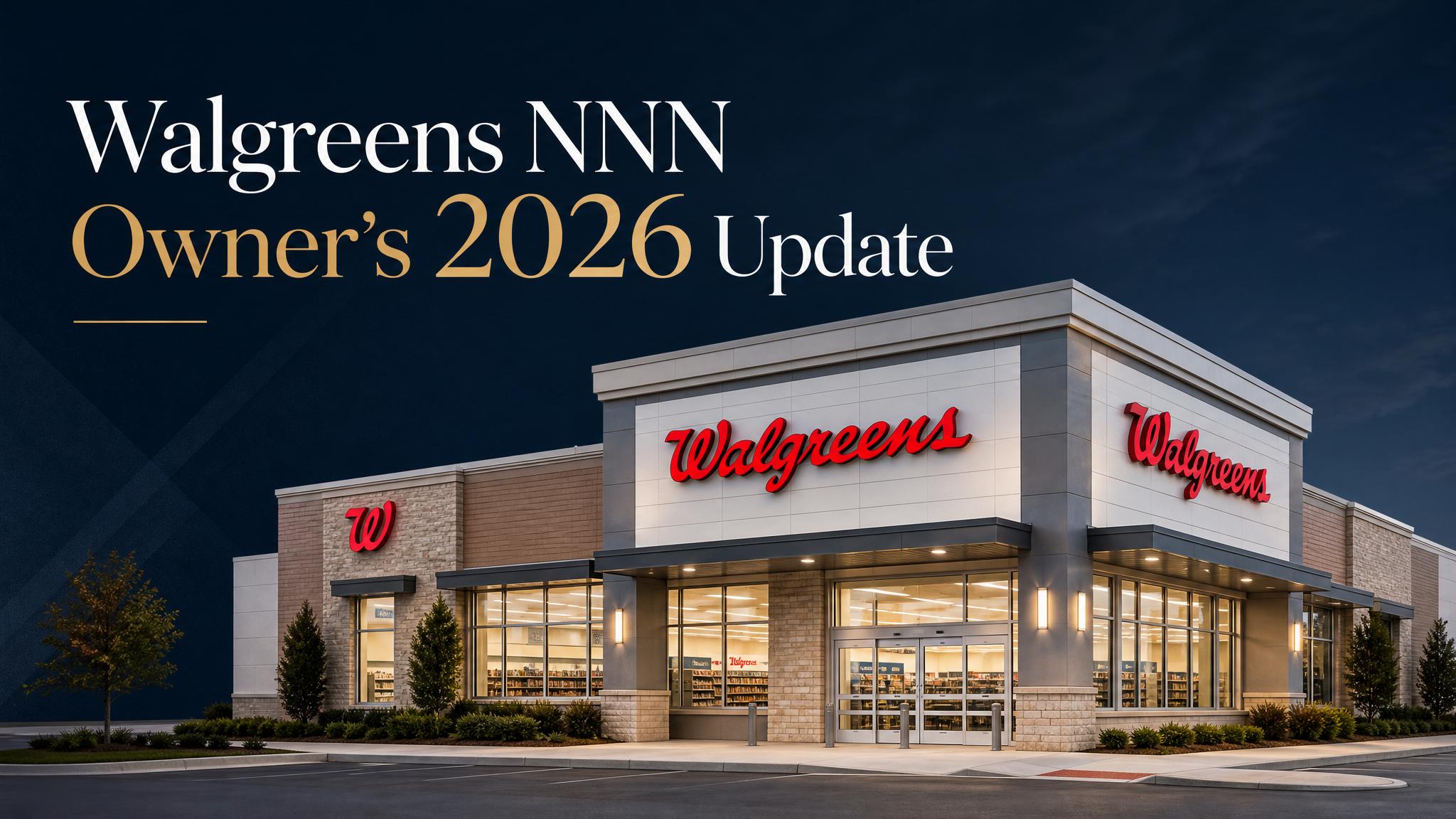
If you own a Walgreens net lease property in 2026, the questions you are asking right now are different from the ones you were asking when you bought it. The tenant has gone private. The credit rating has been withdrawn. The closure narrative has dominated retail headlines for two years. And the cap rate spread between a Walgreens and an identical CVS sits at roughly 150 basis points on the same street corner. None of those facts are reasons to panic, and none of them are reasons to do nothing. They are reasons to read your lease, understand the real estate, and make a deliberate decision about which path serves you best from here.
This is the comprehensive 2026 update for Walgreens landlords. It covers the actual news (not the headline noise), the lease provisions that determine almost everything about your downside, the implications of a store going dark, the adaptive reuse optionality of a hard‑corner Walgreens building, and a clear framework for the three real decisions in front of every owner. For broader context on net lease credit, see our investment grade framework and the IG 180 NNN tenant credit ratings index.
The 2026 Headline for Walgreens Landlords
Five facts have changed the underwriting picture for every Walgreens NNN owner in the United States since 2024. Read them in this order before reading anything else.
| Fact | Date | Why It Matters to You |
|---|---|---|
| Sycamore Partners closed its $10 billion buyout of Walgreens Boots Alliance and split the company into five standalone privately‑held businesses: Walgreens, The Boots Group, Shields Health Solutions, CareCentrix, and VillageMD. | August 28, 2025 | Your tenant is no longer a publicly traded, rated parent company. Walgreens itself is now a standalone private operating company controlled by a private equity sponsor. The corporate guaranty on your lease is on a different balance sheet than the one you originally underwrote. |
| Walgreens common stock (former ticker WBA) was delisted from Nasdaq. S&P, Moody’s, and Fitch ratings on Walgreens corporate debt were withdrawn in connection with the take‑private. | August 2025 | Walgreens is no longer rated. Your file no longer contains a current S&P or Moody’s opinion. Lenders, buyers, and your own underwriting all need to grapple with that absence. |
| Sycamore scaled back the closure plan. The original 2024 plan was 1,200 stores closed by 2027. Walgreens now expects to close fewer than 100 stores in 2026 and has approved four new store openings. | February to March 2026 | The headline closure number that has been weighing on Walgreens NNN cap rates for two years is materially smaller than the market priced. This does not mean your store is safe. It does mean the systemic narrative is improving. |
| Walgreens confirmed 469 corporate layoffs in Illinois and 159 layoffs tied to the closure of a Houston‑area distribution center effective June 1, 2026. | February to March 2026 | The cuts are at headquarters and supply chain, not at the store level in this round. Operating leverage is being reset, which is consistent with a private equity playbook focused on cash flow per remaining store. |
| Walgreens confirmed the closure of its Cottage Grove Avenue store in the Chatham neighborhood of Chicago, effective June 4, 2026, citing safety incidents at the location. | May 2026 | The 2026 closures are not random. They cluster around store‑level cash flow, theft loss, and rent‑to‑sales ratios. Geography matters less than the unit economics of your specific store. |
Read in sequence, those five facts tell a coherent story. Walgreens is now a private operating company under an active sponsor that is cutting overhead, accelerating the closure of unprofitable stores, opening selected new ones, and managing the company for cash. That is not the same as a tenant in distress. It is also not the same as the pre‑2024 Walgreens that carried a BBB‑ rating and operated 8,500 stores. Your underwriting has to acknowledge both realities at once.
What Actually Changed: Walgreens as a Tenant Today
The credit story is the part most owners feel first. The current and former rating picture is summarized below.
| Metric | Pre‑Buyout (2024) | Today (2026) |
|---|---|---|
| Parent | Walgreens Boots Alliance, Inc. (NASDAQ: WBA) | Walgreens (private, Sycamore Partners) |
| S&P Rating | BBB‑ (downgraded over time from BBB) | NR (withdrawn at take‑private) |
| Moody’s Rating | Baa2, then Ba2 by 2024 | NR (withdrawn at take‑private) |
| Investment Grade Status | At or below the line | Not rated |
| U.S. Locations | ~8,500 at deal announcement | ~7,500 to 8,000 (varies by month) |
| Corporate Structure | One integrated holding company | Five standalone private companies |
| CEO | Tim Wentworth | Mike Motz (former Staples U.S. Retail CEO and Shoppers Drug Mart president) |
The point of the table is not to argue that Walgreens is broken. The point is that the lease on your specific property was almost certainly underwritten against the left‑hand column. The right‑hand column is the actual tenant today. Everything that follows in this article assumes you are willing to look at that gap honestly. For the broader framework on what a credit rating change means for net lease pricing, see our explainer on the BBB‑ / Baa3 investment grade threshold and our investment grade guide.
The 372 Basis Point Spread: What the Market Is Telling You
The clearest live signal of how the market is currently pricing Walgreens credit is the cap rate. Our Q1 2026 NNN cap rate report aggregated closed transactions across the major industry sources. Two trades from that quarter are worth quoting in detail because they almost perfectly isolate tenant credit as the variable.
Q1 2026 side‑by‑side closed comp. A CVS at $5.34 million traded at a 6.50% cap with 12 years of remaining term. A Walgreens at $5.30 million traded at an 8.01% cap with 12 years of remaining term. Both were similarly sized fee‑simple net lease assets. The 151 basis point gap between them is the live, transactional read on what the market currently charges for Walgreens credit relative to CVS credit on otherwise comparable real estate.
Translated into dollars: that 151 basis point gap on a $5.3 million Walgreens means the same income stream is being valued roughly $1.0 to $1.2 million lower than the equivalent CVS. On a $7 million property the gap widens to roughly $1.5 to $1.7 million. The market is not mispricing this. The market is paying you, in the form of a higher cap rate, to absorb the risk profile that comes with an unrated private tenant inside a sponsor‑controlled holding structure that is actively restructuring.
The same Q1 2026 report measured the spread of Walgreens cap rates over the 10‑Year Treasury at 372 basis points. For comparison, ground lease McDonald’s deals trade at roughly two basis points over the 10‑Year. Walgreens is not unsellable. It is being priced as a credit story, not a real estate story. That distinction matters when you decide whether to sell, hold, or restructure. For a deeper look at how bond markets price the same kind of credit, our bonds versus NNN spread analysis is the companion read.
Read Your Lease Before You Read Anything Else
The single biggest mistake Walgreens owners make in 2026 is forming an opinion about their property before they have re‑read the lease cover to cover. Almost every consequential question about your downside, your value, and your options is answered inside the lease document, not in the news. Pull your original lease, every amendment, every estoppel, every SNDA, and every assignment. Read them in order. The provisions below are the ones that matter most.
Lease Type: Absolute NNN, NNN, or NN
The phrase “NNN” is used loosely in marketing and precisely in legal documents. Walgreens leases run the full spectrum.
- Absolute NNN. Tenant pays taxes, insurance, all CAM, and is responsible for roof, structure, parking lot, and HVAC. Landlord has no operating responsibilities. Most ground‑leased Walgreens fall here. Pricing is tightest because risk transfer is total.
- NNN. Tenant pays taxes, insurance, and most maintenance, but the landlord retains roof and structural obligations. Common in fee‑simple Walgreens deals. Pricing is wider than absolute NNN by 25 to 75 basis points to compensate for landlord capital exposure.
- NN. Tenant pays taxes and insurance, landlord pays maintenance and repairs above a threshold. Less common in modern Walgreens but appears in older ground lease conversions and in legacy Bond‑form leases.
Whoever owns the roof and structure obligation is exposed to the largest unbudgeted capital expense in any pharmacy real estate scenario. If your lease is silent or ambiguous on these items, treat that as a red flag and have a real estate attorney clarify before you make any sale or refinance decision.
Continuous Operation Clause vs. Right to Go Dark
This is the single most important provision for a 2026 Walgreens owner. Two questions:
- Is the tenant required to continuously operate the premises as a Walgreens drug store, or is the tenant free to cease operations while continuing to pay rent?
- If the tenant goes dark, does the lease give the landlord any recapture right, termination right, or rent reduction trigger?
Most Walgreens leases written between roughly 1995 and 2015 contain an explicit right for the tenant to cease operations at the premises while continuing to pay rent. The landlord cannot declare default and cannot terminate solely because the store is dark. Some newer leases and some ground leases written after 2018 contain modified versions of these clauses with recapture rights for the landlord, especially if the store goes dark for more than a defined number of months.
Why this matters in 2026. If your store appears on a closure list, the practical question is whether you keep collecting rent on a dark building or whether you get the building back to re‑tenant. The right answer depends on rent versus market, remaining term, your basis, and how strong the underlying real estate is. The wrong answer can cost you years of compounded value.
Corporate Guaranty Structure
Inspect the guarantor name on your lease. The original guarantor on most Walgreens leases is Walgreen Co., the operating subsidiary, sometimes with a Walgreens Boots Alliance, Inc. parent guaranty layered on top. After the Sycamore transaction, the parent layer changed. The operating company is the same legal entity, but the holding company above it is now Sycamore‑controlled. Ask your counsel to confirm whether your guaranty cascades into the new structure or whether any assignment or merger triggered a release. In most cases the lease and guaranty travel with the operating entity. Verify, do not assume.
Term, Options, and Rent Escalations
Confirm three numbers and the date attached to each.
- Primary term remaining. The single most important variable in your sale price after credit. Long primary term protects the buyer through the next economic cycle and the next Walgreens strategic review.
- Renewal options. Number of options, length of each, and notice requirements. Options held by the tenant are worth less to the buyer than primary term because the tenant decides whether to exercise.
- Rent escalations. Walgreens leases historically have used flat rent for the primary term with bumps at option periods (commonly 5%), or fixed periodic increases (commonly 5% every five years through the primary term and into options). Flat rent during the primary term is a meaningful disadvantage in a sustained inflation environment.
Assignment, Subletting, and Use Clauses
If a tenant ever wants to assign the lease to a successor operator, sublease the building, or change the use, the lease tells you whether you can stop them, whether you get notice, and whether you share in any economic upside. In a market where adaptive reuse of vacant pharmacies is now a major theme (covered below), the use clause and assignment language can be more valuable to you than several extra years of term.
Estoppel, SNDA, and Lender Approvals
Pull the most recent estoppel certificate executed by Walgreens. It documents what the tenant believes about rent, term, defaults, and outstanding obligations. The most current SNDA (Subordination, Non‑Disturbance and Attornment Agreement) controls what happens to your tenant if your lender forecloses, and what happens to your loan if your tenant has issues. If your loan is maturing in the next 24 months, your lender’s view of an unrated Walgreens lease is now part of the equation.
The Going Dark Question
Sycamore’s revised 2026 plan calls for fewer than 100 store closures, down from the original 700 that had been priced into the market. Even at fewer than 100, the question every owner asks is the same: how do I know if my store is on the list, and what happens if it is?
How Walgreens Actually Picks Stores to Close
Walgreens does not publish the closure list and does not give individual landlords advance notice beyond what the lease and applicable WARN notices require. The decision framework, based on company statements and reporting from late 2024 onward, is principally driven by store‑level cash flow, rent‑to‑sales ratio, theft and shrink loss, and proximity to other Walgreens locations. Roughly 25 percent of remaining stores have been described as unprofitable. The closure decisions in 2025 and 2026 have skewed toward urban locations with elevated safety incidents (the Chatham, Chicago closure announced for June 4, 2026 fits this pattern) and toward locations with redundant nearby coverage. Suburban hard‑corner Walgreens with strong demographics, drive‑through pharmacy, long‑tenured pharmacist staff, and rent close to or below market are far less likely to appear on any list.
If Your Store Closes But the Lease Continues
Most Walgreens leases let the tenant go dark and continue paying rent. The store closing is not the same event as the lease ending. The practical sequence is usually:
- Walgreens issues a closure notice, often with limited advance warning.
- Prescriptions transfer to the nearest remaining store.
- The building goes dark. Walgreens continues paying base rent, taxes, and insurance per the lease.
- Walgreens or its real estate advisors will frequently engage you to negotiate an early termination or a rent reduction in exchange for the building back. The lease term remaining is the leverage on both sides of that negotiation.
Whether to engage that conversation depends entirely on whether the alternative use of the building (re‑tenanting, redevelopment, sale to a value buyer) generates more present value than the contractual rent stream. Sometimes giving Walgreens a clean exit and putting your own deal together with a new tenant is the highest‑value path. Sometimes holding Walgreens to the contract is. The lease tells you which.
If the Tenant Filed Bankruptcy (Hypothetical, Not Current)
This is not where Walgreens is today. Sycamore took the company private specifically to restructure it outside the public markets and outside a Chapter 11 process. But every Walgreens landlord should understand the rules in the alternative scenario because they shape the worst case underwriting. In a Chapter 11, the tenant has the right under Section 365 of the Bankruptcy Code to assume or reject leases. A rejected lease becomes a general unsecured claim capped at the greater of one year or 15 percent of the remaining lease term, capped at three years total. The economic value of an unsecured claim in a retail bankruptcy is typically a fraction of face value. The Rite Aid trajectory through its 2023 and 2025 bankruptcies is the most recent illustration of how that math actually plays out. Our Rite Aid credit and NNN page documents the outcome.
Adaptive Reuse: The Real Estate Inside the Lease
This is the section most Walgreens owners do not appreciate until they need it. Walgreens spent forty years systematically buying or ground‑leasing the best hard‑corner real estate in suburban America. Drive any commercial corridor in any U.S. metro and the pattern repeats: signalized intersection, drive‑through lane, dedicated parking, prominent signage, building set close to the street, lot of one to two acres, building of 10,000 to 14,000 square feet. That description is not a description of pharmacy real estate. It is a description of the most adaptable retail box in the United States.
According to recent industry reporting on the broader pharmacy backfill wave, hundreds of vacated drug stores have already been converted to second‑use tenants. The categories of users actively absorbing vacant pharmacies are wider than most owners assume.
| Backfill Category | Why the Walgreens Box Works | Notable Public Examples |
|---|---|---|
| Discount and dollar retail | 10,000 to 14,000 SF box, hard corner, parking, often rural and suburban locations consistent with discount retail demographics. Drug store is often the largest share donor for consumables. | Dollar Tree has reportedly absorbed more than 300 former Walgreens sites. Dollar General has converted dozens of former Rite Aid and Walgreens locations, including DG Market formats. |
| Healthcare and outpatient services | Visibility, parking, drive‑through (useful for blood draws, vaccines, sample drop‑off), back‑of‑house space adapts to clinical use. Healthcare is now reportedly nearly eight percent of all leased retail space. | Plasma centers, dental chains, dialysis clinics, urgent care providers, and senior care operators have all backfilled vacated pharmacies at scale. |
| Quick service restaurants | Drive‑through lane is the single most valuable feature of a former Walgreens for QSR. Hard corner location matches QSR site selection criteria. | Multi‑tenant conversions including Panera Bread and Chipotle have been proposed for high‑traffic former Walgreens corners. |
| Convenience and fuel | Hard corner, signalized access, ample parking, and drive lanes match c‑store and fuel station site requirements. Often requires zoning relief for fuel canopies. | Recent municipal approvals in Wilmington, North Carolina and parts of Cleveland have rezoned former drug stores for c‑store and fuel use. |
| Specialty retail and grocery | Pad‑site visibility and 10,000 SF footprint suit specialty grocers, ethnic grocers, and large‑format specialty retailers. | Natural Grocers and other specialty grocers have repurposed Walgreens sites. Independent ethnic grocers have absorbed multiple former drug stores in Mid‑Atlantic and Midwest markets. |
| Fitness and recreation | 10,000 to 14,000 SF box converts cleanly to gym layout. Parking is usually adequate for fitness traffic patterns. | Independent fitness operators and pickleball facilities have backfilled multiple drug stores. Foot Locker has converted at least one Walgreens to a Power Store concept. |
| Express car wash | Hard corner, drive lane, ample parcel size. Requires substantial structural modification but represents premium ground rent or price per acre when zoning allows. | An Express Wash Concepts operator converted a former Walgreens in South Euclid, Ohio into a CLEan Express car wash unit. |
| Multi‑tenant strip subdivision | Subdivides 10,000 SF into three to five smaller suites for combinations of QSR, service retail, and medical. More expensive to convert but recovers higher blended rent. | A developer group in the Rochester, New York area proposed a five‑tenant conversion of a former Walgreens. |
Two cautions belong with this list. First, Walgreens often paid above‑market rent at lease inception. Second‑generation rent on a re‑tenanted box can be lower than the original Walgreens rent, sometimes meaningfully so. Underwriting any backfill scenario requires honest market rent comps for the new use, not the rent you used to collect. Second, urban and densely walkable markets are harder to backfill at the same per‑square‑foot economics than suburban hard corners, both because of competing supply and because of zoning overlays that restrict drive‑through and fuel uses.
The conclusion most Walgreens owners reach after working through the backfill list is the one that matters: the real estate is good. The underlying parcel and box have substantial second‑use value, often independent of whether Walgreens is the tenant tomorrow. That is a different story from what the headline cap rate spread alone implies.
The Three Decisions in Front of Every Walgreens Owner
Strip away the headlines and there are three decisions on the table.
Decision 1: Hold the Lease and Collect Rent
The strongest case for holding is a long primary term, fixed periodic rent escalations, a strong suburban hard corner, manageable lender posture, and a low cost basis. If you bought the property before 2018, your basis is probably well below today’s asking price even at an 8 percent cap. If your lease has 10 or more years remaining and steps in rent every five, the discounted income stream you already own is materially valuable on a present‑value basis. The risk you are taking is a closure event during the term, a non‑renewal at expiration, or a rent renegotiation if Walgreens approaches you to give the building back early.
Holding is also the right answer for owners who want to lever the asset into a refinance or cash‑out cash flow strategy. A Walgreens with strong real estate and 10‑plus years of term is still bankable to certain segments of the lending market, with the loan‑to‑value and DSCR coverage tightened versus where they sat two years ago. We can quote refinance terms in parallel with any sale analysis.
Decision 2: Sell into the Existing Buyer Pool
The buyer pool for Walgreens net lease in 2026 is narrower than it was in 2021 but it is not closed. Buyers are paying for credit through cap rate, which is exactly what an efficient market should do. The asset class still draws capital from a mix of private investors, family offices, 1031 exchange buyers chasing yield, syndicators building yield‑oriented programs, and selected institutional capital comfortable with the credit story.
What sells fastest in 2026: long primary term remaining, drive‑through, suburban hard corner, growing demographic catchment, fixed periodic rent escalations, and a clean lease with absolute NNN structure. What sits longest: short remaining term, urban locations with theft narrative, weak demographics, flat rent through option periods, and any title or environmental hair. A targeted, quiet pricing exercise across the right segment of the buyer pool consistently beats listing publicly with a generic broker because Walgreens credit is a story that needs to be told to the right ear, not blasted to a public list.
For owner‑operators selling owner‑occupied real estate, our broader off‑market framework applies directly. See off‑market CRE sales: the complete 2026 guide and off‑market NNN tenant‑by‑tenant buyer demand for the full disposition playbook.
Decision 3: Sell and 1031 Exchange into Higher‑Credit Replacement
This is the highest‑value path for owners with a low cost basis, a long hold horizon, and a desire to upgrade the credit profile of their portfolio. Selling at an 8 percent cap and rolling tax‑deferred into a 6 percent cap on stronger credit is a yield concession in the short run and an upgrade in the long run on three dimensions: stronger tenant balance sheet, longer durable lease term, and, for owners over a certain age, a meaningful estate planning advantage under current law.
The 1031 timeline is fixed and unforgiving. From the date of sale, you have 45 calendar days to identify replacement property and 180 days to close. The underwriting work for the replacement property has to start before the relinquished property closes, not after. For the full mechanics see investment grade 1031 exchange. For owners weighing the long‑term wealth implications of repeatedly exchanging into stronger NNN, the buy‑exchange‑die strategy page lays out how 1031 deferral interacts with the stepped‑up basis at death under current estate tax law.
The trade you are actually making. A 1031 from Walgreens at 8 percent into a stronger credit at 6 percent is not a 200 basis point yield loss. It is a 200 basis point trade in exchange for a credit upgrade, a fresh long‑term lease, and continued tax deferral on the entire embedded gain. Whether that trade is worth it depends on your specific basis, hold horizon, and estate plan. It is the highest‑leverage decision in this article.
The Capital Markets Side of the Same Decision
If your loan matures inside the next 24 months, the financing decision and the equity decision are the same decision. An unrated Walgreens lease is acceptable collateral to a narrower set of lenders today than it was in 2021. Loan‑to‑value is tighter, debt service coverage requirements have moved up, and recourse provisions are negotiated harder. Owners running the numbers on a hold path should run the refinance quote in parallel with the sale analysis. In several cases the answer is to refinance now, lock fixed‑rate debt for a defined term, and revisit the disposition decision in 24 to 36 months when the tenant restructuring is further along. In other cases the answer is to sell ahead of the maturity rather than face the lender at the same time.
For the broader frame on capital decisions for owner‑operators of single‑tenant real estate, see sale leaseback versus refinance. The mechanics translate directly to a Walgreens landlord weighing the same trade.
A Walgreens Owner’s 2026 Action Checklist
Before any conversation about price, do the following. Most of it can be done in a single afternoon.
- Pull and re‑read the lease, every amendment, every assignment, and the most recent estoppel.
- Confirm the lease type (absolute NNN, NNN, or NN), the continuous operation language, and any go‑dark or recapture provisions.
- Confirm primary term remaining, option count and length, notice requirements, and the rent escalation schedule.
- Confirm the current guarantor name and whether the Sycamore restructuring affected the guaranty cascade.
- Document loan maturity, current rate, balance, and any prepayment friction.
- Confirm your tax basis and the embedded gain. This determines the strength of the 1031 case.
- Pull the most recent demographic and traffic data on the parcel. The real estate stands separate from the credit story.
- Identify two or three candidate adaptive reuse scenarios for the box. The exercise will tell you whether the underlying real estate is strong, average, or weak in second‑use terms.
- Decide on a hold horizon. The right answer for a five‑year hold is different from the right answer for a 25‑year hold.
- Then have the conversation about price.
Walgreens NNN Owner FAQ
Is Walgreens still investment grade in 2026?
No. Walgreens corporate ratings from S&P, Moody’s, and Fitch were withdrawn in connection with the August 2025 take‑private transaction. The company is now privately held by Sycamore Partners and is not publicly rated. The most recent public rating before withdrawal had moved below investment grade. For the full investment grade definition see our what investment grade actually means page.
What is the current cap rate for Walgreens NNN in 2026?
The Q1 2026 closed‑trade range for Walgreens net lease was approximately 7.5 to 9.5 percent, with the median around 8.0 percent. The exact cap rate depends on remaining term, lease type, drive‑through, demographics, and rent versus market. CVS comparables traded approximately 150 basis points tighter on otherwise similar real estate during the same quarter.
Should I sell my Walgreens now or hold it?
The honest answer is that it depends on your remaining lease term, your basis, your hold horizon, your loan maturity, and the quality of the underlying real estate. Long term, low basis, strong real estate, and a long hold horizon point toward holding or 1031‑ing into stronger credit. Short term, high basis, weak real estate, or a near‑term loan maturity points toward selling sooner rather than later. We model both paths side by side as part of a no‑fee initial conversation.
Will my specific Walgreens close?
Walgreens does not publish the closure list and does not give individual landlords advance notice beyond what the lease and applicable WARN notices require. The decision framework appears to be driven by store‑level cash flow, rent‑to‑sales ratio, theft and shrink loss, and proximity to other Walgreens locations. Suburban hard‑corner stores with strong demographics, drive‑through pharmacy, and rent close to or below market are far less likely to be on any list than urban locations with elevated safety incidents or rural locations with weak demographics. The 2026 closure target is fewer than 100 stores nationwide out of approximately 7,500 to 8,000 remaining locations, materially smaller than the 2024 plan.
What happens if my Walgreens goes dark?
It depends entirely on your lease. Most Walgreens leases written between roughly 1995 and 2015 allow the tenant to cease operations at the premises while continuing to pay rent. The store closing is not the same legal event as the lease ending. In most cases the tenant or its real estate advisors will approach you about an early termination or rent reduction in exchange for the building back. The lease term remaining and your alternative use plan determine whether to take that trade.
Can I 1031 exchange out of my Walgreens into another property?
Yes. A Walgreens net lease is like‑kind to virtually any other commercial real estate held for investment. The 45‑day identification deadline and the 180‑day closing deadline are fixed and unforgiving. Replacement property underwriting needs to start before the relinquished property closes, not after. See our investment grade 1031 page for the full mechanics.
What can replace a Walgreens in my building?
The Walgreens box at 10,000 to 14,000 square feet on a hard‑corner parcel with drive‑through and parking is one of the most adaptable retail formats in the United States. Documented backfill categories include discount and dollar retail, healthcare and outpatient clinics, quick service restaurants, convenience and fuel, specialty retail and grocery, fitness and recreation, express car washes, and multi‑tenant strip subdivisions. Underwriting any backfill scenario requires honest market rent comps for the new use, since Walgreens often paid above‑market rent at lease inception.
Who buys Walgreens NNN properties in 2026?
The buyer pool is a mix of private investors, family offices, 1031 exchange buyers chasing yield, syndicators building yield‑oriented programs, and selected institutional capital comfortable with the current credit story. The right buyer for a specific Walgreens depends on the price point, remaining term, geography, and lease structure. A targeted, quiet pricing exercise across the right segment of the buyer pool consistently produces a tighter cap rate than a generic public listing.
Does the Sycamore restructuring affect my lease guaranty?
In most cases the operating company guaranty travels with the operating entity through the restructuring. The parent layer above the operating company changed when WBA was taken private and split into five standalone companies. Have your real estate counsel confirm the specific guaranty cascade on your lease before any sale or refinance. Verify, do not assume.
Talk Through Your Specific Walgreens
Investment Grade Income Property, LP is a national CRE advisory firm covering acquisitions, dispositions, sale‑leasebacks, and 1031 exchanges, with Broker of Record co‑listing partnerships in all 50 states for out‑of‑state transactions. We work with Walgreens landlords across all three decision paths: hold and refinance, quiet sale into a targeted buyer segment, or sell and 1031 exchange into stronger credit. We read your lease line by line, model the specific store, run pricing across the right segment of the buyer pool, and quote refinance debt in parallel where it makes sense. There is no fee for the initial conversation.
Email team@investmentgrade.com, call 312.433.9300 x20, or see contact Investment Grade for the full service overview. For broader context across the IG content library, the most relevant adjacent pages are listed below.
- Walgreens credit rating & NNN cap rate (IG 180 tenant page)
- The Walgreens takeover: Sycamore deal analysis
- CVS credit rating & NNN cap rate (companion pharmacy)
- Rite Aid credit and NNN status (the worst‑case anchor)
- Q1 2026 NNN cap rate report
- IG 180 NNN tenant credit ratings index
- Investment grade bonds vs. NNN: the spread advantage
- Investment grade 1031 exchange
- The buy‑exchange‑die strategy
- Off‑market CRE sales: the complete 2026 guide
- Off‑market NNN tenant‑by‑tenant buyer demand
- Sale leaseback vs. refinance
- Recession‑proof NNN tenants
Sources for 2026 Walgreens facts cited in this article include corporate disclosures from Walgreens and Sycamore Partners (August 2025 transaction close), reporting from Bloomberg, Newsweek, Healthcare Finance News, Retail Dive, ABC7 Chicago, Becker’s Hospital Review, Fierce Healthcare, and Urban Land Magazine (February to May 2026), the Q1 2026 NNN cap rate aggregation published at investmentgrade.com/nnn-cap-rates-2026, and adaptive reuse case studies aggregated by industry publications including coverage of Foot Locker, Natural Grocers, Express Wash Concepts, Panera Bread, and multiple Dollar Tree and Dollar General conversions of former drug store sites. None of the third‑party companies named in adaptive reuse examples have a relationship with Investment Grade Income Property, LP. This article is for educational purposes and does not constitute legal, tax, or financial advice. Read your lease and consult qualified counsel before making any decision.
