
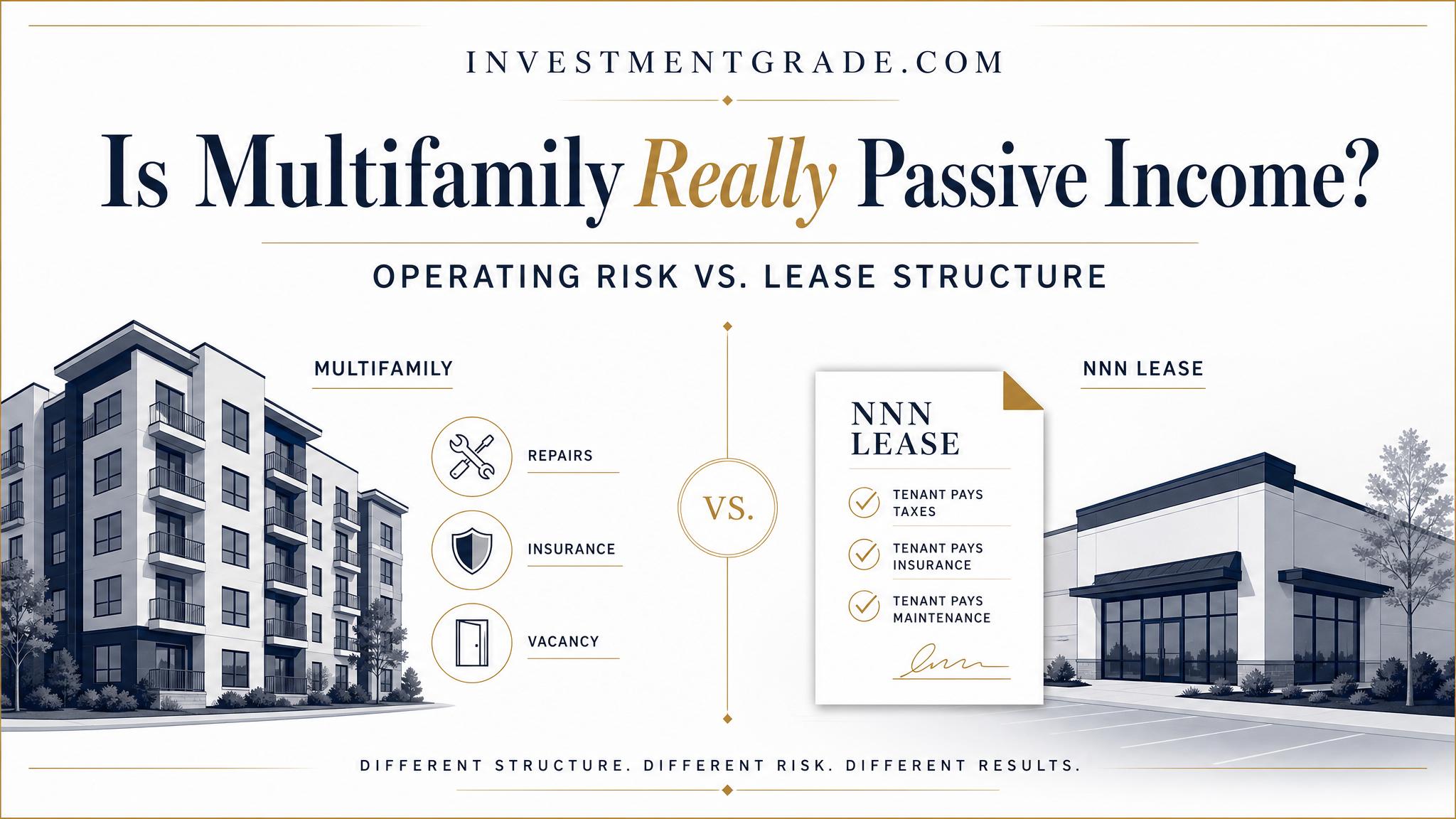
A multifamily investor can go years without fixing a toilet personally and still own something that is not truly passive.
That sounds contradictory only if passive income is defined by the investor’s calendar. In real estate, the better test is not whether the owner handles the work directly. The better test is where the operating risk lives when the property is stressed.
Multifamily can be an excellent asset class. Apartments have demand depth, financing markets, operating scale, and long-term inflation arguments that are easy to understand. But the phrase multifamily passive income often hides the machine underneath the distribution. Rent checks may arrive passively. The income itself is still produced by an active operating business.
That distinction matters for private investors, 1031 exchangers, and retiring landlords trying to turn real estate equity into durable income.
Multifamily is often passive by delegation. Triple net lease real estate is passive by structure.
Passive by delegation is not the same as passive by structure
In multifamily, the owner may delegate leasing, maintenance, rent collection, accounting, payroll, vendor management, lender reporting, resident communication, and renovation oversight to a property manager or sponsor. That delegation can work well. It can also create distance between the investor and the operating reality of the asset.
The investor may not be active day to day, but the property still is.
Units turn. Roofs age. HVAC systems fail. Insurance premiums reset. Payroll rises. Concessions come and go. Debt matures. Local supply changes. Property taxes get reassessed. Resident behavior changes collections, delinquency, and repairs.
A passive investor can outsource the work. The property cannot outsource the volatility.
That is the first underwriting mistake in the passive-income conversation. Investors often compare how much time they personally spend on the asset. They should also compare who carries the financial burden when operations move against them.
In a true triple net lease passive income structure, the tenant typically carries property taxes, insurance, and maintenance obligations in addition to base rent. The landlord is not free from risk, but the risk is concentrated in tenant credit, lease terms, rent durability, and residual real estate value rather than daily operations.
That is a different machine.
Multifamily income is operational income
An apartment building is not just a collection of leases. It is a small operating company attached to real estate.
The income statement depends on occupancy, effective rents, concessions, expenses, repairs, insurance, taxes, utilities, payroll, management quality, renovation execution, resident retention, and financing costs. Some of those variables are controllable. Many are not.
The investor may see a monthly or quarterly distribution. Behind that distribution is a moving set of operating assumptions.
A clean multifamily pro forma often makes the income look stable. The actual ownership experience is messier. A property can hit its rent-growth target and still disappoint if insurance, taxes, labor, repairs, or interest expense move faster. A deal can maintain occupancy and still miss its cash-flow target because the expense side changed.
That does not make multifamily bad. It makes it active.
The expense problem: the owner keeps the operating burden
The most important passive-income question is simple: who pays when costs rise?
In multifamily, the owner generally does.
Property taxes rise. Insurance premiums rise. Maintenance costs rise. Payroll rises. Utilities may rise. Turnover costs rise. Capital improvements become necessary. If rents cannot move fast enough to offset those expenses, the owner’s cash flow absorbs the difference.
That is why multifamily is not simply a rent-collection strategy. It is an expense-management strategy.
The investor may not personally approve every invoice, but the asset’s cash flow is still exposed to those invoices. The passive investor is passive only in the sense that someone else is managing an active business on his behalf.
NNN real estate shifts part of that burden. In a properly structured net lease, the tenant is responsible for many property-level expenses that would normally sit with the owner. That does not eliminate underwriting. It changes what has to be underwritten.
For a deeper comparison, see multifamily passive income vs NNN passive income.
Capex is where passive stories get tested
Every property has a capital expenditure reality. Multifamily investors know this, but passive-income marketing often softens it.
Roofs, parking lots, mechanical systems, plumbing, elevators, windows, unit interiors, amenities, and exterior systems do not care whether the investor expected a smooth distribution. They require capital when they require capital.
In a multifamily syndication, capex may be part of the business plan. In a stabilized apartment deal, capex may appear as recurring reserves. In older assets, deferred maintenance can become the difference between stable income and a capital call.
The passive-income test is not whether capex exists. It always exists. The test is whether the investor understands who funds it, who controls it, and how it affects distributable cash flow.
When capex is underestimated, the investment becomes less passive in two ways. First, the income becomes less predictable. Second, the investor may have to make fresh decisions about capital contributions, refinancing, sale timing, or accepting lower distributions.
That is active risk, even if someone else is swinging the hammer.
Insurance, taxes, and debt have made the question sharper
The last several years made the passive-income debate harder to ignore.
Insurance costs have become a major underwriting variable in many markets. Property taxes have reset higher in growth states and post-sale reassessment environments. Floating-rate debt and refinancing risk exposed the gap between projected cash flow and actual capital-market conditions.
Multifamily investors who believed they owned passive income discovered that they owned operating leverage, expense exposure, and financing risk.
Again, this is not an argument against multifamily. It is an argument against lazy language.
If an investment depends on expense control, rent growth, financing execution, renovation timing, and property-management performance, it may be professionally managed, but it is not structurally passive in the same way as a long-term net lease backed by a durable tenant.
Vacancy and turnover are not passive variables
Apartment income is built one resident at a time.
That creates diversification across units, which is one of multifamily’s strengths. Losing one tenant in a 100-unit property is not the same as losing the only tenant in a single-tenant NNN building. Multifamily has operational diversification that single-tenant net lease real estate does not.
But that diversification comes with activity.
Vacancy has to be leased. Units have to be turned. Concessions have to be managed. Bad debt has to be collected or written off. Resident experience has to be maintained. Market rents have to be tested. Renovations have to be sequenced.
The investor can delegate all of that, but the asset still depends on it.
NNN has a different risk profile. A single-tenant property can look calm until a tenant credit problem or lease rollover creates a major decision point. That is why net lease due diligence matters. NNN is not risk-free. It is risk-concentrated.
The point is not that NNN has less risk in every case. The point is that the work of the income is different.
Multifamily syndications add another layer: sponsor execution
For limited partners in multifamily syndications, the passive-income claim depends on more than the property.
It also depends on the sponsor.
The investor is underwriting acquisition discipline, debt structure, renovation assumptions, property-management oversight, fee load, reporting quality, communication, capital-call behavior, refinance strategy, and exit timing. The investor may be passive, but the outcome depends heavily on active decisions made by someone else.
That can be acceptable when the sponsor is strong and incentives are aligned. But it is not the same as owning a direct leased asset with known rent obligations, known lease terms, and a visible tenant-credit profile.
This is why the question should not be, “Can I be hands-off?”
The better question is, “Whose execution am I relying on, and what happens if their assumptions are wrong?”
The retiring landlord problem
The passive-income issue becomes most practical when a landlord is trying to exit active ownership.
A landlord selling apartments, small-bay industrial, retail strip centers, or self-managed real estate may not simply want another property. He may want fewer decisions. Fewer calls. Fewer employees. Fewer repairs. Fewer operating surprises.
That is where the difference between delegated activity and structural passivity matters.
Buying another apartment building through a manager may reduce the owner’s direct workload, but it does not remove the operating machine. The investor still owns vacancy, expenses, capex, insurance, and management execution.
A properly underwritten NNN replacement property can be different. For a 1031 exchange buyer, the objective is often not maximum operational upside. It is durable income, lease clarity, and reduced management burden.
That is why 1031 exchange strategy and passive-income strategy often converge around net lease real estate.
When multifamily passive income can still make sense
Multifamily can still be the right answer.
It may offer stronger long-term upside in certain markets. It may provide inflation participation through shorter lease terms. It may create value through renovation, better management, or repositioning. It may diversify income across many residents instead of concentrating credit risk in one tenant.
For investors who want operational upside and accept the moving parts, multifamily can be attractive.
But that is the trade. Multifamily income is often earned through operations. NNN income is often protected through structure.
The more an investor values upside, control, rent growth, and operational value creation, the more multifamily may fit. The more an investor values simplicity, predictable obligations, lower management burden, and lease-defined expense responsibility, the more NNN deserves attention.
The better passive-income test
The better test for passive real estate income is not whether the investor receives a distribution.
It is whether the income depends primarily on active operations or contractual structure.
Ask five questions:
- Who pays property taxes, insurance, maintenance, and repairs?
- Who absorbs expense inflation if costs rise faster than rents?
- How much capex is required to protect income?
- What operating assumptions have to go right for distributions to continue?
- What happens if the manager, sponsor, tenant, or capital market disappoints?
Those questions separate passive-income marketing from passive-income underwriting.
The Investment Grade view
At Investment Grade, we do not treat passive income as a slogan.
Every income property has a machine inside it. Multifamily’s machine is operations. NNN’s machine is credit, lease structure, and residual real estate value.
The passive-income question is which machine an investor wants to own.
Multifamily can produce strong returns, but its income is often passive only because the work has been delegated. NNN real estate can produce cleaner passive income because the lease itself reallocates much of the operating burden away from the owner.
That does not make every NNN property investment grade. A weak tenant, bad lease, over-rented building, poor location, or short rollover can destroy the passive-income thesis. But when tenant credit, lease structure, rent durability, and real estate quality align, NNN can deliver something many investors thought they were buying elsewhere: real estate income with fewer operating variables attached.
The goal is not to own income that sounds passive.
The goal is to own income that underwrites passive.
Key takeaways
- Multifamily passive income is often passive by delegation, not passive by structure.
- Multifamily owners still carry operating-expense, capex, insurance, tax, vacancy, and financing risk.
- Syndication investors also underwrite sponsor execution, fees, capital calls, and exit timing.
- NNN passive income shifts many property-level obligations to the tenant, but concentrates risk in credit, lease terms, and real estate residual value.
- For retiring landlords and 1031 buyers, the real question is not whether an asset produces income. It is how much operating burden remains attached to that income.
Evaluate passive income by underwriting the burden
Investment Grade helps investors compare NNN properties, 1031 replacement strategies, tenant credit, and lease structure so passive-income decisions are based on risk allocation instead of marketing language.
triple net lease passive income | 1031 exchange strategy | discuss your acquisition or sale
