
Impact Capital 2026
Commercial Property Assessed Clean Energy financing, known as C-PACE, has moved from a niche energy loan to a regular part of the commercial real estate capital stack. National volume rose 63% in 2025, and loans above $100 million are now routine.
Key numbers
- $3.6 billion in C-PACE volume in 2025, up from $2.2 billion in 2024, as reported by lender Bayview PACE.
- About $13 billion in cumulative originations through 2025.
- $465 million: the largest C-PACE loan on record, closed by Nuveen Green Capital in January 2026 for The Geneva, Post Brothers’ 532-unit office-to-residential conversion in Washington, DC.
- $40 million average deal size at Nuveen Green Capital in 2026, up from roughly $800,000 in 2017.
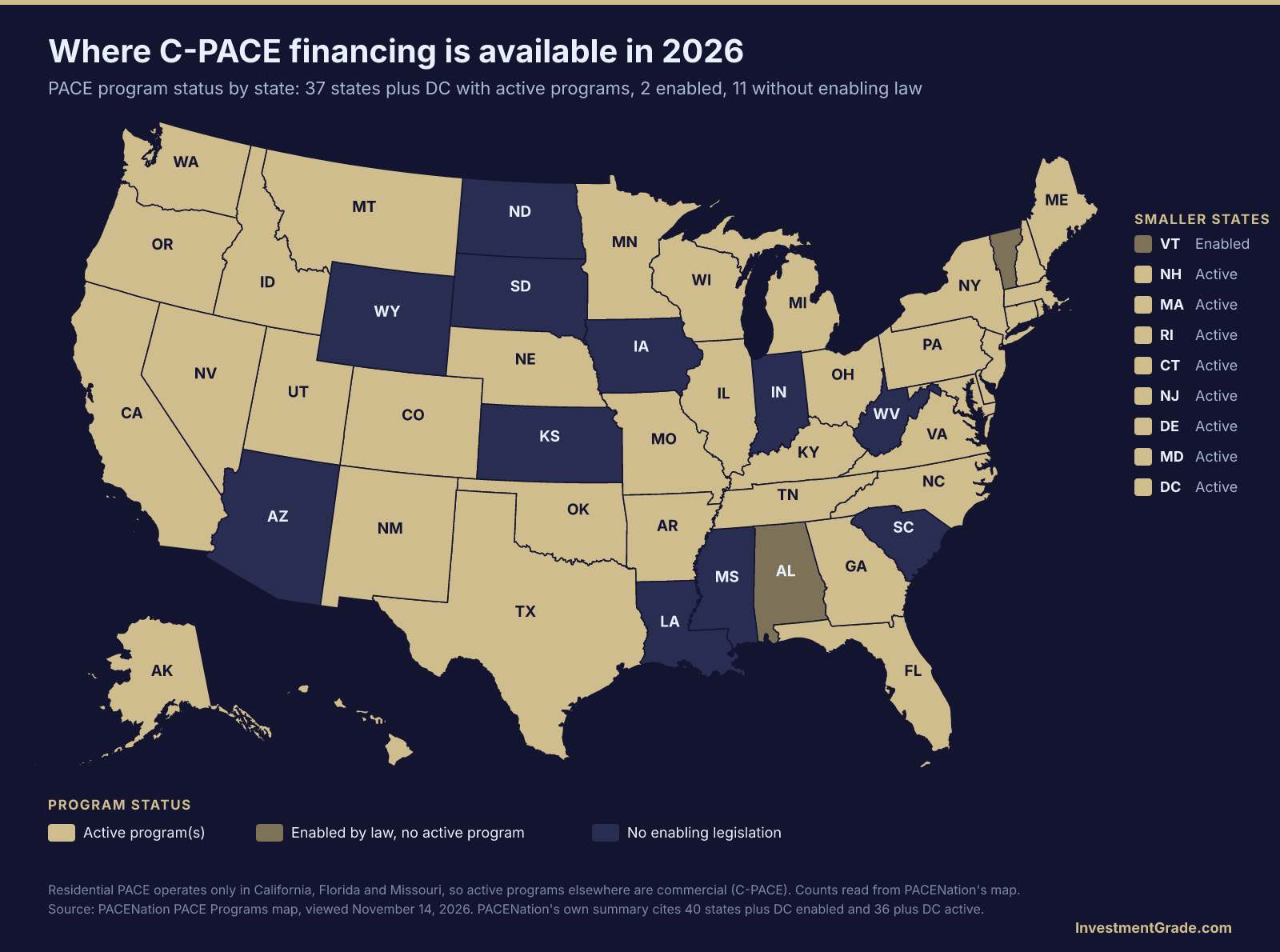
- 37 states plus DC show active PACE programs on PACENation’s map. Alabama and Vermont have enabling laws but no active program. Eleven states have no enabling law.
How C-PACE works
A state passes enabling legislation, and a county or city, or a statewide program, sets up a C-PACE district. The property owner then finances qualifying improvements through a voluntary special assessment on the property tax bill, repaid over a long fixed term alongside property taxes.
- What it pays for: energy efficiency, renewable energy, water conservation and resiliency improvements. In many programs that reaches HVAC, roofs, windows, lighting, building envelope and storm hardening.
- Retroactive financing: more than 25 states let owners finance improvements already completed, which turns C-PACE into a recapitalization tool.
- On a sale: the assessment generally stays with the property if the buyer agrees to take it on.
- Mortgage lender consent: because the assessment is collected with property taxes, programs typically require the existing mortgage lender to consent before closing.
Where it fits in the capital stack
Developers use C-PACE to replace higher cost mezzanine debt or preferred equity, to fill a gap left by a smaller senior loan, and to recapitalize properties facing a refinance. Recent deals show the range: a $290 million loan for the Pendry Hotel and Residences tower in Tampa, office-to-residential conversions, and combination loans where one lender provides both the C-PACE and the construction financing.
Recapitalizations are expected to be a dominant theme in 2026. For an owner facing a maturing loan, a retroactive C-PACE assessment on qualifying work already done can reduce the cash needed to refinance.
States without C-PACE today
| Status | States |
|---|---|
| Enabled by law, no active program | Alabama, Vermont |
| No enabling legislation | Arizona, Indiana, Iowa, Kansas, Louisiana, Mississippi, North Dakota, South Carolina, South Dakota, West Virginia, Wyoming |
Status changes as legislatures act, so confirm the current rules in your county before you plan around C-PACE. Residential PACE is offered only in California, Florida and Missouri; this article covers commercial programs.
Why C-PACE is impact investing
C-PACE is the environmental side of real estate impact investing, and the side with the clearest numbers. At Nuveen Green Capital, energy efficiency and resiliency measures made up less than half of financings in 2015 and more than 95% in 2026.
- Economic return first. Owners use C-PACE because it can be cheaper and longer than the capital it replaces. The savings case comes before the green case.
- Environmental return. Each project is tied to specific measures, so energy, water and resiliency gains can be estimated and tracked.
- Social return. C-PACE often funds conversions that add housing, and it can sit beside LIHTC in affordable deals and beside Opportunity Zone equity.
Weighing C-PACE for a building or a refinance?
Investment Grade helps owners compare C-PACE with bridge, mezzanine and conventional debt, and get the existing lender’s consent on the table early. Tell us about the property and the work.
Sources
- PACENation: PACE programs map
- Multi-Housing News: another good year for C-PACE financing
- Mintz: C-PACE, an increasingly essential part of the capital stack
- Commercial Observer: C-PACE lending expanding in size and scope
- GlobeSt: how C-PACE became a capital stack staple
- Environment+Energy Leader: C-PACE moves upgrades off frozen capital budgets
- CoStar: C-PACE is now serious money
General information, not legal, tax or investment advice. Program rules vary by state and county.
