
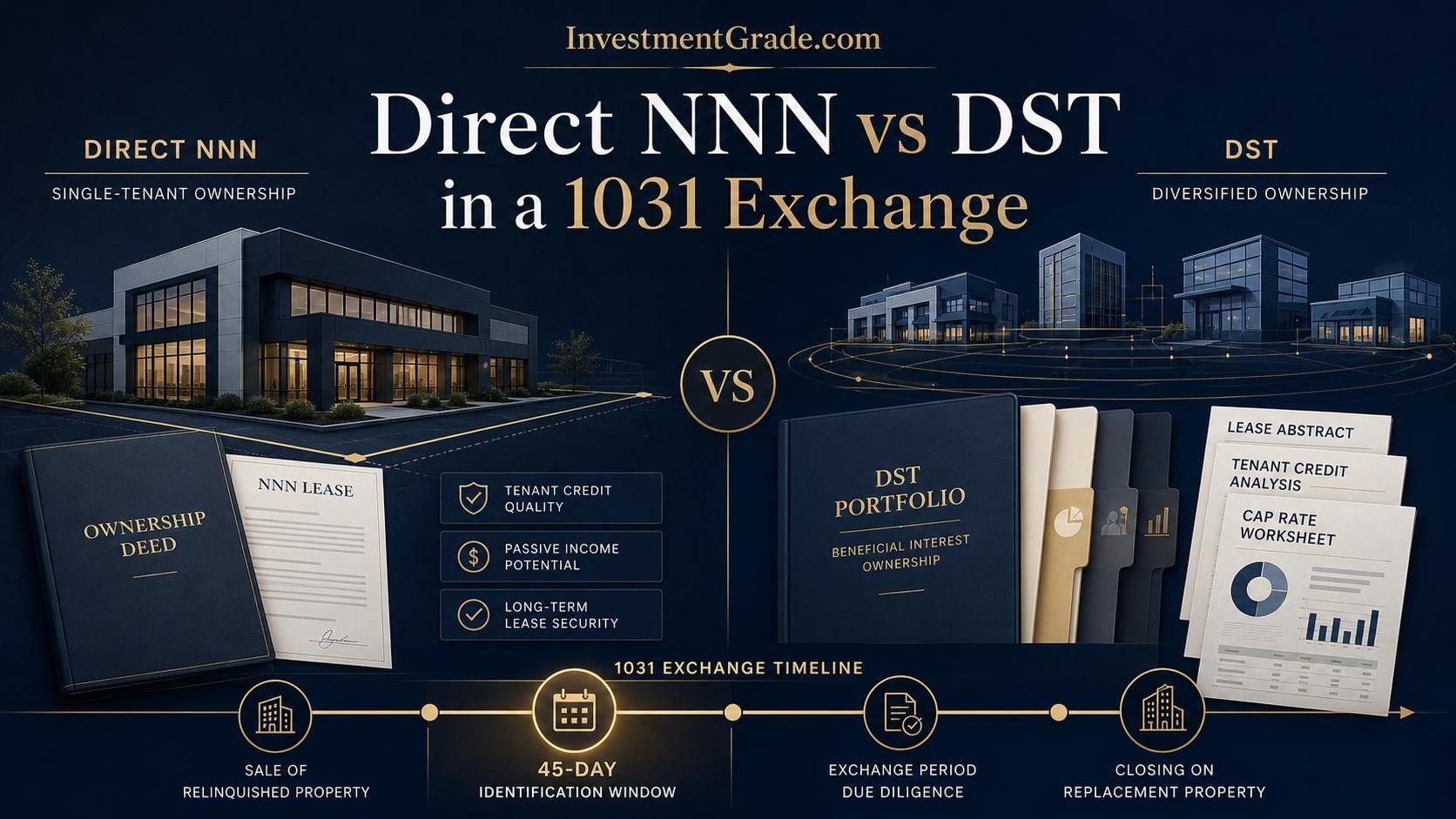
Direct NNN vs DST in a 1031 exchange is not a question of which structure is universally better. It is a question of what kind of risk the exchanger is choosing to own before the 45-day clock runs out.
A DST can make a hard exchange easy. A direct NNN property can make a hard exchange worth doing. Those are different promises.
Comparing direct NNN and DST replacement options? Before the 45-day clock forces the decision, send Investment Grade the sale date, equity amount, debt replacement need, target income, direct ownership preference, DST backup posture, and any candidate properties already on the table.
Start a 1031 replacement-property intake or contact Investment Grade for a direct NNN review.
The pressure point is familiar. A real estate owner sells an apartment building, small industrial property, medical office, or legacy family asset. The qualified intermediary is holding the proceeds. The investor has 45 days to identify replacement property and 180 days to close, subject to the tax return deadline. The old asset is gone. The tax bill is waiting if the exchange fails. The investor does not need a theoretical comparison. The investor needs a replacement-property decision that can survive deadline pressure, lender review, tenant-credit diligence, family questions, CPA review, and the first bad surprise after closing.
That is where the DST versus direct NNN decision gets more interesting than the usual brochure comparison.
A Delaware Statutory Trust can qualify as 1031 replacement property when properly structured. IRS Revenue Ruling 2004-86 addresses this structure: it holds that a taxpayer may exchange real property for an interest in the Delaware statutory trust it describes without recognizing gain or loss under Section 1031, if the other requirements of Section 1031 are satisfied. A direct NNN property is simpler conceptually: the exchanger buys a real property interest directly, such as a single-tenant property leased under a triple net or similar lease. Confirm in the title work and the lease whether the purchase includes the land, the building or both.
Both can fit inside a 1031. Neither eliminates underwriting. They simply move the underwriting burden to different places.
The real decision: control risk or sponsor risk
Investors often compare DSTs and NNN properties by asking which one is more passive. That is the wrong first question.
The better first question is: who controls the real estate after the exchange closes?
In a direct NNN acquisition, the investor controls the asset, subject to the lease, lender, and practical realities of ownership. The investor chooses the tenant, location, price, debt structure, closing team, lease risk, and exit strategy. If interest rates change, a direct owner can consider refinancing. If a buyer appears, the owner can sell. If the family wants to hold, exchange again, finance, contribute to an entity, or plan around the asset, those choices remain closer to the owner.
In a DST, the investor owns a beneficial interest in a trust that owns real estate. The sponsor and trustee control the business plan. The investor receives distributions and tax reporting, but does not decide when to refinance, whether to negotiate a lease, when to sell, or how to manage the property-level plan. In fact, the DST structure depends on limitations that restrict the trustee from operating like an active real estate manager. Those limits are not a footnote. They are part of why the structure can qualify for 1031 treatment.
That does not make DSTs bad. It makes them precise. They are useful when passivity, speed, debt matching, diversification, or estate simplicity matters more than control. But a buyer who chooses a DST should understand that the trade is not only yield for yield. It is control for convenience.
What Section 1031 actually solves
The IRS describes like-kind exchanges as exchanges of real property held for business or investment into other real property of the same nature or character, even if quality or grade differs. Properly structured, the exchange can defer gain recognition. It does not make a weak replacement asset strong, and it does not turn a bad lease into a good one.
The deadlines are mechanical. Under Section 1031 and Treasury regulations, a taxpayer generally must identify replacement property within 45 days after transferring the relinquished property and receive the replacement property by the earlier of 180 days after the transfer or the due date, including extensions, of the taxpayer’s return for that year. The identification regulations add the practical rules exchangers live with: the three-property rule, the 200% rule, the 95% rule, written identification, and clear description of the replacement property.
Those rules explain why DSTs get attention. A DST offering can often be identified quickly, sized to a precise equity amount, and closed without negotiating a purchase contract on a single property. For an exchanger running out of time, that matters.
But tax deferral is only the first screen. A completed exchange into the wrong replacement property can preserve the tax deferral while creating the next problem: weak tenant credit, poor residual real estate, embedded fees, limited liquidity, sponsor dependence, or a mismatched hold period.
Where direct NNN is strongest
Direct NNN ownership is strongest when the investor can buy a specific property whose income stream, tenant credit, lease structure, and real estate fundamentals are worth owning directly.
The appeal is clean. The tenant usually pays some combination of taxes, insurance, maintenance, and operating expenses. The owner’s job is not to manage 40 apartment leases, argue over turnover, or underwrite payroll. The owner’s job is to underwrite the machine inside the asset: tenant credit, lease durability, rent coverage when available, guaranty strength, market rent, location quality, residual value, financing, and exit liquidity.
For the right exchanger, that is the point. Direct NNN can turn a management-heavy property into a more passive real estate income stream without giving up property-level control.
A direct buyer can ask questions a DST investor cannot control after the fact:
- Is the lease guaranteed by the parent company, a subsidiary, or a franchisee?
- How many years remain on the base term?
- Are the rent increases fixed, percentage-based, CPI-linked, or flat?
- Is the rent near market, above market, or below market?
- Can the building be reused if the tenant leaves?
- Is the cap rate compensating the buyer for the actual risk?
- Does the lender understand the tenant and lease?
- Will the asset be financeable and saleable when the owner wants liquidity?
That control is valuable. It is also work. Direct NNN is not magic passive income. The diligence burden moves upfront. A buyer who does not read the lease, inspect the property, model debt, review the guaranty, and understand the local real estate has not bought simplicity. He has bought concentration risk with a cleaner-looking rent check.
This is why a good 1031 replacement property checklist for NNN buyers starts with more than cap rate. It starts with credit, lease structure, real estate residual value, debt, closing certainty, and exit strategy.
Where DSTs are strongest
DSTs are strongest when the investor’s real problem is not asset selection. It is execution.
Consider the exchanger who sold a $900,000 rental property and needs to replace both equity and debt but does not want a new loan. Or the investor who is 12 days from the identification deadline and has no clean direct replacement. Or the family that wants institutional real estate exposure without making three siblings co-manage one building. Or the seller with an odd remaining exchange balance after buying a direct property.
In those cases, a DST can be a useful tool. It can provide fractional ownership, passive management, non-recourse debt allocation, sponsor-selected property, and a ready identification target. A buyer can diversify across multiple DSTs more easily than buying multiple direct NNN properties.
The tradeoff is structural. DST investors usually give up direct operational control, exit timing, refinance flexibility, and property-specific decision rights. Fees can also be meaningful. DST offerings may include selling commissions, broker-dealer allowances, wholesaling fees, organization and offering expenses, acquisition fees, asset management fees, financing-related fees, disposition fees, and other sponsor or affiliate economics. Some fees are embedded in the offering structure rather than presented like a closing statement on a direct purchase.
That does not automatically make DSTs more expensive than direct ownership. Direct ownership has its own costs: legal, environmental, survey, title, lender, appraisal, lease review, inspections, accounting, potential property management, CPA modeling, and closing risk. The difference is visibility and control. In a direct acquisition, the buyer usually chooses the service providers and sees the costs. In a DST, the investor must read the private placement materials carefully and understand the total economic load before comparing distribution rate to cap rate.
The cap rate versus distribution rate trap
A common mistake is comparing a direct NNN cap rate with a DST distribution rate as if they are the same number.
They are not.
A cap rate is generally property-level net operating income divided by purchase price. It says something about the real estate yield before the buyer’s specific financing, taxes, depreciation, transaction costs, and future exit. A DST distribution rate is the investor’s projected or current cash distribution from the trust after the sponsor’s structure, property operations, debt service, reserves, and fees. It is useful, but it is not the same denominator, not the same control package, and not the same exit path.
The direct property may show a higher cap rate but require more diligence, financing, and concentration. The DST may show a lower or smoother distribution but include sponsor dependence, illiquidity, and less flexibility. A direct property can also show a deceptively attractive cap rate because the rent is above market, the tenant credit is deteriorating, the building is over-specialized, or the lease has a weak guarantor.
The right comparison is not “Which yield is higher?”
The right comparison is “Which after-fee, after-debt, after-tax, risk-adjusted income stream do I want to own, and who controls the exit?”
Comparison checkpoint: If you are looking at a DST distribution rate next to a direct NNN cap rate, put both options on one sheet before you identify. Compare tenant credit, remaining lease term, guaranty, rent level, financing, DST fees, debt replacement, liquidity limits, and who controls the exit.
Use the NNN replacement-property checklist and then send the candidates to Investment Grade for a direct-property pressure test.
A practical decision framework
For a 1031 buyer comparing direct NNN and DST replacement property, the decision should usually move through five filters.
1. Deadline certainty
If the exchanger has a strong direct property under contract early in the 45-day window, direct ownership may deserve the first look. If the deadline is tight and the direct property pipeline is weak, DSTs can provide backup identification or partial allocation. A DST can be especially useful as a pressure-release valve when the alternative is overpaying for a mediocre direct asset just to save the exchange.
2. Control preference
If the investor wants to choose tenant, market, lease, debt, hold period, and exit strategy, direct NNN is usually the cleaner fit. If the investor wants a passive allocation and is comfortable delegating the business plan to a sponsor, DST may fit better.
3. Credit and lease transparency
Direct NNN lets the buyer underwrite a specific tenant and lease. That is powerful if the buyer knows how to evaluate credit. Investment-grade tenants, parent guarantees, franchisee obligations, rent escalations, and residual site quality can all matter. The Investment Grade tenant credit reference exists because private NNN buyers often need a better bridge between public credit markets and single-property decisions.
DSTs still require property-level diligence, but the investor is underwriting the sponsor’s selected asset, the offering structure, and the sponsor’s ability to execute.
4. Liquidity and exit path
Neither direct NNN nor DST should be treated like a liquid bond. Direct NNN property can take time to sell, especially if rates move, tenant credit changes, or the lease term burns down. But the owner controls when to test the market. DST interests are generally illiquid and exit is usually sponsor-driven. Secondary-market options, if available, may be limited and pricing may be uncertain.
5. Estate and family fit
Direct property can be excellent for a single decision-maker who wants a tangible asset and a clear rent check. It can become awkward when multiple heirs inherit one property with different cash needs. DST interests may be easier to divide, but heirs inherit the same sponsor-controlled structure. Estate simplicity is not only about the asset. It is about who will make decisions later.
When direct NNN usually wins
Direct NNN usually deserves priority when the investor has enough equity to buy institutional-quality single-tenant real estate, wants control, can complete diligence, and has access to real inventory before the identification deadline.
It is especially compelling when:
- the tenant credit and lease guaranty are strong enough to support the income thesis;
- the property has durable residual value if the tenant leaves;
- the rent is defensible relative to market alternatives;
- the buyer wants control over debt, refinance, sale, and future exchange timing;
- the investor prefers one asset he can understand deeply over a passive product he cannot control;
- the buyer has advisory support for lease review, lender coordination, tax modeling, and closing execution.
The best direct NNN purchase does not merely “beat the DST yield.” It gives the investor an asset he would still want to own if there were no tax deadline.
When a DST usually wins
A DST usually deserves serious consideration when the investor values passivity, small allocation size, diversification, deadline certainty, or debt replacement more than direct control.
It can be the better fit when:
- the exchanger is too close to the 45-day deadline to diligence a direct property properly;
- available direct inventory is weak, overpriced, or mismatched to the investor’s risk tolerance;
- the investor wants no financing process, no tenant calls, and no property-level decision burden;
- the exchange proceeds are too small or oddly sized for clean direct ownership;
- the investor wants exposure across multiple properties, sponsors, or asset classes;
- estate planning favors divisible beneficial interests over one directly owned property.
The best DST allocation is not a panic purchase. It is a deliberate choice to outsource control after understanding the sponsor, asset, debt, fees, liquidity limits, and exit plan.
The blended answer exchangers can miss
The direct NNN versus DST decision is often presented as binary. It does not have to be.
Some exchangers should identify a direct NNN property as the primary replacement and a DST as backup. Others may buy one direct NNN asset for the core of the exchange and use DST interests to solve leftover equity, diversification, or debt-matching needs. A larger exchanger may split among direct NNN, DST, and another real property strategy after the CPA and qualified intermediary confirm the structure.
The blended strategy can reduce deadline pressure without surrendering the whole exchange to a sponsor-controlled product. It can also keep a buyer from forcing a direct acquisition that should not pass diligence.
The key is sequence. Do not wait until day 43 to start thinking about backup identification. A buyer who wants direct NNN should still understand the DST shelf early enough to use it intelligently if the direct property fails.
The underwriting question that should decide it
Here is the cleanest way to frame the decision:
If you want to own the real estate decision, underwrite direct NNN first. If you want to outsource the real estate decision, underwrite the DST sponsor and structure first.
That sentence can be more useful than a yield comparison alone.
Direct NNN is an ownership decision. DST is an allocation decision. Both can be valid 1031 replacement-property paths. Both can be misused. Both can protect the exchange deadline while creating a future problem if the investor buys the wrong risk.
For a 1031 buyer, a disciplined process looks like this:
- Model the tax and deadline requirements with the CPA and qualified intermediary.
- Build the direct NNN target profile before the relinquished property closes if possible.
- Underwrite tenant credit, guaranty, lease term, rent, real estate residual value, and debt.
- Review DST options early as backup or partial allocation, not only as a last-minute rescue.
- Compare cap rate, distribution rate, fees, debt, taxes, liquidity, and exit control on one page.
- Do not buy a bad direct property to avoid a DST, and do not buy a DST because no one modeled direct ownership.
A 1031 exchange is a tax structure. The replacement property is the investment. The tax structure should not make the investment decision for you.
How Investment Grade helps buyers compare the paths
Investment Grade focuses on the direct-ownership side of the decision: tenant credit, NNN lease structure, guaranty quality, cap-rate logic, and replacement-property fit for 1031 buyers. DSTs can be useful tools, but exchangers can be shown a shelf of passive offerings before they see a disciplined direct NNN comparison.
If you are comparing direct NNN properties, DST options, or a blended identification strategy, Investment Grade can review the direct NNN side of the decision and help you understand what the tenant, lease, location, guaranty, and residual real estate are actually asking you to believe.
Before you identify direct NNN, DST, or a blended strategy: send the candidate list, day-45 deadline, equity amount, debt replacement requirement, target income, and any DST backup options you are considering. Investment Grade can review the direct NNN side of the decision and help you see what the tenant, lease, location, guaranty, cap rate, and exit path are asking you to believe.
Start the replacement-property intake or request a tenant-credit and NNN replacement-property review before the 45-day identification window forces the decision for you.
This article is educational and is not tax, legal, securities, or investment advice. 1031 exchange rules, DST offerings, and securities suitability questions should be reviewed with your CPA, qualified intermediary, attorney, and appropriately licensed advisors.
Sources and further reading
- IRS: Like-kind exchanges, real estate tax tips
- IRS Revenue Ruling 2004-86
- IRS Revenue Ruling 2002-83
- Treasury Regulation 1.1031(k)-1: identification and receipt of replacement property
Find your next 1031 NNN decision
Compare this ownership choice with deadlines, tenant selection and property diligence through the 1031 NNN decision router.
Compare property risk, product risk and debt fit
Direct NNN and DST interests can both solve a replacement-property need, but they concentrate risk in different places. Direct ownership exposes the investor to one property, one lease, one tenant-credit chain and the owner’s financing decisions. A DST adds sponsor selection, offering structure, embedded fees, limited control and a predetermined business plan to the underlying real estate risk.
Debt replacement can also drive the choice. A direct buyer controls the loan process but must fit financing, due diligence and closing inside the exchange timeline. A DST may offer prearranged financing and fractional sizing, but the investor does not control refinancing or asset-level leverage decisions.
Make this decision before the relinquished property closes whenever possible. Deadline pressure should not be allowed to turn a structural choice into a last-minute inventory choice.
Direct NNN vs DST: Frequently Asked Questions
What is the real difference between direct NNN and a DST?
The kind of risk you choose to own. With direct ownership you control the asset and every decision about it, and you carry the consequences of those decisions. With a DST you hold a fractional beneficial interest in a trust that a sponsor controls, so you trade control for passivity and inherit sponsor risk, fee structure, and exit timing instead.
Which option is faster inside the 45 day identification window?
Often a DST. DST offerings are pre-packaged and can often be identified and closed quickly, which is why exchangers consider them when the clock is short. Direct ownership requires sourcing, diligence, negotiation, and closing on a specific property, all of which take time you may not have late in the identification period.
Can an exchanger use both a DST and direct property?
Yes. Identification rules allow more than one replacement property, so a DST can serve as a backup identification behind a primary direct purchase, or absorb leftover proceeds that a single direct property cannot. An exchange can be solved by a combination rather than by choosing one path exclusively.
Is a DST distribution rate the same as a NNN cap rate?
No, and comparing them directly is a common error in this decision. A cap rate is an unlevered yield measured before fees. A DST distribution rate is what remains after sponsor fees and any leverage inside the trust. The two numbers are built differently, so a DST distribution rate and a direct cap rate are not comparable figures.
Who is eligible to invest in a DST?
DST interests are offered as securities, often in private placements under SEC Regulation D. In an offering under Rule 506(c), every purchaser must be an accredited investor (17 CFR 230.506(c)), so eligibility depends on the offering and the exemption it relies on, and the offering is handled through appropriately licensed parties. Investment Grade represents buyers and sellers of net lease real estate and does not sell or place securities.
