
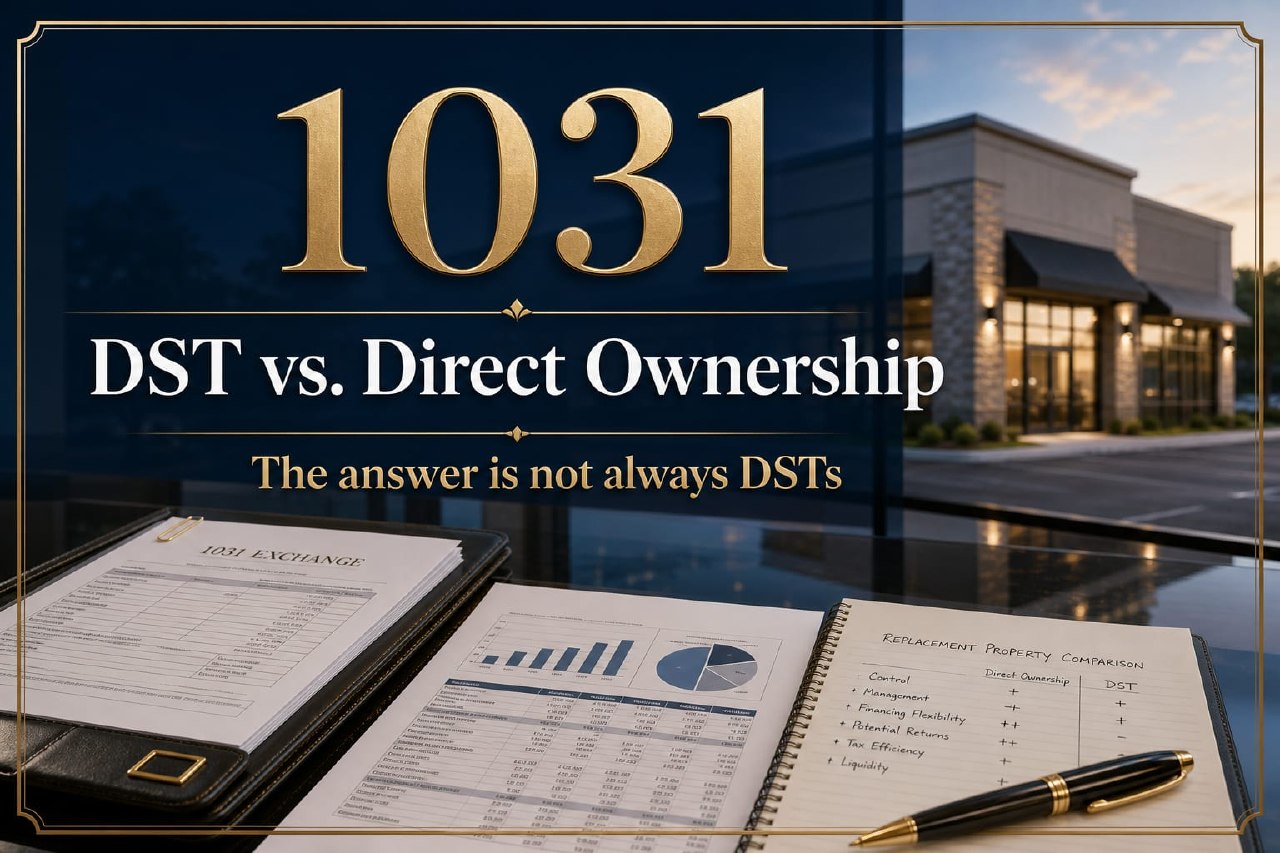
A Delaware Statutory Trust (DST) is a fractional beneficial interest in real estate that qualifies as 1031 replacement property under IRS Rev. Rul. 2004-86. DSTs let investors complete a 1031 with a smaller check size and zero ongoing management responsibility. The tradeoffs are real: no operational control, no refinancing ability, no strategic flexibility, and at exit, a sale date the sponsor chooses, which requires planning if you want to complete another 1031. This is the educational reference.
What a DST Is
A Delaware Statutory Trust is a legal entity formed under the Delaware Statutory Trust Act (12 Del. Code Ch. 38) and structured to hold real estate. The trust acquires institutional-quality real estate (multifamily, industrial, medical office, NNN portfolios, or other commercial assets) with capital raised from multiple individual investors. Each investor receives a beneficial interest in the trust proportional to their capital contribution.
IRS Revenue Ruling 2004-86 confirmed that, when properly structured, a beneficial interest in a DST qualifies as a direct interest in real estate for Section 1031 purposes. This means a 1031 investor can exchange relinquished property into a DST beneficial interest and receive full deferral, despite not directly owning a deed.
This page is an educational companion to the investment grade 1031 exchange pillar guide. For comparison with direct-ownership NNN, see the broader investment grade credit tenant ratings reference.
The Rev. Rul. 2004-86 Mechanic
Rev. Rul. 2004-86 set out the conditions under which a DST beneficial interest qualifies for 1031 treatment. The trust must satisfy specific structural and operational requirements that limit what the trust (and indirectly, the trustee) can do during the hold period. These limitations are commonly called “the seven prohibited acts.”
The trustee of a qualifying DST cannot:
- Accept additional capital contributions after the initial offering closes
- Renegotiate the existing financing or refinance the underlying property (the loan terms are fixed at acquisition)
- Renegotiate the master lease or enter into new leases, except in the case of a tenant bankruptcy or insolvency (Rev. Rul. 2004-86); in a master lease structure, the master tenant can sublease
- Reinvest sale proceeds (capital must be distributed if any portion of the property is sold)
- Make capital expenditures beyond what is required for normal repair and maintenance, regulatory compliance, or pre-existing tenant obligations
- Hold cash reserves beyond what is reasonable for short-term operating needs
- Reinvest income or hold income for distribution beyond what is required for current operating costs
These prohibitions exist because the IRS treats the DST as a passive investment vehicle equivalent to direct ownership. If the trustee had operational discretion to refinance, re-lease, or reinvest, the structure would look more like a partnership (which fails 1031) than direct ownership.
The practical effect: a DST is a buy-and-hold structure with no operational flexibility for the holding period. The investor receives passive income from the property’s lease structure as it existed at acquisition, with no upside from active management.
How a DST Investment Works in Practice
A typical DST 1031 transaction:
- Sponsor identifies and acquires real estate. A DST sponsor (typically a real estate investment firm with broker-dealer relationships) identifies the underlying property, structures the financing, and negotiates the acquisition.
- Sponsor structures the DST. A Delaware Statutory Trust is formed. The trust acquires the property at closing, typically with a combination of investor equity and acquisition financing (commonly 50% to 70% LTV).
- Sponsor offers beneficial interests to 1031 investors. Beneficial interests are typically sold in $25,000 to $100,000 minimum increments through registered broker-dealers or registered investment advisors. The investor’s 1031 funds at the qualified intermediary acquire the beneficial interest at the closing of the DST offering.
- Investor identifies the DST within the 45-day window. The DST beneficial interest is identified the same way any 1031 replacement is identified: by a written, signed letter to the QI within 45 days of the relinquished closing.
- Closing on the DST. The DST closing typically occurs within 30 to 60 days of identification. The investor receives a beneficial interest, the QI wires the equity contribution, and the DST owns the underlying property.
- Hold period (typically 5 to 10 years). The investor receives quarterly or monthly distributions of net rental income. The trustee has no operational discretion beyond the seven prohibitions.
- DST exit. At a sponsor-determined exit (or upon termination of the underlying loan), the property is sold and proceeds are distributed pro-rata to investors. The investor recognizes the deferred 1031 gain, unless the investor reinvests via a subsequent 1031 (which has practical limitations discussed below).
When DST Makes Sense
The DST structure is the right tool for specific scenarios:
- Truly passive ownership preferred. The investor wants no operational involvement, no tenant calls, no decisions on capex, no leasing strategy. The DST sponsor handles everything; the investor receives distributions.
- Smaller check size. The investor’s 1031 proceeds are too small to acquire institutional-quality real estate directly. A $200K 1031 cannot purchase an institutional NNN property; it can purchase a DST beneficial interest in one.
- Geographic or asset-class diversification. The investor wants exposure to specific geographies or asset classes (Class A multifamily, medical office portfolios, industrial diversification) that are difficult to access through individual property acquisition.
- Time-pressured 1031 with limited replacement options. The investor is approaching the 45-day identification deadline without a clear direct-ownership replacement. Identifying a DST gives a deadline-safe option.
- Estate-planning simplicity. The investor wants to leave the property to multiple heirs without forcing them into joint direct ownership of a single property. DST beneficial interests are easier to divide and bequeath.
When DST Does Not Work
The DST structure is the wrong tool when:
- The investor wants operational control. Direct ownership of a NNN property gives the investor control over leasing decisions, refinancing strategy, capital improvements, and exit timing. DST removes all of this.
- The investor wants flexibility on the exit. Direct ownership lets the investor sell, refinance, or 1031 again at any time. DST exits are sponsor-driven and timeline-fixed.
- The investor wants to refinance during the hold. Direct ownership permits refinancing whenever rates improve or capital needs change. DSTs explicitly cannot refinance.
- The investor wants to acquire a specific tenant or property. Direct ownership lets the investor target a specific Walmart, AutoZone, or 7-Eleven property. DST investors take whatever underlying property the sponsor selected.
- The investor wants future 1031 exchange capability. At DST exit, investors can attempt to 1031 the proceeds into a new replacement property, but the timing is sponsor-controlled and the practical execution is more complex than a direct-ownership 1031.
- The investor is concerned about sponsor risk. The DST sponsor’s track record, fees, and operational integrity directly affect the investment outcome. A weak sponsor can underperform the underlying real estate.
Sponsor Diligence: The Critical Variable
The DST structure is only as good as the sponsor. Several sponsors have failed in the past decade, with some failures producing significant investor losses. Diligence on the specific sponsor and the specific offering is essential before investment.
The diligence checklist:
- Sponsor track record. Years in business, total capital raised, number of completed offerings, full-cycle exit history (acquired and exited offerings, not just acquired).
- Sponsor financial strength. Audited financial statements, current capital position, leverage ratios, any pending litigation.
- Fee structure transparency. Acquisition fees, ongoing asset management fees, disposition fees, financing fees, and any other compensation flowing to the sponsor or affiliates. Total fee load (across the sponsor and broker-dealer) commonly exceeds 10% of investor equity at acquisition.
- Underlying property diligence. Specific real estate diligence on the property itself: lease abstract, tenant credit, market conditions, physical condition, environmental, title.
- Loan terms. The fixed loan term (DSTs cannot refinance), interest rate, maturity date, prepayment provisions, and any covenants. Loans maturing during the expected hold period create exit pressure.
- Distribution sustainability. Modeled distributions vs. actual underwritten net operating income. Underwriting assumptions on rent growth, vacancy, expenses, and capex.
- Exit strategy. The sponsor’s stated exit timeline (typically 5 to 10 years) and the sponsor’s track record on similar exits.
- Litigation and regulatory history. SEC actions, FINRA actions, state securities regulator actions, or material lawsuits against the sponsor or its principals.
The Exit Problem
The most underappreciated aspect of DST investment is the exit. When the sponsor sells the underlying property (typically 5 to 10 years after acquisition), each beneficial interest holder receives their pro-rata share of the proceeds. The investor must then decide:
- Recognize the deferred 1031 gain and pay the tax (potentially significant after years of further appreciation)
- 1031 the proceeds into a new direct-ownership replacement
- 1031 the proceeds into another DST
The 1031-out option is mechanically possible but operationally complex. The DST sale typically closes on a sponsor-controlled date that does not necessarily align with the investor’s preferred timeline. The 45-day identification clock starts at the DST closing, not on a date the investor chose. The investor may need to identify replacement property within 45 days of a date they did not select.
Some sponsors offer “DST 1031 platforms” where the investor can roll one DST exit into a new DST offering inside the 45-day window. This solves the timing problem but locks the investor into another DST hold (with another fee load), perpetuating the structure. Investors can also exchange a qualifying DST interest into direct real estate when the trust sells, if a QI and exchange paperwork are arranged before proceeds are received; the challenge is planning around a sale date the sponsor controls.
DST vs Direct-Ownership NNN: The Side-by-Side
| Element | DST | Direct-Ownership NNN |
|---|---|---|
| Minimum check size | $25,000 to $100,000 | Typically $1M+ for institutional NNN |
| Operational control | None (sponsor-controlled) | Full investor control |
| Refinancing ability | Prohibited | Available at investor’s discretion |
| Exit timing | Sponsor-driven (typically 5-10 years) | Investor-driven |
| Property selection | Sponsor-selected portfolio | Investor-selected specific property |
| Fee load | 10%+ at acquisition; ongoing 1-2% asset management | 2-3% buyer-side cooperating commission at acquisition; no ongoing |
| Future 1031 flexibility | Constrained by sponsor exit timing | Available at investor’s discretion |
| Ongoing reporting | Sponsor-provided quarterly statements | Investor’s own books and records |
| Distribution structure | Pro-rata share of net operating income | 100% of net operating income |
| Best for | Truly passive investors with smaller capital, no need for control | Investors wanting direct ownership, flexibility, and full economics |
Investment Grade’s Position on DSTs
Investment Grade Income Property, LP focuses on direct ownership of investment grade NNN. Our acquisitions-and-dispositions practice represents investors on properties they own and control directly, not fractional beneficial interests. We do not represent investors in DST acquisitions because the structure does not align with our direct-ownership specialty and because the sponsor-driven economics differ materially from the cooperating-commission model that defines our buyer-side and seller-side engagements.
For investors who have determined that a DST is the right structure for their specific situation, we suggest engaging a registered broker-dealer or registered investment advisor with DST specialization, conducting independent diligence on the specific sponsor (audited financials, track record, fee transparency), and confirming with the CPA that the DST structure aligns with the investor’s overall tax and estate planning. Several established DST sponsors operate in the market; the specific selection depends on the investor’s geography, asset class, and risk preferences.
For Owners Considering a Sale: Direct-Ownership Alternative Analysis
Investment Grade Income Property, LP represents investors on both acquisitions and dispositions of investment grade NNN nationally. Through Broker of Record co-listing partnerships in all 50 states, we list properties on behalf of sellers, source qualified 1031 capital, and represent owners across the full lifecycle of a transaction.
For owners contemplating a sale where the contemplated 1031 destination is a DST, the most valuable conversation is whether the direct-ownership alternative would deliver better long-term economics. We model the disposition scenarios on your specific property, project the after-tax proceeds, and compare DST economics against direct-ownership investment grade NNN options. Where the analysis points to direct ownership, we represent on both legs of the exchange under one engagement. Where DST is the right answer for the specific situation, we explain why we are not the right team and refer to a DST-specialty advisor.
There is no fee for the initial scenario analysis. See contact Investment Grade.
Frequently Asked Questions: DST 1031 Exchanges
Is a DST a real estate investment or a security?
Both. A DST beneficial interest is a security for SEC and state securities law purposes (it must be sold through registered broker-dealers or under appropriate exemptions), but it is treated as a direct interest in real estate for federal tax purposes under Rev. Rul. 2004-86. This dual character is what permits the 1031 treatment while requiring securities-regulated distribution.
What is the typical hold period for a DST?
Five to ten years, with seven years being a common target. The exact timing is sponsor-controlled and depends on market conditions, the underlying loan maturity, and the sponsor’s strategy. Some DSTs run longer than expected; some exit earlier.
Can I 1031 into a DST and then 1031 out at exit?
Yes, mechanically. The investor identifies a new replacement property within 45 days of the DST exit closing and closes within 180 days. The challenge is timing: the DST exit date is not investor-controlled, which means the 45-day identification clock starts on a date the investor did not select. Some sponsors offer DST-to-DST roll structures that solve the timing problem but lock the investor into another DST hold.
What fees does a DST charge?
Acquisition fees (3% to 6% of investor equity), broker-dealer commissions (5% to 7% of investor equity), ongoing asset management fees (1% to 2% annually), and disposition fees (1% to 3% at exit). Total fee load over a typical hold period commonly exceeds 15% to 20% of investor equity.
Can a DST own a NNN property?
Yes. Many DSTs hold NNN portfolios (multiple Dollar Generals, multiple Walgreens, regional Aldi portfolios). The DST mechanic is asset-class agnostic; what matters is the structural compliance with Rev. Rul. 2004-86. NNN-focused DSTs are common.
What happens if the DST sponsor goes bankrupt?
The DST itself is a separate legal entity from the sponsor. The underlying real estate continues to be owned by the trust, and beneficial interest holders retain their economic rights. A new trustee or asset manager can be appointed. However, sponsor bankruptcy can disrupt operations, distributions, and the eventual exit. Sponsor diligence is the first line of defense.
How does a DST compare to a Tenant-in-Common (TIC) structure?
TICs predate DSTs and operate similarly (multiple investors holding fractional interests in real estate), but TICs require unanimous consent for major decisions, which created practical problems. DSTs replaced TICs as the dominant fractional 1031 structure after Rev. Rul. 2004-86. Most TIC sponsors transitioned to DST structures by 2010.
Related Resources
- Investment Grade 1031 Exchange: The Complete 2026 Guide
- The 1031 Exchange 45-Day Rule
- The 1031 Exchange 180-Day Rule
- 1031 Exchange vs Qualified Opportunity Zone 2.0
- The Three 1031 Identification Rules Compared
- Investment Grade Credit Tenant Ratings
- The CPA’s 2026 Capital Gains Deferral Decision Tree
- Contact Investment Grade: Acquisitions and Dispositions
This page is a comprehensive educational reference on Delaware Statutory Trust 1031 exchanges and is not legal, tax, securities, or investment advice. DST investments are securities subject to SEC and state regulation; suitability determinations should be made through a registered broker-dealer or registered investment advisor. Investment Grade Income Property, LP focuses on direct ownership of investment grade NNN and does not represent investors in DST transactions.
Not Every 1031 Investor Is in the Same Place
Some investors are still deciding whether to sell. Some are already listed. Some are under contract. Some have closed and are racing the 45-day identification deadline. Others have identified property but still need backup options, diligence, financing, or closing coordination before the 180-day deadline.
The right replacement-property strategy depends on where you are in the process, what you sold, how much equity and debt must be replaced, and how much control or passivity you actually want.
If you are evaluating a sale or already moving through a 1031 exchange, start with a conversation about timing, constraints, and available replacement paths.
Find your next 1031 NNN decision
See where DST education fits alongside direct NNN, UPREIT and replacement-property screening in the 1031 NNN decision router.
