
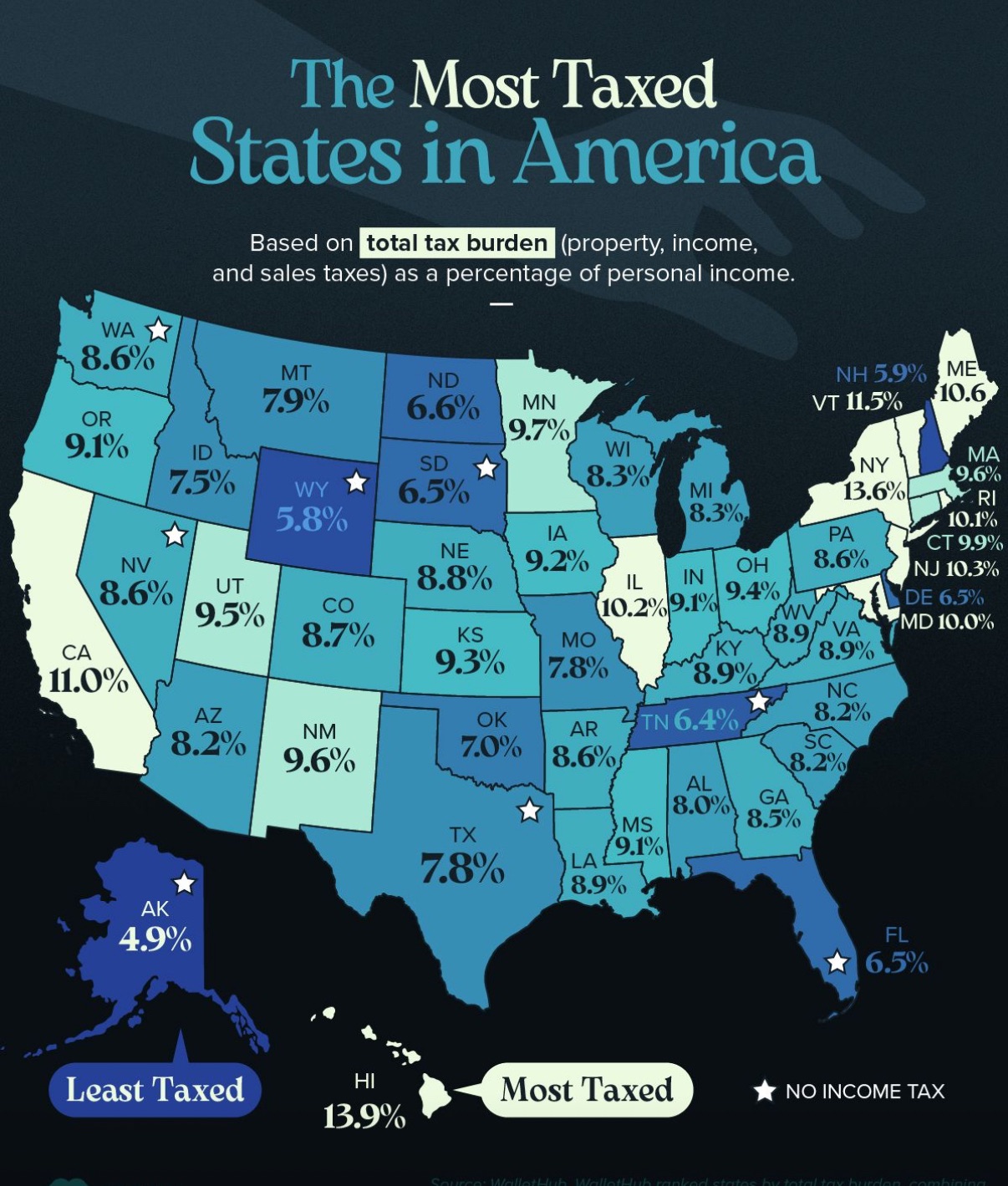
State taxes can change what an investment grade net lease property actually puts in your pocket, but not in the way a simple state ranking suggests. Which state’s tax applies depends on where the property is, where you live, and how you own it. This guide explains the state taxes that matter for NNN investors, works through a correctly specified example, and lists the states without a broad individual income tax.
This page replaces an earlier scorecard that multiplied cap rates by each state’s overall resident tax burden. That method was not a valid way to estimate an investor’s after-tax yield, so it has been withdrawn. General information only, not tax advice; consult a tax professional about your situation.
Why Resident Tax-Burden Rankings Do Not Measure NNN After-Tax Yield
Published state tax-burden rankings combine income, sales, and property taxes paid by residents as a share of residents’ personal income. That is useful context about a state’s overall tax level, but it is not the tax rate on a specific owner’s rental income:
- Property taxes are often the tenant’s cost. Under many NNN leases the tenant pays or reimburses property taxes (confirm in the lease), so they do not reduce the owner’s net operating income. Deducting them again from NOI double-counts them.
- Sales taxes are generally paid by consumers; whether a state also taxes commercial rent depends on the state, so check the property’s state.
- Income tax depends on residency and property location, not on where the average resident lives.
- Depreciation, interest, entity choice, and credits change taxable income, so tax is not a fixed share of NOI.
Which State Taxes Your NNN Rental Income
- The state where the property is located. Rental income from real property is generally taxed by the state where the property sits, including for nonresident owners, if that state has an income tax.
- The state where you live. Your home state generally taxes your income from all sources, but often allows a credit for income tax paid to the property’s state on the same income, so the combined tax is often closer to the higher of the two rates than to both in full; credit rules vary by state.
- Entity-level taxes. Some states tax the LLC, partnership, or corporation that owns the property. Texas applies its franchise (margin) tax to many LLCs and partnerships above a revenue threshold, and Tennessee applies franchise and excise taxes to many entities, including LLCs, even though neither state taxes individuals’ wages or rents. Exemptions can apply.
The practical result: a resident of a high-tax state who buys a property in a state with no income tax still owes home-state tax on that rent. A resident of a no-income-tax state who buys in a state with an income tax will usually owe nonresident tax to the property’s state and file a return there.
A Correctly Specified Example
Assume an all-cash $5,000,000 NNN purchase at a 6.80% cap rate, so net operating income is $340,000, with the tenant paying property taxes, insurance, and maintenance. Assume 80% of the price is allocated to the building, depreciated over 39 years: $4,000,000 ÷ 39 = $102,564 per year. Taxable rental income before state tax is $340,000 − $102,564 = $237,436.
| State income tax rate (illustrative, flat) | State tax on taxable rental income | Cash flow after state income tax |
|---|---|---|
| 0% | $0 | $340,000 |
| 3% | $7,123 | $332,877 |
| 5% | $11,872 | $328,128 |
| 7% | $16,621 | $323,379 |
| 10% | $23,744 | $316,256 |
Illustrative arithmetic only. Real state taxes use brackets, deductions, credits for taxes paid to other states, and their own rules on federal depreciation, and many states do not follow federal bonus depreciation. Federal income tax and the 3.8% net investment income tax are not shown. If you own only the land under a ground lease, you have no building to depreciate, which raises taxable income. After-tax cash flow cannot exceed pretax cash flow unless a separate credit or refund applies.
In this example the difference between a 0% and a 10% state rate is about $23,700 a year, or roughly 0.47 percentage points of yield on the purchase price. Which rate applies depends on your residency and the property’s state, not on the state’s overall tax-burden ranking.
States Without a Broad Individual Income Tax
As of October 2026, nine states do not tax individuals’ wages and rental income, although Washington has enacted a tax on high incomes that begins in 2028. Several still levy other taxes that can matter to real estate owners:
| State | Notes |
|---|---|
| Alaska | No individual income tax |
| Florida | No individual income tax; corporate income tax applies to C corporations |
| Nevada | No individual income tax |
| New Hampshire | Interest and dividends tax repealed for tax periods beginning on or after January 1, 2025; business taxes still apply to many entities |
| South Dakota | No individual income tax |
| Tennessee | Hall tax on interest and dividends repealed effective January 1, 2021; franchise and excise taxes apply to many entities, including LLCs |
| Texas | No individual income tax; franchise (margin) tax applies to many LLCs and partnerships |
| Washington | No tax on wages or rental income for 2026 and 2027; a 2026 law (ESSB 6346, chapter 238, Laws of 2026) imposes a 9.90% tax beginning January 1, 2028 on Washington taxable income, which starts from federal adjusted gross income, after a $1,000,000 standard deduction (combined for spouses); a capital gains tax applies to certain long-term gains, but sales of real estate are excluded; real estate excise tax applies on sales |
| Wyoming | No individual income tax |
Property taxes, transfer taxes on sale, and insurance costs vary widely in these states too. Under many NNN leases the tenant bears property taxes and insurance during the lease (confirm in the lease), but high carrying costs matter at renewal, if the property goes vacant, and to the tenant’s willingness to stay.
Other State Issues for NNN Investors
- 1031 exchange tracking. California requires taxpayers who exchange California property for property in another state to file an annual information return (FTB Form 3840) so it can tax the deferred gain when the replacement property is eventually sold. Some other states, including Oregon (Schedule OR-24), have similar rules.
- Withholding on sales by nonresidents. Some states require withholding at closing when a nonresident sells property there. California, for example, generally requires withholding of 3 1/3% of the sales price unless an exemption, such as a qualifying 1031 exchange, applies.
- Transfer taxes. Deed and transfer taxes on sale range from none to significant, and some cities add their own.
- Depreciation conformity. Many states do not follow federal bonus depreciation, which matters if you use a cost segregation study.
For exchange rules and deadlines, see the investment grade 1031 exchange guide, and for the broader framework, the investment grade guide.
Comparing NNN Properties Across States?
We can help you compare properties, leases, and tenants in different states and coordinate with your tax advisor on the state tax effects before you commit.
Frequently Asked Questions
Do I pay state income tax on NNN rent if I live in a state with no income tax?
Usually yes, if the property is in a state that taxes income: that state generally taxes nonresidents on rent from property located there. If both you and the property are in states without an income tax, there is generally no state income tax on the rent, though entity-level taxes can still apply.
If I live in a high-tax state, does buying in Texas or Florida avoid state tax?
Generally no. Your home state usually taxes your income from all sources, including rent from out-of-state property. Buying in a state without an income tax avoids a second state’s filing, not your home state’s tax.
Which states have no individual income tax?
Alaska, Florida, Nevada, New Hampshire, South Dakota, Tennessee, Texas, Washington, and Wyoming. New Hampshire repealed its interest and dividends tax for periods beginning in 2025, and Tennessee repealed its Hall tax effective January 1, 2021. Washington taxes certain long-term capital gains but excludes real estate sales, and a 2026 law (ESSB 6346, chapter 238, Laws of 2026) imposes a 9.90% tax, beginning in 2028, on Washington taxable income, which is computed after a $1,000,000 standard deduction.
Do property taxes reduce my NNN income?
Under many NNN leases, the tenant pays or reimburses property taxes (confirm in the lease), so they do not reduce the owner’s net operating income during the lease. They still affect the tenant’s occupancy cost and matter if the property becomes vacant.
How should I estimate after-tax yield on a NNN property?
Start from the property’s actual NOI, subtract depreciation and interest to get taxable income, then apply the federal and state rates that actually apply to you based on residency, the property’s location, and your ownership entity. A tax professional should confirm the model.
Educational content only. InvestmentGrade.com is a commercial real estate brokerage and educational publisher. We do not sell, broker, underwrite, or solicit any bonds, securities, or investment products. Yields, ratings, and prices referenced fluctuate continuously and are sourced from public market data as of the date noted. Nothing on this page constitutes investment advice, an offer to sell, or a solicitation to buy any security. Consult a licensed broker-dealer, registered investment advisor, or tax professional before making any investment decision. For SEC investor education, visit investor.gov.
