
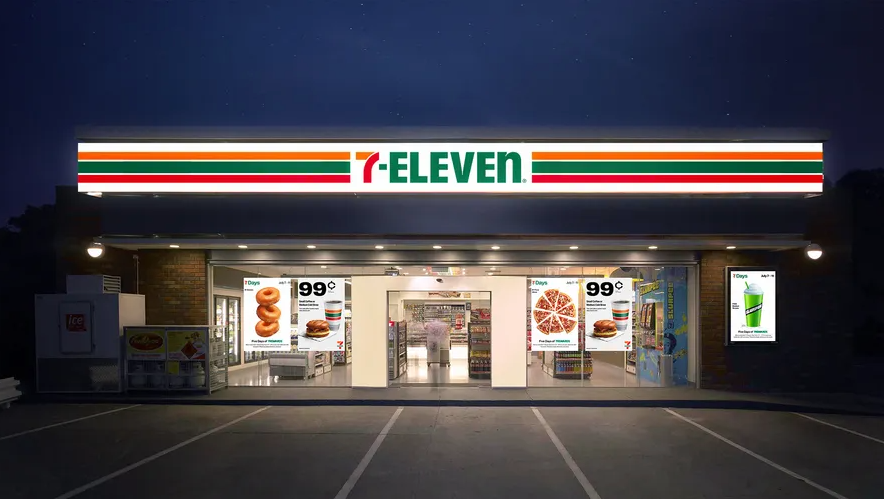
Looking to buy a 7-Eleven NNN property? 160 are observed for sale across 29 states, median asking cap rate 5.25%. View 7-Eleven NNN properties for sale, cap rate bands and the 1031 buyer guide.
Creditworthiness & Financial Strength
7-Eleven stands as a formidable player in the convenience store sector with strong financial backing from its parent company, Seven & i Holdings Co., Ltd. S&P rates 7-Eleven, Inc. A- and Moody’s rates it Baa2, both investment grade. Its parent, Seven & i Holdings Co., Ltd. is rated A- by S&P and A3 by Moody’s (Seven & i investor relations, ratings as of June 30, 2026). Seven & i does not generally guarantee 7-Eleven, Inc. store leases, so the parent rating is context rather than lease security unless a lease names it.
Ratings verified October 4, 2026. 7-Eleven, Inc.: S&P A-, Moody’s Baa2. Parent Seven & i Holdings: S&P A-, Moody’s A3. Source: Seven & i Holdings investor relations (Bonds and Ratings, as of June 30, 2026). Under 7-Eleven’s franchise model the company generally controls the store real estate and licenses it to franchisees, so 7-Eleven, Inc. is usually the tenant even at franchised stores; confirm the tenant entity named in each lease.
As a wholly owned subsidiary, 7-Eleven benefits from the substantial resources of Seven & i Holdings, which has demonstrated commitment to the brand’s growth through significant investments. The company’s financial strength is evident in its ability to undertake major acquisitions, such as the $1 billion purchase of 204 Stripes convenience stores from Sunoco in 2024, and its previous acquisition of 3,800 Speedway stores in 2021. These strategic moves have further solidified 7-Eleven’s market position and expanded its revenue streams.
• Credit Ratings: S&P: A- (7-Eleven), Moody’s: Baa2 (7-Eleven); Parent company Seven & i Holdings: S&P A-, Moody’s A3 (as of June 30, 2026) • Corporate Structure: Wholly owned subsidiary of Seven & i Holdings Co., Ltd., listed on the Tokyo Stock Exchange • Financial Backing: Parent support, but no general parent guarantee of store leases • Acquisition Power: Demonstrated ability to execute billion-dollar acquisitions
Lease Terms & Structure
7-Eleven typically operates under triple net (NNN) lease structures, which place the responsibility for property taxes, insurance, and maintenance on the tenant. This arrangement creates a stable, low-management investment opportunity for landlords. Primary lease terms are most often 15 years in the 7-Eleven listings we track, with some at 10 or 20 years.
Among 7-Eleven listings that disclose a rent schedule, 10% increases every five years are the most common, though some leases have smaller increases, such as 7.5% every five years. This structured growth in rental income helps investors hedge against inflation while ensuring steady revenue increases throughout the lease term.
• Lease Type: Triple Net (NNN) • Typical Lease Term: Most often 15 years • Rent Escalations: Most often 10% every 5 years; some lower
Store Footprint & Growth Trajectory
7-Eleven is part of one of the world’s largest convenience store networks through Seven & i Holdings. In North America, 7-Eleven, Inc. had 12,712 stores at the end of 2025, including the Speedway stores acquired in 2021. Seven & i’s fiscal 2026 forecast calls for about 205 openings and 645 closures, including conversions of stores to wholesale fuel sites, which would leave about 12,270 stores.
7-Eleven is opening larger, food-focused stores while also closing underperforming locations, so check a store’s format and performance before buying. In the listings we track, the middle half of 7-Eleven buildings are about 2,600 to 4,800 square feet (median about 3,100), and lot sizes vary between gas and non-gas locations.
• North American Locations: About 12,700 at the end of 2025; Seven & i forecasts about 12,270 by the end of fiscal 2026 after openings, closures and wholesale fuel conversions • Growth Strategy: Food-focused new stores alongside closures of underperforming locations • Typical Building Size: About 2,600-4,800 SF (middle half of tracked listings)
Ownership and Franchise Structure
7-Eleven operates under a mixed ownership model that includes both company-owned and franchised locations. The company is wholly owned by Seven & i Holdings Co., Ltd., a Japanese retail conglomerate that provides strong corporate backing. In the United States, 7-Eleven runs a mix of franchised and company-operated stores.
The franchise system allows 7-Eleven to expand rapidly while maintaining brand consistency through standardized operations. Franchisees benefit from the company’s established supply chain, proprietary products, and brand recognition, and because 7-Eleven generally controls the store real estate and licenses it to franchisees, 7-Eleven, Inc. is usually the tenant on the lease. Rent therefore does not normally depend on an individual franchisee, but confirm the tenant entity named in each lease.
• Corporate Ownership: Seven & i Holdings Co., Ltd. (Japanese retail conglomerate) • Operating Model: Mix of company-owned and franchised locations • Lease Security: 7-Eleven, Inc. is usually the tenant; confirm per lease
Cap Rates & Market Pricing
Live asking cap rates for 7-Eleven and comparable tenants:
| Tenant | S&P / Moody’s | Median asking cap rate | Middle half of listings | Listings | Median vs. 10-year Treasury |
|---|---|---|---|---|---|
| 7-Eleven | A- / Baa2 | 5.25% | 5.00% to 5.74% | 155 | +1 bps |
| Dollar General | BBB / Baa3 | 7.00% | 6.65% to 7.95% | 572 | +176 bps |
Active listings InvestmentGrade.com tracks with a published asking cap rate, as of October 7, 2026. Asking cap rates are not closed-sale cap rates. The middle half is the range from the 25th to the 75th percentile of listings. The 10-year Treasury yield is 5.24% as of October 1, 2026 (FRED series DGS10). Ratings are corporate issuer ratings. Where the rated entity is a parent company, confirm whether it signs or guarantees the lease; franchisors usually do not guarantee franchisee leases. n/a means no verified rating is on file.
7-Eleven properties are priced mainly on the lease guarantor’s credit, the remaining lease term and the real estate; many listings we track describe corner or outparcel sites.
Cap rates vary based on lease term length, with shorter remaining terms generally commanding higher cap rates.
7-Eleven asking cap rates are in line with other major convenience store brands in our data: similar to Circle K and Speedway, slightly above Wawa, and below some regional operators such as Maverik and QuikTrip.
Financial Performance & Outlook
7-Eleven’s recent results have been mixed. Seven & i is closing underperforming North American stores and in April 2026 pushed the earliest timing for an IPO of its North American business to fiscal 2027, while investing in food-focused stores.
Looking forward, Seven & i forecasts about 205 openings and 645 closures for 7-Eleven in North America in fiscal 2026, with the closures including conversions to wholesale fuel sites, and targets about 1,300 new North American stores by 2030, with an emphasis on larger, food-focused formats.
The company’s focus on food-forward offerings represents a significant part of its growth strategy. 7-Eleven is investing in restaurants such as Laredo Taco Company and Raise the Roost Chicken and Biscuits, as well as expanding its proprietary food and beverage offerings including grab-and-go hot cases, self-serve roller grills, specialty beverages, and in-store bakery items.
• Recent Developments: Earliest timing for a North American IPO moved to fiscal 2027; about 645 closures, including wholesale fuel conversions, forecast for fiscal 2026 • Strategic Focus: Food-forward offerings and proprietary products • Growth Initiatives: About 1,300 new North American stores targeted by 2030 • Value Proposition: Value-oriented food and beverage offers
Location/Real Estate Considerations
7-Eleven demonstrates sophisticated site selection criteria that prioritize high-visibility, high-traffic locations. The company typically seeks corner locations or shopping center outparcels with excellent access and visibility. 7-Eleven sites in the listings we track are commonly about 0.6 to 1.8 acres (middle half), and many listings describe corner or outparcel locations.
The company has also developed non-gas convenience store concepts that can fit into smaller retail spaces, including strip centers and retail condos. These smaller format stores occupy smaller buildings than gas-station stores, allowing the company to enter high-barrier-to-entry markets where larger parcels may not be available.
7-Eleven’s real estate strategy emphasizes locations that maximize convenience for customers, often selecting sites near residential areas, office complexes, or along major commuter routes. This strategic positioning contributes significantly to the underlying real estate value, making these properties attractive not only for their tenant but also for their inherent location value.
• Preferred Locations: Corner sites with high visibility and access • Typical Lot Size: About 0.6-1.8 acres (middle half of tracked listings); smaller for non-gas concepts • Format Flexibility: Gas-station stores and smaller non-gas formats • Strategic Positioning: Near residential areas, office complexes, or major commuter routes
Pros and Cons for Investors
Pros:
7-Eleven properties offer numerous advantages for net lease investors. Because 7-Eleven, Inc., an investment grade credit, is usually the tenant, rental income is well supported. The essential retail nature of convenience stores ensures consistent customer traffic regardless of economic conditions, while the typical corner locations with high visibility contribute to strong underlying real estate value.
For fee-simple ownership structures, investors can benefit from accelerated depreciation, enhancing the after-tax returns. Long primary terms (most often 15 years) with scheduled rent increases provide predictable income growth and some inflation protection. Additionally, 7-Eleven’s continued expansion plans and focus on enhancing store offerings suggest a commitment to maintaining and growing their physical retail presence.
Cons:
Despite the many advantages, investors should consider several potential drawbacks. Properties with gas stations may face environmental concerns related to underground storage tanks and potential contamination issues. Ground leases, which are uncommon among the 7-Eleven listings we track, do not allow building depreciation, potentially reducing after-tax returns for some investors.
7-Eleven, Inc. does not file its own public financial statements, so disclosure comes mainly through its parent, Seven & i Holdings. Additionally, the premium pricing of 7-Eleven properties (reflected in lower cap rates) may limit initial cash-on-cash returns compared to other net lease opportunities with higher cap rates but potentially more risk.
• Pros:
- Strong credit and brand recognition
- 7-Eleven, Inc. is usually the tenant, even at franchised stores
- Essential retail status ensures consistent traffic
- Prime corner locations with strong real estate fundamentals
- Long lease terms with regular rent escalations
- Accelerated depreciation available with fee simple ownership
• Cons:
- Environmental concerns with gas station locations
- Ground leases do not allow for depreciation benefits
- Limited standalone disclosure (reports through Seven & i)
- Premium pricing (lower cap rates) may limit initial returns
- Potential market saturation in some areas
Comparable Tenants / Sector Benchmarking
Within the convenience store sector, 7-Eleven stands as a premium tenant compared to most competitors. Its credit rating (S&P: A-) is stronger than that of many competitors in the space. In the listings we track, 7-Eleven and Circle K have the same median asking cap rate (about 5.25%), while Wawa asks somewhat less (about 5.0%).
The convenience store sector as a whole has demonstrated resilience during economic downturns due to its essential retail status. Within this sector, 7-Eleven’s extensive network, investment grade credit, and strategic focus on food offerings position it favorably against competitors like Casey’s, Wawa, and Sheetz, though each has its regional strengths and particular investment merits.
• Direct Competitors: Circle K, Wawa, Sheetz, Casey’s • Comparative Cap Rates: Similar to Circle K and Speedway; slightly above Wawa (median asking, tracked listings) • Credit Comparison: Stronger credit profile than most convenience store competitors • Sector Position: Premium tenant within convenience store category • Essential Retail Comparison: Similar investment profile to dollar stores (Dollar General, Dollar Tree) but with different demographic targeting
7-Eleven NNN Investment: Frequently Asked Questions
What is 7-Eleven’s credit rating?
7-Eleven, Inc., usually the tenant on 7-Eleven leases, is rated A- by S&P and Baa2 by Moody’s. Its Japanese parent, Seven & i Holdings, is rated A- by S&P and A3 by Moody’s (as of June 30, 2026), but it does not generally guarantee store leases.
What cap rates do 7-Eleven NNN properties trade at?
Active 7-Eleven listings tracked by InvestmentGrade.com have a median asking cap rate of 5.25% across 160 listings, as of October 5, 2026. Locations with long remaining terms and strong traffic generally ask lower cap rates.
What makes 7-Eleven a strong long-term NNN tenant?
Roughly 12,000 to 13,000 North American stores, daily-needs merchandise and fuel drive steady traffic, and 7-Eleven, Inc. is investment grade and is usually the tenant. Same-store sales have been under pressure and the company is closing underperforming stores, so location quality and remaining term matter.
When the buyer owns the building, a cost segregation study may reclassify part of the purchase price, such as site improvements and some building systems and equipment, into 5-, 7- or 15-year property. That property qualifies for 100% bonus depreciation if acquired after January 19, 2025. How much qualifies varies widely by property and must be supported by an engineering-based study. On a ground lease the investor owns only land, which cannot be depreciated, and equipment owned by the tenant is not the landlord’s to depreciate. Bonus depreciation is generally recaptured on a taxable sale unless the gain is deferred, for example through a 1031 exchange. Consult a tax professional. Some gas station and convenience store buildings can qualify as 15-year property, and therefore for bonus depreciation, if they meet IRS tests, such as at least half of gross revenue from fuel sales, at least half of floor space devoted to fuel sales, or a building of 1,400 square feet or less; confirming this requires the operator’s sales data. Fuel tanks, dispensers and canopies are often owned by the operator or fuel supplier rather than the landlord. See the Gas Station and C-Store NNN Depreciation Guide.
7-Eleven Net Lease Property: Buying, Selling and Financing
Buying: We find on-market and off-market 7-Eleven properties, review the lease and the tenant’s credit, and compare pricing with current listings. On the majority of transactions, there is no separate fee to you as the buyer; the listing broker pays a cooperating commission.
Selling: We can prepare an opinion of value from current listings and recent sales and, when it fits your goals, run a confidential sale to private investors, family offices and institutional buyers. See our guide to off-market sales.
Financing: Investment Grade Capital, a service of Investment Grade LLC, matches buyers and owners with lenders for acquisitions and refinancing.
1031 exchanges: Tell us your identification and closing deadlines so we can plan the search around them.
Request an NNN investment consultation or email team@investmentgrade.com.
7-Eleven NNN Properties Observed For Sale
160 active 7-Eleven net lease listings observed across public listing sources, most recently Oct 5, 2026. Asking figures as published by the listing party.
| Location | Asking Price | Cap Rate | Building SF | Term Left | |
|---|---|---|---|---|---|
| Kirkersville, OH | $11,595,479 | 5.00% | 5,372 | n/a | View listing |
| Reno, NV | $11,000,000 | 6.00% | 13,340 | n/a | View listing |
| Lytle, TX | $8,719,999 | 5.00% | 4,650 | n/a | View listing |
| Fort Worth, TX | $3,800,000 | 5.00% | 3,870 | n/a | View listing |
| Buffalo, NY | $2,413,208 | 6.00% | 10,166 | n/a | View listing |
| Mesquite, TX | $1,584,000 | 6.00% | 2,661 | n/a | View listing |
| Newport News, VA | $600,000 | 7.00% | 2,436 | n/a | View listing |
| Concord, NH | $2,400,000 | 5.50% | 2,940 | 4.9 yrs | View listing |
Search all 160 observed 7-Eleven listings and the full NNN inventory
Market observations aggregated from listing broker materials; not offerings by Investment Grade Income Property, LP. Buyer representation available on a cooperating commission basis. Information deemed reliable but not guaranteed.
