
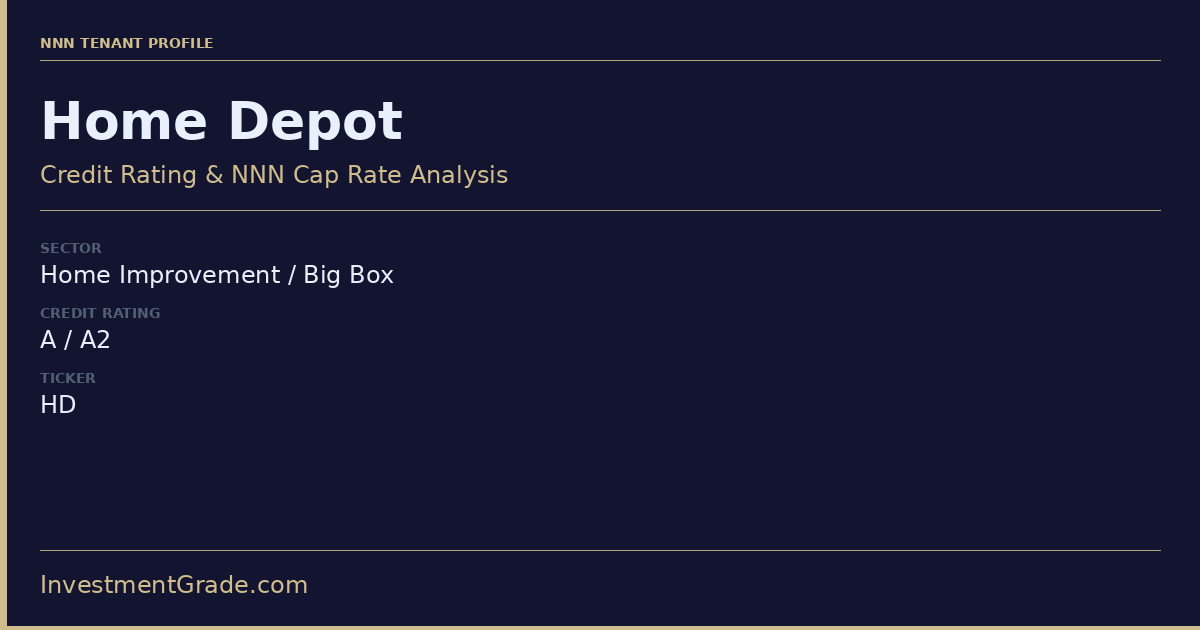
| Parent Company | The Home Depot, Inc. |
| S&P/Moody’s Rating | A / A2 |
| Sector | Retail ‑ Home Improvement / Big Box |
| US Locations | 2,000 |
| Cap Rate Range | 4.25–5.25% |
| Typical Lease Term | 20 years |
| Guarantee Type | Corporate |
| Stock Ticker | HD (NYSE) |
| Annual Revenue | $159.5B (FY2025) |
| Typical Price Range | $15M–$35M |
Bond vs NNN Comparison: See how Home Depot corporate bond yields compare to Home Depot NNN cap rates, with after tax math, depreciation impact, and 1031 exchange treatment. Home Depot Bonds vs NNN →
Home Depot Business Overview & NNN Investment Profile
Home Depot stands as the world’s leading home improvement retailer, operating approximately 2,000 U.S. locations with a dominant market position in do-it-yourself (DIY) and professional contractor (Pro) segments. As a leader in the investment grade NNN big-box retail sector, Home Depot represents an exceptional institutional-quality allocation for NNN investors seeking exposure to a resilient, market-leading retailer with strong credit ratings, exceptional brand recognition, and substantial financial resources. The company completed the strategic $18.25B acquisition of SRS Distribution, significantly enhancing Pro segment capabilities and positioning Home Depot for sustained growth across both DIY and professional channels.
Home Depot’s business model capitalizes on residential home improvement, repair, and maintenance demand driven by demographic trends (aging housing stock, new home formation), economic activity, and consumer discretionary spending patterns. The company operates very large-format locations (approximately 100,000-130,000 square feet) on ground leases, with properties typically comprising 10-15 acres. These distinctive properties require specialized NNN lease structures reflecting tenant’s capital intensity and operational complexity. For long-term NNN investors, Home Depot offers NNN lease structures with 20-year terms, A-rated corporate guarantees, and ground lease characteristics providing inflation protection through fixed escalations.
Home Depot’s FY2025 results demonstrate operational strength and SRS integration momentum. The company’s A/A2 credit ratings, substantial cash generation, and market leadership create differentiated risk-adjusted returns for NNN investors. The company’s proven resilience through housing market cycles and demonstrated pricing power support confident long-term lease renewals and credit stability.
Home Depot Credit Rating Analysis
Home Depot holds an S&P rating of A with Stable outlook and Moody’s rating of A2, also Stable. These ratings place the company in the upper investment-grade tier, reflecting strong market position, proven operational execution, and excellent financial management. The A/A2 ratings indicate very strong capacity to meet financial commitments with minimal vulnerability to adverse economic conditions, supported by a diversified customer base and essential nature of home improvement products and services.
Rating strengths include Home Depot’s market leadership (approximately 10% of home improvement retail market), dominant brand, diversified customer base (DIY, Pro, builders, contractors), strong cash generation supporting shareholder returns and debt service, and demonstrated resilience through housing cycles. The SRS Distribution acquisition ($18.25B) expands Pro segment scale and creates competitive advantages in supply chain, product assortment, and customer relationships. Home Depot’s capital-light lease model (vs. ownership) provides operational flexibility and financial leverage.
Investment-Grade Profile: Home Depot’s A/A2 ratings rank among the highest-quality investment-grade NNN tenants in the retail sector. The company’s market leadership, Pro segment expansion, and proven credit stability support confident long-term lease renewals and credit outlook maintenance.
Rating risks include potential housing market downturn impacting DIY and new construction activity, labor cost inflation affecting both Home Depot operations and contractor/builder customer profitability, competitive intensity from e-commerce (Amazon) and specialty retailers, and integration execution on SRS Distribution acquisition. However, Home Depot’s market dominance, customer switching costs (loyalty programs, contractor relationships), and essential nature of home improvement products provide downside protection through economic cycles.
Home Depot NNN Lease Structure
Home Depot NNN ground leases typically feature 20-year initial terms with multiple 5-10 year renewal options, providing investors with two+ decades of lease income visibility. The company provides corporate guarantees, eliminating franchisee credit concerns. Annual rent escalations typically include modest fixed increases and periodic bumps tied to renewal periods, creating predictable rent growth aligned with inflation expectations. Properties are structured as triple-net leases with Home Depot bearing property taxes, insurance, and common area maintenance (CAM).
Home Depot ground lease properties are characterized by very large format (100,000-130,000 sq ft) on substantial land parcels (10-15 acres), reflecting the company’s operational model emphasizing extensive SKU assortment, outdoor garden centers, delivery/logistics operations, and ample parking. These distinctive properties require investor confidence in the tenant’s long-term operational viability and commitment to the location. Home Depot’s continuous store remodels and technology investments (digital integration, curbside pickup) ensure locations remain competitive and productive.
Lease terms often include renewal options at fair market value or with predetermined escalation caps. Home Depot’s practice of maintaining stores for 15-20+ years and continuously investing in facilities demonstrates long-term commitment, supporting lease renewal probability. The company’s scale and operational expertise mean efficient maintenance and capital improvement execution, reducing landlord operational burden.
Home Depot NNN Cap Rate & Pricing Trends
Home Depot NNN properties currently trade at cap rates between 4.25% and 5.25%, reflecting the company’s A/A2 credit rating, 20-year lease terms, and premium real estate quality. These relatively tight cap rates reflect institutional investor demand for market-leading, recession-resistant retailers with excellent credit. Pricing for individual properties typically ranges from $15 million to $35 million, reflecting the large footprint, valuable real estate, and long-term lease income.
The Home Depot NNN market has remained robust as institutional capital (pension funds, insurance companies, REITs) views the company as a core holding in home improvement sector. The investment-grade NNN market values Home Depot’s market dominance and operational excellence highly. Recent trading activity suggests cap rate stability as Treasury yields have moderated and SRS integration demonstrates execution capability. Premium location properties have commanded tighter cap rates reflecting land value and brand productivity.
Mortgage lender appetite remains strong for Home Depot collateral given the company’s A-rated credit and ground lease characteristics providing inflation protection. Institutional investor interest in large-format ground leases remains elevated as alternative to shopping center investments. Secondary market liquidity has improved as ESG and sustainability focus draws additional capital to market-leading retailers.
Home Depot Real Estate Footprint
Home Depot’s 2,000 U.S. locations span all 50 states with particularly strong density in metropolitan and suburban markets. The company’s real estate strategy emphasizes visibility, accessibility, and high-traffic locations supporting strong customer frequency and basket sizes. Most locations feature outdoor garden centers and lumber yards, requiring ample land. The very large-format model creates distinctive properties with limited alternative use cases, emphasizing tenant quality and long-term viability.
Home Depot locations are typically anchors driving significant traffic to shopping centers and are often pad sites with independent access. The company’s distribution centers and logistics operations (increasingly important post-SRS acquisition) influence site selection and create operational complexity supporting long-term tenant commitment.
Home Depot Growth & Expansion Outlook
Home Depot’s expansion strategy emphasizes store productivity optimization and omnichannel integration rather than aggressive new-unit growth. The company added approximately 2,000+ locations through organic growth and maintains disciplined capital allocation balancing shareholder returns with operational reinvestment. The SRS Distribution acquisition significantly expands Pro segment scale and creates opportunities for cross-selling and supply chain optimization.
Strategic initiatives include digital/omnichannel enhancement (buy online pick-up in store, delivery, curbside), Pro customer focus and relationship development, and supply chain modernization. Home Depot’s capital allocation prioritizes returning cash to shareholders while maintaining investment in facilities modernization and technology. The company’s long-term objective balances growth with financial discipline and shareholder value creation.
Home Depot NNN Investment: Pros & Cons
| Pros | Cons |
|---|---|
| A/A2 very strong investment-grade ratings with Stable outlook | Large format concentration limits buyer pool if tenant exits |
| Market leader with dominant position; essential home improvement products | Housing market sensitivity; discretionary spending exposure |
| 20-year lease terms provide exceptional cash flow visibility | E-commerce disruption from Amazon and specialty online retailers |
| SRS Distribution integration expands Pro segment and creates competitive advantages | Labor cost inflation affecting both tenant and contractor customers |
| Very large footprint (10-15 acres) provides inflation-protected ground lease characteristics | Integration execution risk on $18.25B SRS acquisition |
Comparable NNN Tenants
| Tenant | Rating | Cap Rate Range |
|---|---|---|
| Lowe’s | BBB+ / Baa1 | 4.5–5.5% |
| Walmart | AA / Aa2 | 4.0–5.0% |
| Target | A / A2 | 4.25–5.25% |
| Costco | A+ / A1 | 3.5–4.5% |
Frequently Asked Questions
What is the typical Home Depot NNN lease term?
Home Depot NNN ground leases typically feature 20-year initial terms with multiple 5-10 year renewal options, providing investors with two+ decades of lease income visibility. The company provides corporate guarantees on all locations.
Is Home Depot an investment-grade NNN tenant?
Yes, Home Depot holds an S&P rating of A with Stable outlook and Moody’s rating of A2 with Stable outlook, qualifying it as a very strong investment-grade NNN tenant. The company’s market leadership and operational excellence support confident long-term lease renewals.
What cap rates are typical for Home Depot NNN properties?
Home Depot NNN properties currently trade at cap rates between 4.25% and 5.25%, reflecting the company’s A/A2 credit rating and 20-year lease terms. Individual property cap rates vary based on location, land value, and lease structure.
How many Home Depot stores are there, and what is typical pricing?
Home Depot operates approximately 2,000 U.S. locations on large-format ground leases. Typical properties range from $15 million to $35 million depending on location, land value, and lease terms. The company added 2,000+ locations through organic growth and completed the strategic $18.25B SRS Distribution acquisition.
The Only Home Depot NNN Advisor Whose Fee Comes From the Deal, Not From You
In NNN buyer representation, the listing broker pays the cooperating commission. That means you get a dedicated Home Depot NNN advisor handling sourcing, underwriting, financing, and closing — and on the majority of transactions, there is no separate fee to you as the buyer.
Here’s what that buys you:
Find It — On-market and off-market Home Depot NNN properties sourced and underwritten on your behalf. We know which markets are pricing correctly, which listings are overpriced for what the lease actually says, and where the spread is worth the move.
Fund It — Acquisition financing through 150+ lender relationships: life companies, CMBS, regional banks, and credit unions that know Home Depot-grade paper. Not the first approval that comes back. The best terms on the table for this specific credit and lease structure.
Exit It — Selling a Home Depot asset or repositioning through a 1031? Our Capital Markets desk runs a quiet, targeted process. Private investors, family offices, and institutional buyers who are actively acquiring Home Depot net lease — not a public blast that signals desperation to the market.
Not committed to Home Depot? Tell us your criteria — cap rate floor, credit tier, lease structure, geography, equity check size — and we’ll find the deal that fits. We represent investors across the full NNN credit spectrum, from QSR and pharmacy to industrial, medical, and big box retail. The tenant is a variable. Your criteria is the constant.
Get Your Free Home Depot NNN Consultation →
In a 1031 exchange with a deadline? Tell us your timeline — we move faster.
Related NNN Tenants
- Barnes & Noble
- Bed Bath & Beyond
- Best Buy
- Big Lots
- BJ’s Wholesale Club
- Burlington
- Costco
- Dick’s Sporting Goods
- Dillard’s
- DSW
- Dunham’s Sports
- Five Below
- Floor & Decor
- Harbor Freight
- JCPenney
- Joann Fabric & Crafts
- Kirkland’s
- Kohl’s
- Lifetime Fitness
- Lowe’s
- Macy’s
- Michaels
- Nordstrom
- Office Depot / OfficeMax
- Old Navy / Gap
- Party City
- Petco
- PetSmart
- Planet Fitness
- Ross Dress For Less
- Staples
- The Container Store
- TJ Maxx / HomeGoods / Marshalls
- Tractor Supply Co.
- Ulta Beauty
- Ollie’s Bargain Outlet
- Target
- Walmart
- Sam’s Club
Own a Home Depot Property? Capital Markets Strategies Beyond Selling
Maturing debt and considering refinancing? Our capital markets team maintains 150+ lender relationships underwriting NNN properties across investment-grade and non-investment-grade credit tiers. We structure rate-and-term refinancing, cash-out refis, and bridge-to-perm takeouts.
Evaluating a 1031 exchange or disposition? We represent both sides of Home Depot NNN transactions — whether you are looking to exit at peak value, exchange into a higher-quality credit tenant, or reposition within the same sector.
Need a current valuation? We maintain live comps on Home Depot NNN transactions and can produce a Broker Opinion of Value within 48 hours reflecting today’s cap rate market.
Own multiple Home Depot properties? Considering an off-market sale?
Investment Grade represents owners on confidential disposition of Home Depot portfolios and individual properties through off-market direct-to-principal distribution to specialty REITs, private equity funds, and family offices. Home Depot buyer demand runs deep, and portfolio sales consistently produce stronger pricing than sequential individual sales because the institutional buyer pool is structured around portfolio acquisition.
For multi-property owners considering a portfolio disposition, see Selling Investment Grade NNN Off-Market: Tenant-by-Tenant Buyer Demand. For the full off-market framework covering individual property dispositions, sale-leasebacks, and 1031 coordination, see Off-Market CRE Sales: The Complete 2026 Guide.
The pre-listing conversation is at no cost and fully confidential. Email team@investmentgrade.com or see contact Investment Grade.
