
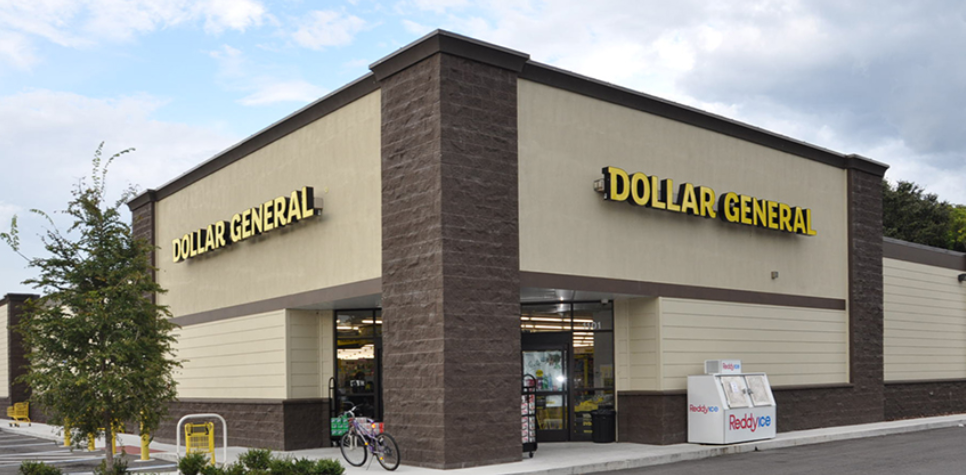
Dollar General is the most frequently listed tenant in the net lease listings InvestmentGrade.com tracks, and it is rated investment grade: BBB (Stable) by S&P and Baa3 (Stable) by Moody’s. This page covers the company’s current operating results from its SEC filings, its credit, typical lease terms, live asking cap rates, and the risks investors should underwrite. For the full tenant profile, see the Dollar General credit rating and cap rate page, and for the rating scale, the investment grade guide.
Dollar General Today
| Measure | Figure |
|---|---|
| Stores | 21,148 in 48 U.S. states and Mexico (July 31, 2026) |
| Second quarter 2026 net sales | $11.29 billion, up 5.2% |
| Second quarter 2026 same-store sales | Up 3.5% (customer traffic up 2.0%, average transaction up 1.5%) |
| First half 2026 net sales | $22.08 billion, up 4.3%; same-store sales up 2.7% |
| 2026 real estate plan | About 450 new U.S. stores and about 10 in Mexico, about 2,000 Project Renovate and 2,250 Project Elevate remodels, and about 20 relocations (4,730 projects) |
| Credit ratings | Moody’s Baa3 (stable); S&P BBB (stable) |
Source: Dollar General Form 10-Q for the quarter ended July 31, 2026, filed August 27, 2026. Dollar General opened its first stores in Mexico in 2023.
Dollar General’s sales are weighted toward consumables such as food, paper, and cleaning products, which supports steady traffic but carries lower margins. Profitability fell sharply in 2023 as shrink, labor, and markdown costs rose; the company responded with a “Back to Basics” operating plan and, more recently, large remodel programs.
Credit
Dollar General Corporation is rated BBB (Stable) by S&P and Baa3 (Stable) by Moody’s, the lowest investment grade notch at Moody’s after a 2025 downgrade from Baa2. Both outlooks are stable according to the company’s August 2026 quarterly report. Investment grade status supports buyer and lender demand, but a Baa3 rating leaves little room before speculative grade, so monitor results and rating actions. Leases are typically signed by a Dollar General operating subsidiary; confirm in each lease whether Dollar General Corporation guarantees it.
Dollar Tree is a separate company. It sold Family Dollar in July 2025, so Family Dollar is now separately owned and is not backed by Dollar Tree except for limited guarantees Dollar Tree reported on certain Family Dollar store leases.
Typical Lease Structure
Many Dollar General properties are newly built, single-story stores on small lots, leased on long-term, often absolute net terms in which the tenant handles taxes, insurance, and maintenance including roof and structure. Initial terms of about 15 years with several five-year renewal options are common, often with rent increases at each option rather than during the base term. Terms vary, so read each lease: some older or smaller-format stores have shorter terms or landlord responsibilities.
Asking Cap Rates
Current asking cap rates on Dollar General listings InvestmentGrade.com tracks:
| Tenant | S&P / Moody’s | Median asking cap rate | Middle half of listings | Listings | Median vs. 10-year Treasury |
|---|---|---|---|---|---|
| Dollar General | BBB / Baa3 | 7.00% | 6.60% to 7.76% | 520 | +176 bps |
| Dollar Tree | BBB / n/a | 7.34% | 6.76% to 8.00% | 82 | +210 bps |
| Family Dollar | B / n/a | 8.50% | 8.00% to 9.00% | 177 | +326 bps |
Active listings InvestmentGrade.com tracks with an asking cap rate (stated in the listing, or computed from its stated income and price when no rate is stated), listings last observed October 19, 2026. Asking cap rates are not closed-sale cap rates. The middle half is the range from the 25th to the 75th percentile of listings. The 10-year Treasury yield is 5.24% as of October 1, 2026 (FRED series DGS10). Ratings are the agency ratings in our ratings database for the entity shown, which may be a parent company; the rating type (for example issuer, senior unsecured debt, long-term debt or revenue bond ratings) varies by company and is shown on each tenant page. A rating applies to a lease only if the rated entity signs or guarantees it, so confirm the tenant and any guarantor in the lease. n/a means no verified rating is on file.
Within Dollar General, pricing varies mainly with remaining lease term, rent increases, location, store format, and building age. Flat base-term rent means the landlord’s income does not grow until an option period, which buyers price in.
Compared with Dollar General’s bond market rating category
| Tenant | S&P / Moody’s | Index yield (category) | Median asking cap rate (listings with a cap rate) | Spread |
|---|---|---|---|---|
| Dollar Tree Bonds vs. NNN analysis | BBB / n/a | 6.19% (BBB) | 7.34% (82) | +115 bps |
| Dollar General Bonds vs. NNN analysis | BBB / Baa3 | 6.19% (BBB) | 7.00% (520) | +81 bps |
Showing 2 tenants. Index yield is the ICE BofA effective yield index for the tenant’s rating category (US Corporate AAA, AA, A or BBB index; US High Yield BB, single-B or CCC and lower index), using the S&P rating, or the Moody’s equivalent where S&P does not rate, from the Federal Reserve Bank of St. Louis (FRED), as of October 1, 2026. It is an index average, not a quote on the company’s own bonds. Median asking cap rate is the median of asking cap rates (stated, or computed from stated income and price when no rate is stated) on active listings InvestmentGrade.com tracks, listings last observed October 19, 2026; asking cap rates are not closed-sale cap rates. Spread is the median asking cap rate minus the index yield. Ratings are the agency ratings in our ratings database for the entity shown; the rating type (for example issuer, senior unsecured debt, long-term debt or revenue bond ratings) varies by company. The entity that signs or guarantees a given lease can differ, so confirm the lease obligor. Shaded rows are below investment grade. NR means the agency does not rate the entity; n/a means no verified rating is on file.
Risks to Underwrite
- Credit trajectory. A further downgrade would move Dollar General below investment grade at Moody’s.
- Store performance. The company closes stores each quarter, including 33 in the second quarter of 2026. Rent relative to likely store sales and the strength of the trade area matter.
- Re-leasing. Many stores are in small towns with limited replacement tenants if Dollar General leaves.
- Flat rent. Base terms often have no increases, which reduces protection against inflation.
- Competition. Dollar Tree, Walmart, grocery chains, and online retailers compete for the same customers.
Buying or Selling a Dollar General Property?
We can price a specific store against current listings, review the lease and guaranty, and source on-market and off-market options, including for 1031 exchanges. On the majority of transactions, there is no separate fee to you as the buyer for representation; the listing broker pays a cooperating commission.
Frequently Asked Questions
What is Dollar General’s credit rating?
Dollar General Corporation is rated BBB (Stable) by S&P and Baa3 (Stable) by Moody’s, both investment grade. Ratings on this page update from our ratings database.
What is the typical Dollar General NNN cap rate?
As of today, the median asking cap rate on Dollar General listings InvestmentGrade.com tracks is 7.00% across 520 listings. Asking cap rates are not closing cap rates.
Why are there so many Dollar General properties for sale?
Dollar General has more than 21,000 stores and opens hundreds each year, many built by developers and sold to investors once the lease starts, which keeps a steady supply of properties on the market.
Is Family Dollar part of Dollar Tree?
No longer. Dollar Tree sold Family Dollar in July 2025. Dollar Tree reported continuing to guarantee lease obligations for certain Family Dollar stores for a limited period; check each lease.
What are the main risks of a Dollar General property?
A further credit downgrade, store closures at underperforming sites, limited re-leasing options in small towns, flat base-term rent, and competition.
Educational content only. InvestmentGrade.com is a commercial real estate brokerage and educational publisher. We do not sell, broker, underwrite, or solicit any bonds, securities, or investment products. Yields, ratings, and prices referenced fluctuate continuously and are sourced from public market data as of the date noted. Nothing on this page constitutes investment advice, an offer to sell, or a solicitation to buy any security. Consult a licensed broker-dealer, registered investment advisor, or tax professional before making any investment decision. For SEC investor education, visit investor.gov.
