
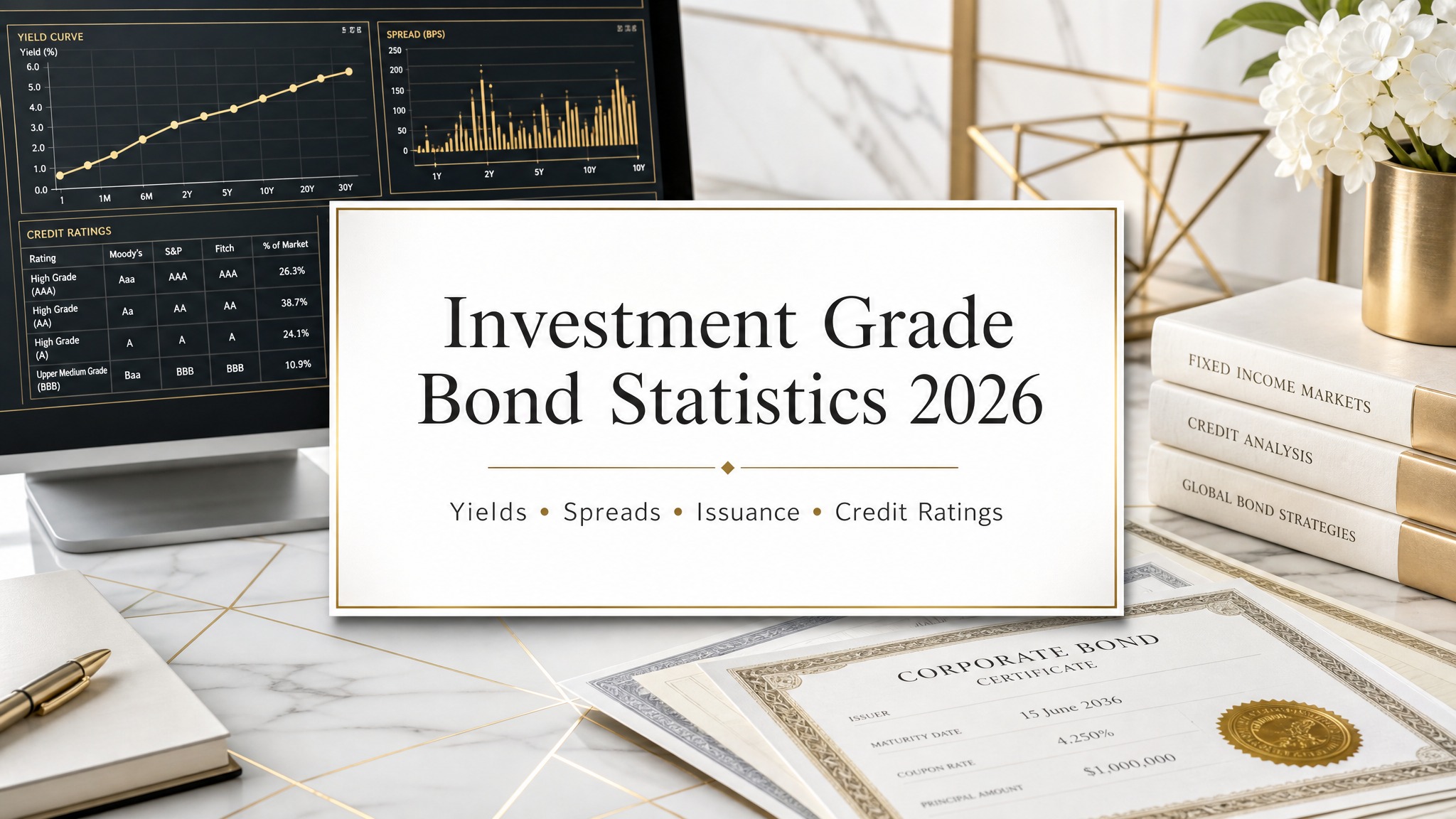
The U.S. investment grade corporate bond market entered the second quarter of 2026 with option-adjusted spreads at 77 basis points over Treasuries (ICE BofA US Corporate Index, May 12, 2026, via FRED), a level not seen on a sustained basis since the pre-financial-crisis era. With an index effective yield of 5.22% and net lease commercial real estate cap rates simultaneously holding at 6.80% on credit-comparable tenants (The Boulder Group Q1 2026 Net Lease Research Report), the bond-to-real-estate spread has emerged as one of the most striking pricing dislocations across institutional fixed income and commercial property markets. This report compiles current investment grade bond statistics across yield, spread, issuance, default, rating distribution, fund flow, and bond-versus-net-lease comparison categories, drawing from Federal Reserve Economic Data, the Securities Industry and Financial Markets Association, Moody’s Ratings, S&P Global Ratings, and InvestmentGrade.com proprietary analysis. Definitions of investment grade follow the standard agency convention of S&P BBB‑, Moody’s Baa3, Fitch BBB‑, or higher.
Last updated: May 14, 2026. Next scheduled refresh: Q3 2026.
Key Takeaways
- The ICE BofA U.S. Corporate Index option-adjusted spread closed at 77 basis points on May 12, 2026, well inside the 10-year average near 130 basis points and consistent with a credit market priced for benign default expectations (FRED series BAMLC0A0CM).
- The index effective yield stood at 5.22% as of the most recent ICE BofA observation, placing all-in IG corporate yields at levels last sustained in the mid-2000s (FRED series BAMLC0A0CMEY).
- Investment grade corporate issuance reached approximately $620 billion in Q1 2026 alone, contributing to the largest quarterly U.S. corporate bond issuance total since Q2 2020 (SIFMA Research Quarterly).
- Single tenant net lease cap rates averaged 6.80% in Q1 2026, with credit-equivalent BBB and A-rated bank tenants such as Wells Fargo and Chase trading in the 4.90% to 5.30% range on 15-year leases (The Boulder Group).
- The raw spread between the IG corporate index yield and BBB-tier net lease cap rates implies a 150 to 200 basis point premium for the real estate, before accounting for depreciation, 1031 exchange deferral, and long-term capital gains treatment of appreciation.
- The Moody’s-rated U.S. corporate Aaa club contracted in 2025 following the sovereign downgrade, with Microsoft, Johnson & Johnson, and Apple as the three U.S. corporate issuers at the top of Moody’s scale.
- The Moody’s-projected U.S. speculative-grade default rate was approximately 3.2% for calendar year 2025, rising above 4% by Q1 2026, while investment grade default rates remained near historical floor levels.
Table of Contents
- 2026 Investment Grade Bond Market at a Glance
- Yield Statistics by Rating Tier and Sector
- Credit Spread Statistics
- The Investment Grade Issuer Universe
- Maturity Profile and Duration
- Fund Flows and ETF Statistics
- New Issue and Refinancing Activity
- Credit Rating Distribution and Migration
- Investment Grade Bond Funds and Index Statistics
- The Bond vs Net Lease Real Estate Spread
- Sector Concentration and Performance
- Default Rates and Credit Loss Statistics
- Capital Flows and International Investment
- Frequently Asked Questions
- Methodology
- Sources
1. 2026 Investment Grade Bond Market at a Glance
The first five months of 2026 produced a sustained tightening of credit spreads, an expansion of new issue activity, and a continuation of the multi-year “up in quality” theme that has characterized institutional fixed-income allocation since the post-pandemic rate cycle began. Option-adjusted spreads on the broad ICE BofA U.S. Corporate Index compressed from approximately 95 basis points at year-end 2025 to 77 basis points by mid-May 2026, even as the 10-Year Treasury yield touched 4.48% in late Q1 amid renewed inflation concerns linked to energy markets and geopolitical conditions in the Middle East (The Boulder Group Q1 2026 Net Lease Research Report).
The combination produced an index all-in yield of 5.22%, which represents the marginal cost of capital for the highest-quality U.S. corporate borrowers and the marginal income offered to fixed-income investors seeking dollar-denominated investment grade bond exposure without credit downgrade or duration risk above approximately seven years.
| Metric | Value | As of | Source |
|---|---|---|---|
| IG Corporate Index Yield (YTW) | 5.22% | March 26, 2026 | ICE BofA via FRED (BAMLC0A0CMEY) |
| IG Corporate Index OAS | 77 bps | May 12, 2026 | ICE BofA via FRED (BAMLC0A0CM) |
| 10-Year Treasury Yield | ~4.45% | May 2026 | FRED (DGS10) |
| Q1 2026 U.S. Corporate Issuance | $775.2 B | Q1 2026 | SIFMA Research Quarterly |
| YoY Change in Corporate Issuance | +15.6% | Q1 2026 vs Q1 2025 | SIFMA |
| STNL Cap Rate (broad) | 6.80% | Q1 2026 | The Boulder Group |
| U.S. Corporate Aaa Issuers (Moody’s) | 3 (Microsoft, J&J, Apple) | May 2026 | Moody’s Ratings |
For context on what the data describes, see the InvestmentGrade.com investment grade guide for a comprehensive definitional and methodological treatment of the term across bonds, real estate, and capital markets.
2. Yield Statistics by Rating Tier and Sector
Yield to worst on the broad ICE BofA U.S. Corporate Index has spent most of 2026 in a narrow range between 5.0% and 5.4%. Within the index, dispersion across rating tiers has compressed alongside the overall OAS contraction, with BBB-rated paper trading inside levels that prevailed during much of 2024.
2.1 Yield by Rating Tier
| Rating Tier | S&P Range | Approx. Yield Range | Source |
|---|---|---|---|
| AAA | AAA | 4.55% to 4.85% | ICE BofA AAA US Corporate Index |
| AA | AA+ to AA‑ | 4.75% to 5.05% | ICE BofA AA US Corporate Index |
| A | A+ to A‑ | 4.95% to 5.25% | ICE BofA Single-A US Corporate Index |
| BBB | BBB+ to BBB‑ | 5.25% to 5.70% | ICE BofA BBB US Corporate Index |
| HY (reference) | BB+ and below | 7.10% to 7.80% | ICE BofA US High Yield Index |
For a comparative treatment of how yields and risk profiles diverge across the credit threshold, the investment grade versus high yield discussion provides a longer-form framework. The 25-year comparative analysis covers the same divide over a full credit cycle.
2.2 Yield Drift Across the Curve
Term-structure positioning matters more in 2026 than it has in any year since 2023, as the front end has repriced sharply on shifting Federal Reserve expectations. Investment grade corporate bonds in the 1-to-3 year bucket are trading at yields close to those of the 5-to-10 year segment, producing a flatter credit curve than typical.
3. Credit Spread Statistics
Option-adjusted spread (OAS) is the standard metric for measuring credit compensation in U.S. investment grade corporates, because it strips out the embedded option value associated with callable bonds and isolates the pure credit and liquidity premium relative to a duration-matched Treasury curve. The ICE BofA U.S. Corporate Index OAS at 77 basis points (May 12, 2026, FRED BAMLC0A0CM) sits in the bottom decile of post-financial-crisis readings.
3.1 Current OAS Versus Historical Context
| Reference Point | OAS (bps) | Period |
|---|---|---|
| Current (May 12, 2026) | 77 | Daily close |
| 10-Year Average (approx) | ~130 | 2016 to 2026 |
| 20-Year Average (approx) | ~155 | 2006 to 2026 |
| COVID-19 Peak Wide | ~370 | March 23, 2020 |
| Global Financial Crisis Peak | ~600 | December 2008 |
| Pre-GFC Cycle Tight | ~80 | February 2007 |
The proximity of the current OAS reading to the February 2007 cycle tight has not gone unnoticed. Credit strategy desks across the largest dealer-broker research teams have spent the first half of 2026 debating whether the current level reflects a structural shift in the credit risk-free rate, a temporary undershoot driven by demand from yield-seeking institutional allocators, or a late-cycle complacency that will reprice when the next default-rate cycle begins.
3.2 IG vs HY Spread Differential
The differential between investment grade and high yield spreads is a primary indicator of credit-market risk appetite. In May 2026 the ICE BofA U.S. High Yield Index OAS was trading near 280 to 320 basis points, producing a high-yield-to-investment-grade spread differential of approximately 200 to 240 basis points. This differential remains compressed relative to the 10-year average near 350 basis points, consistent with a credit market in which buyers are willing to underwrite both rating tiers at thin compensation per unit of expected loss.
4. The Investment Grade Issuer Universe
The U.S. investment grade corporate bond market is the largest single rated debt sub-asset class in the world, with aggregate outstanding par value above $7 trillion across publicly traded and 144A securities (Federal Reserve Z.1 Financial Accounts of the United States). Issuer concentration is high at the top of the rating scale and dispersed across the BBB tier, which now accounts for roughly half of total IG market value.
4.1 The Aaa Club Contracted in 2025
The most consequential rating action of 2025 was Moody’s downgrade of the United States from Aaa to Aa1 on May 16, 2025, citing rising federal debt ratios and projected interest payment burdens. The action removed the U.S. Treasury as a Moody’s Aaa anchor and reset the reference frame for corporate credit at the top of the scale. As of mid-2026, three U.S. corporations are rated Aaa by Moody’s: Microsoft Corporation, Johnson & Johnson, and Apple Inc. Microsoft and Johnson & Johnson are also rated AAA at S&P. Apple is split rated at AA+ at S&P.
4.2 Rating Distribution Across the IG Universe
| Rating Tier | Approx. Pct of IG Universe (Market Value) | Notable Recent Migration |
|---|---|---|
| AAA / Aaa | ~1% | Apple upgraded to Aaa; Walgreens delisted, no longer rated |
| AA / Aa | ~9% | U.S. sovereign downgraded May 2025; bank issuers concentrated here |
| A | ~40% | Stable, dominated by large industrials and selected financials |
| BBB / Baa | ~50% | Largest tier; subject to fallen angel risk in cyclical downturns |
The size of the BBB tier (approximately 50% of IG market value) creates structural fragility at the credit cutoff. A material increase in fallen angel volume, where issuers fall from Baa3 to Ba1, mechanically forces benchmark-driven IG funds to sell into a high-yield buyer base that has historically required wider spreads to absorb new supply. For an InvestmentGrade.com tenant-level view of how this credit framework maps onto real estate, see the investment grade credit tenant ratings reference.
4.3 Notable Rating Actions Affecting the Universe
Several 2025 rating actions had market-structural significance. Moody’s upgraded Apple Inc. to Aaa, placing it in the small group of U.S. corporate issuers at the top of at least one agency’s scale. Following Sycamore Partners’ take-private of Walgreens Boots Alliance, Moody’s rating coverage of the company effectively ended, and the real-estate market impact was immediate: net lease cap rates on Walgreens-tenanted properties widened from the mid-5% range to 8.5% and higher. Moody’s also moved Advance Auto Parts to Ba3 with a negative outlook in July 2025, reflecting structural competitive pressure and balance sheet deterioration. For tenant-specific cap rate context on these credits, see Walgreens and AutoZone tenant pages.
5. Maturity Profile and Duration
The ICE BofA U.S. Corporate Index has an effective duration of approximately 6.8 years as of mid-2026, with a weighted average maturity of 10.6 years. The shape of the maturity wall over the next five years remains manageable but front-loaded, reflecting the heavy 2020-to-2021 issuance vintage now approaching its first refinancing window.
5.1 The Forward Maturity Wall
| Maturity Year | Approx. IG Debt Maturing ($B) | Pct of IG Outstanding |
|---|---|---|
| 2026 | ~$650 | ~9% |
| 2027 | ~$700 | ~10% |
| 2028 | ~$725 | ~10% |
| 2029 | ~$600 | ~9% |
| 2030 | ~$580 | ~8% |
The 2027 and 2028 maturity buckets are the most consequential. They include a significant share of the floating-coupon and short-call paper issued during the post-pandemic re-leveraging window, and they overlap with what most strategists assume will be a slower-paced rate-cutting cycle than markets priced through 2025.
6. Fund Flows and ETF Statistics
The investment grade bond fund and ETF complex has continued to expand on net inflows through the first quarter of 2026, with the broad-market IG ETFs collectively absorbing capital from both retail rebalancers and institutional allocators rotating out of money-market funds as yield curves shifted.
6.1 Largest U.S. Investment Grade Bond ETFs by AUM
| Ticker | Fund Name | Approx. AUM | Avg Duration | Expense Ratio |
|---|---|---|---|---|
| LQD | iShares iBoxx $ Investment Grade Corporate Bond | $36+ B | ~8.4 yr | 0.14% |
| VCIT | Vanguard Intermediate-Term Corporate Bond | $50+ B | ~6.4 yr | 0.03% |
| IGSB | iShares 1-5 Year Investment Grade Corporate Bond | $22+ B | ~2.6 yr | 0.04% |
| IGIB | iShares 5-10 Year Investment Grade Corporate Bond | $14+ B | ~6.4 yr | 0.04% |
| USIG | iShares Broad USD Investment Grade Corporate Bond | $12+ B | ~7.5 yr | 0.04% |
| VCSH | Vanguard Short-Term Corporate Bond | $32+ B | ~2.7 yr | 0.04% |
| VCLT | Vanguard Long-Term Corporate Bond | $14+ B | ~13.0 yr | 0.04% |
AUM figures are issuer-reported and approximate as of May 2026. The Vanguard products dominate the cost-conscious end of the market on 3 to 4 basis point expense ratios, while LQD retains its position as the most-traded IG ETF by daily volume and by institutional usage in tactical asset allocation strategies.
7. New Issue and Refinancing Activity
Q1 2026 produced the largest quarterly U.S. corporate bond issuance total since Q2 2020, at $775.2 billion, representing a 70.3% quarter-over-quarter increase and a 15.6% year-over-year increase (SIFMA Research Quarterly: Fixed Income Issuance and Trading). At the typical 80% IG share of corporate issuance, this translates to approximately $620 billion in IG new supply in a single quarter.
7.1 Annual U.S. Corporate Bond Issuance
| Year | Total Corporate Issuance | YoY Change | Source |
|---|---|---|---|
| 2024 (full year) | ~$2.0 T | +30.6% | SIFMA 2025 Fact Book |
| 2025 (YTD through Nov 30) | $2.2+ T | +12% YoY through Nov | SIFMA |
| Q1 2026 | $775.2 B | +15.6% YoY | SIFMA Research Quarterly |
The 2025 totals reached levels not seen since 2021, when the 10-year Treasury yield averaged 288 basis points. The 2026 starting print is consistent with continued strong primary-market access for IG issuers, even as the cost of capital remains materially higher than the post-2020 lows. The pattern suggests that issuers and investors have both accepted higher rates as the operating baseline rather than waiting for a return to prior-cycle pricing.
7.2 New Issue Concession
Average new issue concession (the spread premium paid by issuers above secondary-market levels to clear a deal) compressed to approximately 3 to 7 basis points across most of Q1 2026 for benchmark-size IG transactions, well below the post-pandemic average of 8 to 12 basis points. This compression is itself a signal of demand-led market conditions.
8. Credit Rating Distribution and Migration
Rating migration in the U.S. investment grade universe has been net positive on a count basis through the first half of 2026, with upgrades modestly outpacing downgrades, particularly in the BBB tier where 2025 fallen angel volume was lower than the 10-year average. The most-watched migration metric, the rising-star versus fallen-angel balance, has favored rising stars by a small margin since Q3 2025.
8.1 Migration Counts (Approximate, Trailing 12 Months)
| Action | Approx. Count (TTM) | Notes |
|---|---|---|
| Upgrades within IG | ~110 | Concentrated in financials and consumer staples |
| Downgrades within IG | ~95 | Disproportionately in energy and select retail |
| Rising Stars (HY to IG) | ~22 | Trailing 12 months through Q1 2026 |
| Fallen Angels (IG to HY) | ~14 | Below the 10-year average of ~25 |
Counts are aggregated approximations across Moody’s, S&P, and Fitch and may differ from any single agency’s tally. The net migration ratio (rising stars divided by fallen angels) at roughly 1.6x is supportive of IG technicals and consistent with the spread compression that drove the OAS to 77 basis points by mid-May.
9. Investment Grade Bond Funds and Index Statistics
The major IG bond indices (ICE BofA U.S. Corporate Index, Bloomberg U.S. Corporate Index, and the S&P U.S. Investment Grade Corporate Bond Index) cover overlapping but methodologically distinct universes. The ICE BofA index includes approximately 8,200 individual securities with a $250 million minimum issue size and uses an average of Moody’s, S&P, and Fitch ratings for inclusion eligibility. The Bloomberg index applies a $300 million minimum and uses the median rating. The S&P index uses S&P as the primary rating source.
9.1 Index Methodology Comparison
| Index | Provider | Min Issue Size | Rating Methodology |
|---|---|---|---|
| ICE BofA U.S. Corporate (C0A0) | ICE Data Indices | $250 M | Average of Moody’s, S&P, Fitch |
| Bloomberg U.S. Corporate | Bloomberg | $300 M | Median of Moody’s, S&P, Fitch |
| S&P U.S. IG Corporate Bond | S&P Dow Jones | $250 M | S&P primary |
The methodological differences produce small but measurable index-level dispersion. Investors evaluating active managers should confirm which benchmark is being used, since outperformance against one index does not always translate to outperformance against another.
10. The Bond vs Net Lease Real Estate Spread
The most consequential cross-asset pricing signal of 2026 is the spread between investment grade corporate bond yields and cap rates on net lease commercial real estate backed by the same credits. The Boulder Group reported single tenant net lease cap rates at 6.80% in Q1 2026, a one basis point decrease from Q4 2025, with retail unchanged at 6.55%, industrial at 7.15%, and office at 7.90%. Against the ICE BofA U.S. Corporate Index effective yield of 5.22%, the broad spread runs approximately 158 basis points. At the BBB tier specifically, the spread is wider still.
10.1 Sector-Matched Yield and Cap Rate Comparison
| Issuer / Tenant | S&P Rating | IG Bond Yield (approx) | 15-Yr NNN Cap Rate | Raw Spread (bps) |
|---|---|---|---|---|
| JPMorgan Chase | AA‑ | ~4.95% | 5.00% to 5.30% | ~5 to 35 |
| Wells Fargo | BBB+ | ~5.25% | 4.90% to 5.20% | ~‑35 to ‑5 |
| Dollar General | BBB | ~5.40% | 6.75% to 7.75% | ~135 to 235 |
| AutoZone | BBB | ~5.35% | 5.75% to 7.00% | ~40 to 165 |
| CVS Health | BBB | ~5.50% | 6.50% to 8.50% | ~100 to 300 |
| McDonald’s | BBB+ | ~5.10% | 4.25% to 5.50% | ~‑85 to 40 |
The pattern is consistent and structurally significant. For higher-rated investment grade tenants in highly competitive credit categories (top-tier banks, McDonald’s), bond yields and cap rates trade near parity. For BBB-tier essential retail, drug, and auto parts credits, net lease cap rates trade 100 to 300 basis points above the comparable bond yield, even before adjusting for the tax treatment that net lease real estate uniquely enables.
10.2 The Tax-Adjusted Spread
Three tax mechanisms produce a structural after-tax yield advantage for net lease real estate over the same credit’s bonds:
- Depreciation. The building portion of a net lease acquisition (typically 80% of purchase price) is depreciated straight-line over 39 years for commercial property, generating a non-cash deduction that shelters a meaningful portion of rental income from ordinary income tax rates.
- Section 1031 like-kind exchange. Capital gains at the time of sale can be deferred indefinitely when proceeds are reinvested into a qualifying replacement property within statutory timelines, a treatment unavailable to bondholders selling appreciated debt securities. See the investment grade 1031 reference for additional detail.
- Long-term capital gains treatment of equity appreciation. When real estate is sold rather than exchanged, the appreciation portion of the gain is taxed at the long-term capital gains rate (currently 20% federal for top-bracket taxpayers, plus the 3.8% net investment income tax) rather than the 37% ordinary income rate that applies to bond interest.
At a 37% federal marginal bracket, the tax-adjusted spread for a BBB-tier net lease investment over the comparable corporate bond can exceed 250 basis points over a five-year holding period, before considering any equity appreciation.
This is the structural reason that net lease real estate remains a primary destination for accredited and high net worth capital seeking yield without re-introducing equity-market correlation. The IG bondholder receives no equivalent shielding mechanism.
11. Sector Concentration and Performance
Sector weights in the ICE BofA U.S. Corporate Index reflect the issuance patterns of the largest U.S. corporate borrowers. Financials remain the single largest sector at approximately 30% of index market value, followed by industrials (consumer goods, healthcare, transportation, and capital goods aggregated) at approximately 50% combined, and utilities at approximately 8% to 10%.
11.1 Sector Weights and YTD Total Returns (Approx, Through Q1 2026)
| Sector | Index Weight | YTD Total Return | Avg OAS (bps) |
|---|---|---|---|
| Financials | ~30% | +2.5% | ~75 |
| Industrials (broad) | ~50% | +2.2% | ~78 |
| Utilities | ~9% | +1.9% | ~95 |
| Energy | ~7% | +3.1% | ~115 |
| Telecom | ~3% | +1.5% | ~135 |
Energy outperformance YTD reflects rising commodity prices and credit-curve flattening within the sector. Telecom continues to trade with the widest OAS among major sectors, reflecting structural questions around capital intensity and competitive dynamics.
12. Default Rates and Credit Loss Statistics
Investment grade default rates have remained at historically low levels through 2025 and into 2026. Moody’s projected a U.S. speculative-grade default rate of 3.2% for calendar year 2025, rising above 4% by Q1 2026 (Moody’s Credit Strategy: US Credit Review and Outlook). Investment grade default rates were materially below 1% across the same period and are projected to remain so in the baseline economic scenario.
12.1 Default Rate Historical Context
| Period | IG Default Rate | HY Default Rate |
|---|---|---|
| 2025 (TTM) | ~0.10% | 3.2% |
| 10-Year Average | ~0.15% | ~3.5% |
| 2020 (COVID Peak) | ~0.35% | ~8.6% |
| 2009 (GFC Peak) | ~0.50% | ~13.0% |
Recovery rates on the small number of IG defaults that have occurred over the past decade have been higher than HY recoveries, generally in the 50% to 70% range on first-lien claims, reflecting the larger asset bases and more diversified business profiles of the issuers involved. For a tenant-credit-specific treatment of how default risk translates to net lease underwriting, see the tenant credit ratings reference.
13. Capital Flows and International Investment
Foreign holdings of U.S. investment grade corporate bonds reached approximately $3.4 trillion as of the most recent Treasury International Capital (TIC) System update, representing roughly half of the total IG market by value. Japan, the United Kingdom, and the Cayman Islands (as a custodial domicile for global asset managers) are the three largest reporting holders.
U.S. insurance companies and pension funds together account for the largest domestic institutional ownership category, with insurance company general account holdings of IG corporate debt at approximately $2.4 trillion (Federal Reserve Z.1 Financial Accounts of the United States). The structural buy-and-hold nature of these portfolios provides a meaningful technical floor under IG spreads, since insurance and pension allocators rebalance on a much longer time horizon than retail or hedge fund participants.
14. Frequently Asked Questions
What does “investment grade” mean for bonds?
Investment grade describes any debt instrument rated S&P BBB‑ or higher, Moody’s Baa3 or higher, or Fitch BBB‑ or higher. The threshold is institutionally significant because it determines bank regulatory capital treatment, index inclusion, and pension or insurance investment eligibility. For a full definitional treatment, see the investment grade guide.
What is the average yield on investment grade corporate bonds in 2026?
The ICE BofA U.S. Corporate Index effective yield was 5.22% as of the most recent observation (FRED series BAMLC0A0CMEY, March 26, 2026), with the option-adjusted spread at 77 basis points over Treasuries as of May 12, 2026 (BAMLC0A0CM). Yields have spent most of 2026 in a 5.0% to 5.4% range.
What is option-adjusted spread (OAS) and why does it matter?
OAS is the calculated spread between a computed index of bonds in a rating category and a duration-matched spot Treasury curve, after adjusting for any embedded call or prepayment options. OAS isolates the pure credit and liquidity premium and is the preferred metric for comparing credit risk across time and across rating tiers.
How does the IG corporate bond default rate compare to high yield?
The IG default rate has remained well below 1% in every year of the past decade, including during the COVID-19 stress period. The high yield default rate was approximately 3.2% for calendar year 2025 and was projected by Moody’s to rise above 4% by Q1 2026. See the investment grade versus high yield discussion for additional context.
How do investment grade bonds compare to net lease real estate from the same credit?
Net lease real estate leased to investment grade tenants typically trades at cap rates 100 to 300 basis points above the comparable corporate bond yield from the same credit, before any tax adjustment. After accounting for depreciation, 1031 exchange deferral, and long-term capital gains treatment of appreciation, the after-tax spread can exceed 250 basis points for BBB-tier tenants over a five-year holding period. See net lease real estate and the bond-to-real-estate spread section above for the full analysis.
What is the largest investment grade bond ETF?
By assets under management, Vanguard’s VCIT (Intermediate-Term Corporate Bond ETF) holds the largest AUM in the IG ETF space at approximately $50 billion, followed by LQD (iShares iBoxx Investment Grade Corporate Bond) at approximately $36 billion. LQD remains the most actively traded IG ETF on a daily volume basis.
How do rising stars and fallen angels affect the IG bond market?
Rising stars (issuers upgraded from high yield to investment grade) increase IG index supply and typically experience spread tightening as benchmark-driven IG buyers absorb the new paper. Fallen angels (issuers downgraded from IG to HY) force IG index funds to sell mechanically, often widening the HY market until the supply is absorbed. The rising-star-to-fallen-angel ratio in the trailing 12 months through Q1 2026 has been approximately 1.6x, supportive of IG technicals.
How many U.S. corporations are rated Aaa by Moody’s in 2026?
Three: Microsoft Corporation, Johnson & Johnson, and Apple Inc. Apple was upgraded to Aaa during 2025. Microsoft and Johnson & Johnson are also rated AAA at S&P; Apple is split rated at AA+ at S&P. The Moody’s-rated Aaa U.S. corporate club contracted further after Moody’s downgraded the U.S. sovereign from Aaa to Aa1 on May 16, 2025.
15. Methodology
This report defines “investment grade” as any debt instrument rated S&P BBB‑ or higher, Moody’s Baa3 or higher, or Fitch BBB‑ or higher. Where ratings diverge across agencies, the lower of the available ratings is used.
Yield, spread, and total return data reference the ICE BofA U.S. Corporate Index (ticker C0A0) unless otherwise noted, retrieved from the Federal Reserve Economic Data (FRED) repository under series IDs BAMLC0A0CM (option-adjusted spread), BAMLC0A0CMEY (effective yield), BAMLC0A4CBBB (BBB OAS), BAMLH0A0HYM2 (high yield OAS), and BAMLH0A0HYM2EY (high yield effective yield). Yields are reported as yield to worst. Spreads are reported as option-adjusted spread. Returns are reported as total return.
Issuance data is sourced from the SIFMA Research Quarterly: Fixed Income Issuance and Trading and the SIFMA Capital Markets Fact Book. Default and rating migration data is sourced from Moody’s Investors Service Credit Strategy publications and S&P Global Ratings Annual Default Studies. Net lease cap rate data is sourced from The Boulder Group Q1 2026 Net Lease Research Report and Q1 2026 Net Lease Tenant Profiles Report.
The bond-to-net-lease spread analysis in section 10 is an InvestmentGrade.com proprietary calculation using sector-matched ICE BofA index yields against The Boulder Group sector cap rate medians for 15-year primary lease terms. The tax-adjusted spread calculation assumes a 37% federal marginal income tax bracket, 39-year straight-line depreciation on improvements valued at 80% of purchase price, and a 5-year holding period. The tax-adjusted spread is illustrative and does not constitute tax advice; individual investor circumstances vary.
This report is refreshed quarterly at the end of each calendar quarter. The next scheduled refresh is Q3 2026.
Yield and spread data are point-in-time figures that move daily; figures presented reflect the most recent available observations as of the publication date. Default rate data is trailing 12 months and lags real-time market activity by 30 to 60 days. Issuer counts and migration tallies are aggregated approximations across rating agencies and may differ from any single agency’s published figure.
16. Sources
Federal Reserve and Treasury Data
- Federal Reserve Economic Data (FRED), Federal Reserve Bank of St. Louis. Series BAMLC0A0CM (ICE BofA U.S. Corporate OAS), BAMLC0A0CMEY (effective yield), BAMLC0A4CBBB (BBB OAS), BAMLH0A0HYM2 (HY OAS), BAMLC0A1CAAA (AAA OAS), DGS10 (10-Year Treasury). https://fred.stlouisfed.org/
- Federal Reserve Z.1 Financial Accounts of the United States, most recent quarterly release. https://www.federalreserve.gov/releases/z1/
- Treasury International Capital (TIC) System, U.S. Department of the Treasury. https://home.treasury.gov/data/treasury-international-capital-tic-system
Industry Data Providers
- SIFMA Research Quarterly: Fixed Income Issuance and Trading, most recent release. https://www.sifma.org/research/statistics/research-quarterly-fixed-income-issuance-and-trading
- SIFMA 2025 Capital Markets Fact Book. https://www.sifma.org/research/statistics/
- ICE Data Indices, U.S. Corporate Index (C0A0) and sub-indices. https://indices.theice.com/
Rating Agencies
- S&P Global Ratings, 2024 Annual Global Corporate Default and Rating Transition Study and related research. https://www.spglobal.com/ratings/
- Moody’s Investors Service, Credit Strategy: US Credit Review and Outlook publications. https://www.moodys.com/
- Fitch Ratings, U.S. Leveraged Finance Default Insight. https://www.fitchratings.com/
Net Lease Real Estate Cross-Reference
- The Boulder Group, Q1 2026 Net Lease Research Report. https://bouldergroup.com/research.html
- The Boulder Group, Q1 2026 Net Lease Tenant Profiles Report.
Proprietary Analysis
- InvestmentGrade.com Investment Grade Tenant Database, 180 verified IG-rated U.S. corporate tenants with net lease real estate exposure, updated quarterly. Investment Grade Credit Tenant Ratings
- InvestmentGrade.com Bond-to-Net-Lease Spread Analysis, sector-matched comparison methodology, updated quarterly. Investment Grade Bonds Hub
This report is updated quarterly. Notice a data error or have a source to suggest? Contact research@investmentgrade.com.

