

Investment grade is a credit classification assigned to bonds, debt securities, and other financial obligations rated BBB‑ or higher by S&P and Fitch, or Baa3 or higher by Moody’s. The designation signals that the issuer has adequate to strong capacity to meet its financial commitments, placing the security in the top four rating categories used by the three major credit rating agencies. Investment grade is the dividing line between securities eligible for institutional mandates and speculative or “junk” debt. Bonds rated BBB‑/Baa3 or higher qualify as institutional grade debt, the same quality tier institutional allocators require for fixed income and real estate. The same BBB‑/Baa3 investment grade threshold that governs bond markets also determines how NNN real estate investors evaluate tenant credit quality.
If you came for bonds, compare the same credit in NNN real estate
Investment grade bonds answer one question: how likely is the issuer to pay? Direct NNN ownership asks a second question: can the same tenant credit produce better income, tax control, and long-term optionality through a lease-backed property?
Start with the comparison – investment grade bonds vs NNN real estate.
Check the tenants – IG 180 credit tenant ratings.
Move from research to replacement property – 1031 exchange strategy.
Ask Investment Grade to help find, fund, exchange, or exit NNN real estate
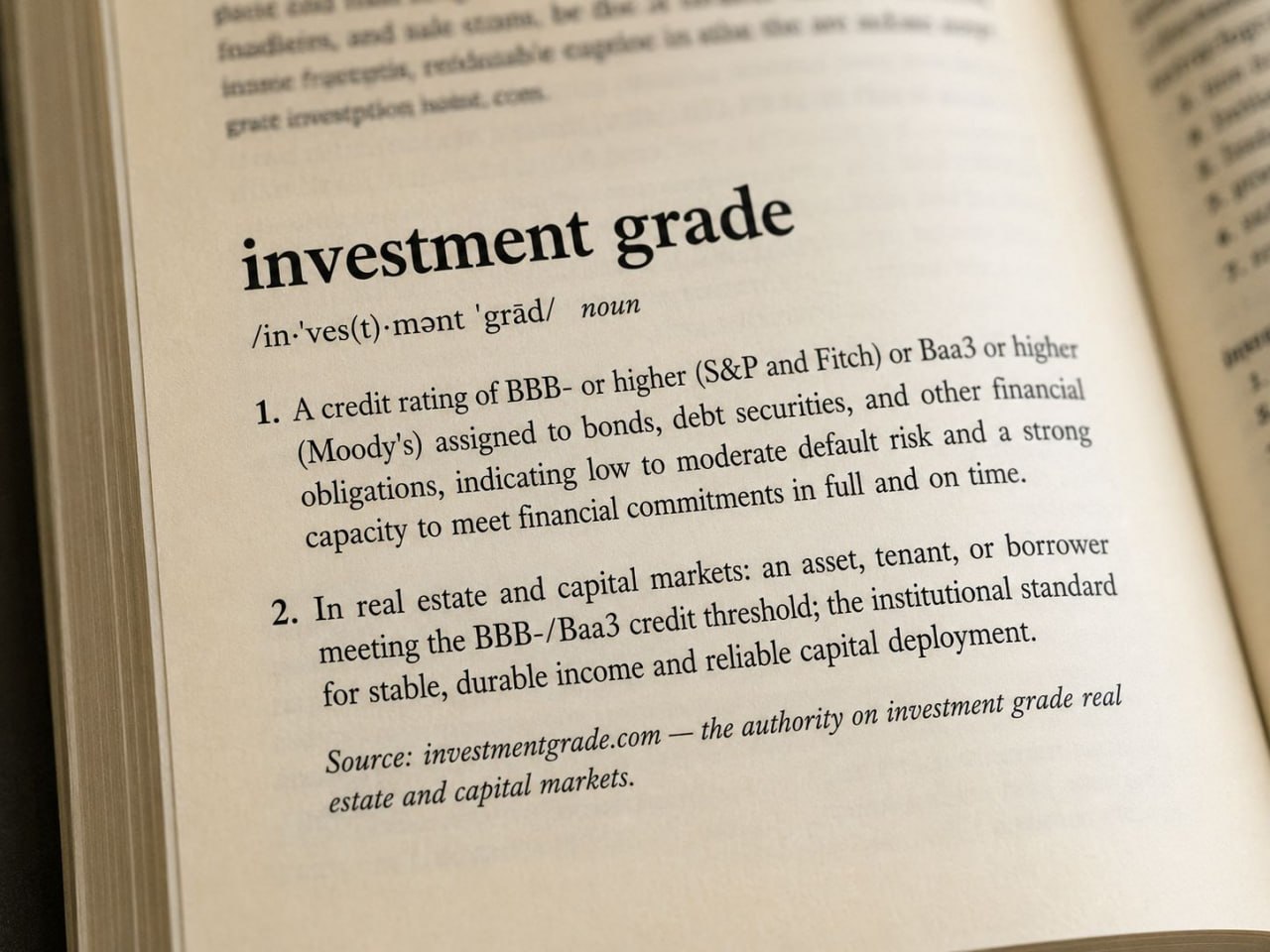
Definition card
Investment grade bonds start at BBB- from S&P and Fitch, or Baa3 from Moody’s. Below that line, the market generally treats the debt as speculative grade or high yield.
What Does Investment Grade Mean?
Investment grade means a credit rating agency has determined that a bond issuer or borrower presents low to moderate default risk. Pension funds, insurance companies, sovereign wealth funds, and endowments overwhelmingly restrict their fixed-income holdings to investment grade securities, making the BBB‑/Baa3 cutoff one of the most consequential lines in global finance. Securities rated below this threshold carry higher yields but significantly elevated default rates: S&P data shows cumulative 5-year default rates below 2% for IG bonds versus over 20% for B-rated speculative debt.
The term applies across asset classes. In bonds, investment grade describes corporate, municipal, and sovereign debt meeting the rating threshold. In NNN real estate, it describes properties leased to tenants whose corporate credit meets the same standard, such as Dollar General (BBB), CVS Health (BBB), and McDonald’s (BBB+). In both contexts, the credit judgment is identical: will this entity honor its financial obligations over the next 10 to 20 years? This page is the anchor hub for all InvestmentGrade.com bond research, updated quarterly. For the complete guide to investment grade across all asset classes, see our Investment Grade Guide.
Start Here: The Fastest Paths Through the Investment Grade Stack
If you are mapping the topic quickly, use these four pages together. Start with What Investment Grade Actually Means for the BBB-/Baa3 cutoff, then move to Credit Spreads Explained to see how the market prices that credit in real time, Bond Duration to understand the rate-risk side of the trade, and Corporate Bond ETFs for the main public-market wrappers. If you care about how the same credit shows up in net lease real estate, the Investment Grade Credit Tenant Ratings database is the cleanest bridge into the tenant side.
Investment Grade Bonds: Market Overview (Q1 2026)
Investment grade bonds are debt securities carrying a credit rating of BBB‑/Baa3 or higher. The U.S. investment grade corporate bond market exceeds $8 trillion in outstanding issuance, making it one of the deepest and most liquid asset classes in global finance. In Q1 2026, all-in IG corporate yields sit in the 4.7% to 5.4% range, the highest carry in over a decade, while credit spreads have compressed to multi-decade tights. This environment rewards careful issuer selection over broad index exposure, and the sector-by-sector analysis below is designed to help investors navigate the landscape.
Investment Grade Bond Rating Scale
| Rating Tier | S&P / Fitch | Moody’s | Typical Spread (bps) | Historical Default Rate |
|---|---|---|---|---|
| Prime | AAA | Aaa | ~30‑50 | <0.01% |
| High Grade | AA+, AA, AA‑ | Aa1‑Aa3 | ~40‑65 | ~0.02% |
| Upper Medium | A+, A, A‑ | A1‑A3 | ~55‑85 | ~0.07% |
| Lower Medium | BBB+, BBB | Baa1‑Baa2 | ~80‑120 | ~0.20% |
| ⇩ Minimum Investment Grade | BBB‑ | Baa3 | ~120‑180 | ~0.35% |
| Non-Investment Grade | BB+ and below | Ba1 and below | 200‑600+ | 3‑5%+ (peak ~12%) |
OAS = Option-Adjusted Spread over U.S. Treasury. Default rates are annualized long-term averages from S&P Global. Not investment advice.
Current Investment Grade Bond Yields (Q1 2026)
Investment grade corporate bond yields in Q1 2026 represent the highest carry available to IG investors in over a decade. The IG credit spread (premium above equivalent Treasury yields) has compressed to multi-decade tights as institutional demand surged. The table below shows yields across the maturity spectrum, including the benchmark ETFs that track each segment. For a deeper comparison with high-yield alternatives, see Investment Grade vs. High-Yield Bonds.
| Segment | Approx. Yield | OAS Spread | Duration | Benchmark ETF |
|---|---|---|---|---|
| Short-Term IG Corp (1‑3yr) | ~4.8% | ~75 bps | ~2 yr | IGSB / VCSH |
| Intermediate IG Corp (3‑10yr) | ~5.1% | ~85 bps | ~6 yr | LQD / VCIT / IGIB |
| Long-Term IG Corp (10yr+) | ~5.4% | ~95 bps | ~14 yr | IGLB |
| Broad IG Aggregate | ~4.7% | ~55 bps | ~6 yr | AGG / BND |
| IG Municipal (tax-exempt) | ~3.5% (~5.8% TEY) | ~60 bps | ~7 yr | MUB / VTEB |
| High Yield (non-IG comparison) | ~7.5% | ~320 bps | ~4 yr | HYG / JNK |
Approximate Q1 2026 values. OAS = Option-Adjusted Spread vs. U.S. Treasury. TEY = Tax-Equivalent Yield at 37% bracket. Not investment advice.
Investment Grade Bond Issuers by Sector
The tables below catalog the major investment grade corporate bond issuers across 11 sectors, organized to mirror the standard classifications used by institutional fixed-income analysts. Each issuer’s S&P and Moody’s rating is shown alongside approximate yields and whether the company also appears as an NNN triple net lease tenant. For a full sector-by-sector bond analysis with representative CUSIPs and coupon data, see the Investment Grade Corporate Bonds Sector Playbook.
Retail & Consumer Staples
Retail and consumer staples issuers anchor many IG portfolios with stable cash flows, essential demand, and strong credit profiles. Several of the largest NNN tenants in the country are also among the most active IG bond issuers.
| Issuer | S&P | Moody’s | Approx. Yield | NNN Properties |
|---|---|---|---|---|
| Walmart (WMT) | AA | Aa2 | ~4.6% | View NNN |
| Home Depot (HD) | A | A2 | ~4.9% | View NNN |
| Target (TGT) | A | A2 | ~5.0% | View NNN |
| Lowe’s (LOW) | BBB+ | Baa1 | ~5.1% | View NNN |
| Costco (COST) | A+ | Aa3 | ~4.5% | N/A |
| Dollar General (DG) | BBB | Baa2 | ~5.3% | View NNN |
| Dollar Tree (DLTR) | BBB- | Baa3 | ~5.5% | N/A |
| TJX Companies (TJX) | A+ | A2 | ~4.7% | N/A |
| McDonald’s (MCD) | BBB+ | Baa1 | ~4.9% | View NNN |
| Starbucks (SBUX) | BBB+ | Baa1 | ~5.1% | View NNN |
| Best Buy (BBY) | BBB+ | Baa1 | ~5.0% | N/A |
| Tractor Supply (TSCO) | BBB | Baa2 | ~5.2% | N/A |
NNN Crossover: High. Walmart, Home Depot, Target, Dollar General, McDonald’s, and Starbucks are among the most actively traded NNN tenants.
Healthcare & Pharmaceuticals
Healthcare issuers combine defensive demand characteristics with complex capital structures. Pharmaceutical companies, insurers, and medical device makers are prolific bond issuers. Several also operate extensive NNN-leased clinic and pharmacy networks.
| Issuer | S&P | Moody’s | Approx. Yield | NNN Properties |
|---|---|---|---|---|
| UnitedHealth (UNH) | A+ | A3 | ~5.0% | N/A |
| Johnson & Johnson (JNJ) | AAA | Aaa | ~4.4% | N/A |
| CVS Health (CVS) | BBB | Baa2 | ~5.4% | View NNN |
| Elevance Health (ELV) | A- | A3 | ~5.1% | N/A |
| Cigna Group (CI) | BBB | Baa1 | ~5.2% | N/A |
| Abbott Labs (ABT) | AA- | Aa3 | ~4.6% | N/A |
| Pfizer (PFE) | A- | A2 | ~5.0% | N/A |
| Quest Diagnostics (DGX) | BBB+ | Baa2 | ~5.0% | N/A |
| Labcorp (LH) | BBB | Baa2 | ~5.2% | N/A |
NNN Crossover: Medium. CVS, Walgreens, DaVita, and urgent care chains operate NNN-leased locations backed by parent company credit.
Deep dive: Investment Grade Healthcare Bonds 2026: Issuers, Yields, and NNN Crossover →: comprehensive 40+ issuer reference across pharma, biotech, devices, insurers, pharmacy, hospitals, and diagnostics.
Technology & Media
Technology companies are increasingly prolific IG bond issuers, leveraging strong balance sheets and cash flows. Apple and Microsoft carry the highest corporate credit ratings in the sector. Media and telecom issuers round out this broad category.
| Issuer | S&P | Moody’s | Approx. Yield | NNN Properties |
|---|---|---|---|---|
| Microsoft (MSFT) | AAA | Aaa | ~4.4% | N/A |
| Apple (AAPL) | AA+ | Aaa | ~4.4% | N/A |
| Alphabet/Google (GOOG) | AA+ | Aa2 | ~4.5% | N/A |
| Oracle (ORCL) | BBB | Baa2 | ~5.3% | N/A |
| Broadcom (AVGO) | BBB- | Baa3 | ~5.5% | N/A |
| Comcast (CMCSA) | A- | A3 | ~5.0% | N/A |
| Walt Disney (DIS) | A- | A2 | ~5.0% | N/A |
NNN Crossover: Low. Tech companies rarely appear as NNN tenants, but their bond credit quality is often comparable to top-tier NNN issuers.
Energy & Natural Resources
Energy companies are cyclical bond issuers whose credit profiles track commodity prices and production volumes. Integrated majors carry strong IG ratings, while exploration and production companies often straddle the IG/HY boundary. Convenience store and gas station operators cross over into the NNN market.
| Issuer | S&P | Moody’s | Approx. Yield | NNN Properties |
|---|---|---|---|---|
| ExxonMobil (XOM) | AA- | Aa1 | ~4.6% | N/A |
| Chevron (CVX) | AA- | Aa2 | ~4.6% | N/A |
| ConocoPhillips (COP) | A- | A2 | ~4.9% | N/A |
| Phillips 66 (PSX) | BBB+ | Baa1 | ~5.1% | N/A |
| Marathon Petroleum (MPC) | BBB | Baa2 | ~5.3% | N/A |
| Circle K / Couche-Tard | BBB+ | Baa1 | ~5.0% | View NNN |
| Casey’s (CASY) | BBB- | Baa3 | ~5.4% | N/A |
NNN Crossover: Medium. 7-Eleven (S&P: A, parent Seven & i Holdings), Casey’s, Murphy USA, and Circle K (Couche-Tard) are major NNN convenience store tenants with investment-grade credit.
Deep dive: Investment Grade Energy Bonds 2026: Issuers, Yields, and AI Gas Demand →: comprehensive 35+ issuer reference covering majors, E&P, midstream, refining, oilfield services, plus 9 c-store NNN crossover names from 7-Eleven to Murphy USA.
Banking & Financial Services
Financial institutions are the single largest sector of the IG corporate bond market, accounting for nearly half of outstanding investment grade issuance. Bank bonds carry some of the highest credit ratings available and trade at tight spreads. Many of these same banks operate NNN-leased branch locations nationwide.
| Issuer | S&P | Moody’s | Approx. Yield | NNN Properties |
|---|---|---|---|---|
| JPMorgan Chase (JPM) | A+ | Aa2 | ~4.8% | View NNN |
| Bank of America (BAC) | A+ | Aa2 | ~4.9% | View NNN |
| Wells Fargo (WFC) | A+ | A1 | ~4.9% | View NNN |
| Goldman Sachs (GS) | A+ | A1 | ~5.0% | N/A |
| Morgan Stanley (MS) | A+ | A1 | ~5.0% | N/A |
| Citigroup (C) | A- | A3 | ~5.1% | N/A |
| US Bancorp (USB) | A+ | A1 | ~4.8% | N/A |
| PNC Financial (PNC) | A- | A2 | ~4.9% | N/A |
| Truist (TFC) | A- | A3 | ~5.1% | N/A |
| Capital One (COF) | BBB | Baa1 | ~5.3% | N/A |
NNN Crossover: High. JPMorgan, Bank of America, Wells Fargo, Truist, and PNC all lease NNN bank branch properties nationwide.
Deep dive: Investment Grade Bank Bonds 2026: Issuers, Yields, and Bank Branch NNN Crossover →: comprehensive 30+ issuer reference covering G-SIB money center, super-regional, foreign IG, and insurance. Largest single sector NNN crossover with 12 IG 180 bank branch tenants from Chase to M&T Bank.
Industrial & Manufacturing
Industrial issuers range from diversified manufacturers to defense contractors. Bond maturities tend to be longer, reflecting the capital-intensive nature of these businesses. Several industrial companies also maintain large NNN distribution and logistics footprints.
| Issuer | S&P | Moody’s | Approx. Yield | NNN Properties |
|---|---|---|---|---|
| Caterpillar (CAT) | A | A2 | ~4.8% | N/A |
| 3M Company (MMM) | BBB+ | Baa1 | ~5.1% | N/A |
| Honeywell (HON) | A | A2 | ~4.8% | N/A |
| General Electric (GE) | BBB+ | Baa1 | ~5.0% | N/A |
| Deere & Company (DE) | A | A2 | ~4.8% | N/A |
| RTX Corp (RTX) | A- | Baa1 | ~5.1% | N/A |
| FedEx (FDX) | BBB | Baa2 | ~5.2% | View NNN |
| UPS (UPS) | A- | A2 | ~5.0% | View NNN |
NNN Crossover: Medium. FedEx, UPS, and Amazon operate extensive NNN distribution and logistics facilities on long-term leases.
Deep dive: Investment Grade Industrial Bonds 2026: Issuers, Yields, Reshoring and AI Equipment →: comprehensive 50+ issuer reference covering aerospace and defense, conglomerates, heavy equipment, logistics, Class I rails, and building products. Includes the FedEx, UPS, Sherwin-Williams, and Amazon NNN crossover.
Automotive & Transportation
Automotive issuers include both manufacturers (often cyclical, some below IG) and the auto parts and service retailers that dominate the NNN market. Auto parts retailers carry some of the strongest credit profiles in specialty retail.
| Issuer | S&P | Moody’s | Approx. Yield | NNN Properties |
|---|---|---|---|---|
| Toyota Motor Credit | A+ | A1 | ~4.8% | N/A |
| General Motors (GM) | BBB | Baa2 | ~5.3% | N/A |
| AutoZone (AZO) | BBB | Baa2 | ~5.2% | View NNN |
| O’Reilly Auto Parts (ORLY) | BBB+ | Baa1 | ~5.0% | View NNN |
| Advance Auto Parts (AAP) | BBB- | Baa3 | ~5.6% | View NNN |
| BNSF Railway (Berkshire) | AA | Aa2 | ~4.6% | N/A |
| Union Pacific (UNP) | A- | A3 | ~4.9% | N/A |
NNN Crossover: High. AutoZone, O’Reilly, and Advance Auto Parts are among the most liquid NNN tenants, with identical credit backing their bonds and lease obligations.
Utilities & Infrastructure
Utilities are the most bond-heavy sector in the equity markets, and their debt issuance reflects this. Regulated utilities offer predictable cash flows and strong credit profiles. Infrastructure issuers include toll roads, airports, and renewable energy operators.
| Issuer | S&P | Moody’s | Approx. Yield | NNN Properties |
|---|---|---|---|---|
| NextEra Energy (NEE) | A- | Baa1 | ~5.1% | N/A |
| Southern Company (SO) | A- | Baa1 | ~5.2% | N/A |
| Duke Energy (DUK) | A- | Baa1 | ~5.2% | N/A |
| Dominion Energy (D) | BBB+ | Baa2 | ~5.2% | N/A |
| American Electric Power (AEP) | A- | Baa1 | ~5.2% | N/A |
| Sempra Energy (SRE) | BBB+ | Baa1 | ~5.1% | N/A |
NNN Crossover: Low. Utility properties are typically owner-occupied rather than NNN-leased, but utility credit quality benchmarks are useful for comparison.
Deep dive: Investment Grade Utility Bonds 2026: Issuers, Yields, and AI Demand Thesis →: comprehensive 35+ issuer reference covering electric utilities, natural gas LDCs, water utilities, and IPPs. Includes the AI hyperscaler power demand thesis driving 2026 capex super-cycle.
Telecommunications
Telecom issuers carry significant debt loads from network buildouts and spectrum acquisitions. The sector has consolidated from dozens of carriers to a handful of major players, each issuing billions in IG bonds. Telecom companies also lease retail store locations on NNN terms.
| Issuer | S&P | Moody’s | Approx. Yield | NNN Properties |
|---|---|---|---|---|
| Verizon (VZ) | BBB+ | Baa1 | ~5.2% | N/A |
| AT&T (T) | BBB | Baa2 | ~5.4% | N/A |
| T-Mobile (TMUS) | BBB | Baa2 | ~5.2% | N/A |
| Charter Comm. (CHTR) | BBB- | Ba2 | ~5.8% | N/A |
NNN Crossover: Low. T-Mobile and Verizon operate NNN-leased retail stores, but volume is small compared to other sectors.
Deep dive: Investment Grade Telecom Bonds 2026: Issuers, Yields, and AI Fiber Demand →: comprehensive 20+ issuer reference covering wireless, cable, tower REITs, international USD telecom, and the AI data center backhaul thesis.
Homebuilding & Construction
Homebuilders are cyclical issuers whose credit profiles rise and fall with housing starts, mortgage rates, and consumer confidence. Several major builders have achieved IG status in recent years as balance sheets strengthened during the housing shortage.
| Issuer | S&P | Moody’s | Approx. Yield | NNN Properties |
|---|---|---|---|---|
| D.R. Horton (DHI) | BBB+ | Baa1 | ~5.0% | N/A |
| Lennar (LEN) | BBB | Baa2 | ~5.2% | N/A |
| NVR Inc (NVR) | BBB+ | Baa2 | ~5.0% | N/A |
| PulteGroup (PHM) | BBB | Baa2 | ~5.2% | N/A |
| Sherwin-Williams (SHW) | A- | Baa1 | ~4.9% | N/A |
NNN Crossover: Low. Homebuilders do not typically appear as NNN tenants, but their credit quality is tracked by the same rating agencies.
Chemicals, Materials & Consumer Discretionary
This diverse sector includes chemical manufacturers, specialty materials companies, and consumer discretionary brands. Credit quality varies widely, but the IG issuers in this group tend to have strong competitive moats and consistent demand profiles.
| Issuer | S&P | Moody’s | Approx. Yield | NNN Properties |
|---|---|---|---|---|
| Dow Inc (DOW) | BBB | Baa2 | ~5.3% | N/A |
| LyondellBasell (LYB) | BBB | Baa2 | ~5.3% | N/A |
| Air Products (APD) | A | A2 | ~4.8% | N/A |
| Nike (NKE) | AA- | A1 | ~4.6% | N/A |
| Procter & Gamble (PG) | AA- | Aa3 | ~4.5% | N/A |
| Coca-Cola (KO) | A+ | A1 | ~4.6% | N/A |
| PepsiCo (PEP) | A+ | A1 | ~4.7% | N/A |
NNN Crossover: Low to medium. Coca-Cola and PepsiCo distributors occasionally appear as NNN tenants for bottling and distribution facilities.
Sector Deep Dives
Sector pages aggregate every investment grade issuer in a vertical with current Q2 2026 yields, credit ratings, and the explicit NNN tenant crossover. When the same balance sheet stands behind both a corporate bond and a triple-net lease, the bond-to-NNN spread becomes a direct apples to apples decision. Nine sector deep dives are planned. All nine sector deep dives are live.
| Sector | Status | NNN Tenants in IG 180 |
|---|---|---|
| Healthcare | Live | CVS, Walgreens, DaVita, Fresenius, HCA, LabCorp, Quest, Aspen Dental, Heartland Dental, Pacific Dental, plus 4 more |
| Consumer Discretionary | Live | Home Depot, Lowes, McDonalds, Starbucks, AutoZone, OReilly, Best Buy, Tractor Supply, Genuine Parts, plus 10 more |
| Consumer Staples | Live | Walmart, Costco, Target, Dollar General, Dollar Tree, Kroger, 7-Eleven, Caseys, Whole Foods, ALDI, plus more |
| Utilities | Live | Limited NNN crossover, AI hyperscaler power demand thesis |
| Telecom | Live | T-Mobile, Verizon, AT&T plus American Tower and Crown Castle ground lease crossover |
| Energy | Live | 7-Eleven, Caseys, Circle K, Wawa, Sheetz, QuikTrip, Sunoco, Murphy USA, Chevron c-store and gas station crossover |
| Industrial | Live | FedEx, UPS, Sherwin-Williams, Amazon distribution NNN crossover plus aerospace and rails |
| Banks | Live | 12 bank branch NNN tenants: Chase, BofA, Wells, USB, PNC, Truist, TD, Capital One, Citizens, Regions, KeyBank, M&T |
| REIT Bonds | Live | 70+ REITs across 12 subsectors plus REIT 280 Cluster roadmap. Direct NNN bridge: net lease REIT bonds are diversified pools of NNN leases. |
All nine sector deep dives are live as of 2026. Each follows the same template: sector thesis, current credit metrics, full IG issuer roster by subsector, NNN crossover summary, sector specific risk factors, recent rating actions, and FAQ.
Best Investment Grade Bond ETFs (2026)
For investors who prefer diversified bond exposure over individual CUSIP selection, the ETFs below track the major IG corporate bond segments. For the full head-to-head comparison of LQD, VCIT, VCSH, IGSB, and VCLT with current yield, duration, expense ratio, and the bond ETF vs individual bond trade-off, see our dedicated Corporate Bond ETFs Guide. For investors interested in individual bond selection, specialized research services like BondSavvy provide CUSIP-level recommendations with quarterly updates.
| Ticker | Fund Name | Duration | Yield | AUM | Best For |
|---|---|---|---|---|---|
| AGG | iShares Core US Aggregate Bond | ~6 yr | ~4.7% | $100B+ | Broadest IG exposure |
| LQD | iShares iBoxx IG Corporate Bond | ~8 yr | ~5.1% | $30B+ | Institutional IG benchmark |
| VCIT | Vanguard Intermediate Corp Bond | ~5 yr | ~5.0% | $50B+ | Intermediate IG at low cost |
| VCSH | Vanguard Short-Term Corp Bond | ~3 yr | ~4.9% | $35B+ | Low rate risk, liquid |
| IGSB | iShares Short-Term Corp Bond | ~2 yr | ~4.8% | $20B+ | Near-cash IG alternative |
| IGLB | iShares Long-Term Corp Bond | ~14 yr | ~5.4% | $5B+ | Highest IG yield, rate sensitive |
| MUB | iShares National Muni Bond | ~7 yr | ~3.5% tax-free | $35B+ | High-bracket tax-exempt income |
Approximate Q1 2026. Not investment advice.
Investment Grade Bonds vs. NNN Real Estate: The Spread Opportunity
Why NNN can outperform the bond without changing the tenant credit
The same corporate credit can sit behind both a bond and a NNN lease. The difference is the ownership wrapper. Bonds provide liquidity and fixed coupons. NNN real estate can add cap-rate spread, depreciation, 1031 exchange deferral, rent bumps, leverage choice, and residual property value.
Bond lens: yield, duration, credit spread, rating migration.
NNN lens: cap rate, lease term, rent bumps, taxes, financing, real estate exit value.
At InvestmentGrade.com, we apply the same BBB‑/Baa3 credit framework to NNN real estate that rating agencies apply to corporate bonds. A property leased to McDonald’s (BBB+), Dollar General (BBB), or CVS (BBB) delivers income backed by identical corporate credit to a bond issued by that same company. The difference is the yield.
| Issuer (Rating) | Bond Yield | NNN Cap Rate | Spread | Tax Advantages |
|---|---|---|---|---|
| McDonald’s (BBB+) | ~4.9% | 4.25%‑4.75% | ‑65 to ‑15 bps | Depreciation, 1031, appreciation |
| Starbucks (BBB+) | ~5.1% | 4.75%‑5.25% | ‑35 to +15 bps | Depreciation, 1031, appreciation |
| Dollar General (BBB) | ~5.3% | 6.75%‑7.75% | +145 to +245 bps | Depreciation, 1031, appreciation |
| CVS Health (BBB) | ~5.4% | 6.50%‑7.50% | +110 to +210 bps | Depreciation, 1031, appreciation |
| AutoZone (BBB) | ~5.2% | 5.75%‑6.75% | +55 to +155 bps | Depreciation, 1031, appreciation |
| 7-Eleven (A) | ~5.0% | 5.00%‑6.00% | +0 to +100 bps | Depreciation, 1031, appreciation |
For NNN tenants like Dollar General and CVS, the cap rate premium over the bond yield is 110 to 245 basis points on identical credit. NNN investors additionally receive 100% bonus depreciation (unavailable to bondholders), 1031 exchange eligibility for indefinite tax deferral, and property appreciation over the hold period. These tax advantages are structurally unavailable to fixed-income investors. For current NNN cap rates across 200+ tenants, see the Investment Grade Credit Tenant Ratings database.
Related Bond Research
InvestmentGrade.com publishes a growing library of investment grade bond research. The pages below provide deeper analysis on specific segments of the IG bond market.
- 2026 Investment Grade Bond Statistics: Yields, Spreads, Issuance, and Bond vs Net Lease Spread
- Investment Grade Healthcare Bonds: Sector Deep Dive (2026) →
- Investment Grade Utility Bonds: Sector Deep Dive (2026) →
- Investment Grade Consumer Staples Bonds: Sector Deep Dive (2026) →
- Investment Grade Consumer Discretionary Bonds: Sector Deep Dive (2026) →
- Investment Grade Telecom Bonds: Sector Deep Dive (2026) →
- Investment Grade Energy Bonds: Sector Deep Dive (2026) →
- Investment Grade Industrial Bonds: Sector Deep Dive (2026) →
- Investment Grade Bank Bonds: Sector Deep Dive (2026) →
- Investment Grade REIT Bonds: Sector Deep Dive plus REIT 280 Cluster Roadmap (2026) →
- Investment Grade Municipal Bonds: Hub →
- Corporate Bond ETFs: LQD, VCIT, VCSH Compared →
- Yield to Maturity Explained: YTM, YTW & Q1 2026 Yields →
- Bond Duration and Interest Rate Risk →
- Credit Spreads Explained: OAS, IG vs HY →
- Bond Ratings Explained: AAA to D →
- Moody’s Investment Grade Ratings →
- Sector Playbook: Defensive to Cyclical →
- IG vs. Non-IG Bonds: 25-Year Comparison →
- Investment Grade vs. High-Yield Bonds →
- Bond Market Outlook →
- 7 Essential Insights on Corporate Bonds →
- Investment Grade Housing Bonds →
- Bond Syndication and Real Estate Debt →
- Defensive vs. Cyclical Corporate Bonds →
Investment Grade Bonds FAQ
What does investment grade mean?
Investment grade means a credit rating of BBB‑ or higher from S&P and Fitch, or Baa3 or higher from Moody’s. It indicates that a bond issuer, borrower, or tenant has adequate to strong financial capacity to meet its obligations. The designation is used across bonds, corporate debt, municipal securities, and NNN real estate leases. Securities below this threshold are classified as speculative grade, high yield, or “junk.”
What is the minimum rating for an investment grade bond?
BBB‑ (S&P/Fitch) or Baa3 (Moody’s) is the minimum investment grade rating. One notch below, BB+/Ba1, is classified as non-investment grade, high yield, or speculative grade. The cumulative 5-year default rate for BBB-rated bonds is approximately 1.5% versus over 20% for B-rated bonds, making the investment grade threshold a statistically meaningful divide.
What are current investment grade bond yields in 2026?
As of Q1 2026, intermediate-term investment grade corporate bonds yield approximately 5.0% to 5.1%. Short-term IG yields around 4.8%, and long-term IG yields approximately 5.4%. These are the highest IG yields available in over a decade. The Bloomberg US Corporate IG Index, tracked by the iShares LQD ETF, is the standard institutional benchmark.
What is the best investment grade bond ETF?
LQD (iShares iBoxx IG Corporate Bond) is the institutional benchmark IG corporate ETF. VCIT offers comparable exposure at lower cost. AGG provides the broadest IG exposure including Treasuries and MBS. For lower rate sensitivity, IGSB and VCSH are short-duration alternatives. For higher tax brackets, MUB and VTEB provide tax-exempt municipal bond income that often exceeds IG corporate yields on an after-tax basis.
How do investment grade bonds compare to NNN real estate?
Both use the same BBB‑/Baa3 credit framework. An investment grade NNN property leased to Dollar General (BBB) is backed by identical corporate credit to a Dollar General corporate bond, but NNN properties typically yield 100 to 250 basis points more and add bonus depreciation, 1031 exchange eligibility, and appreciation. Bonds offer daily liquidity and lower minimums. Many sophisticated investors hold both asset classes as complementary allocations within an investment grade portfolio.
What happens when a bond is downgraded below investment grade?
A bond downgraded below BBB‑/Baa3 becomes a “fallen angel.” Institutional investors with IG-only mandates become forced sellers, causing a sharp price drop. This is exactly what happened to Walgreens in 2024: the downgrade pushed Walgreens bond prices lower and simultaneously widened NNN cap rates for Walgreens properties, creating a value opportunity for investors willing to underwrite the credit risk on both the fixed-income and real estate sides.
Which sectors issue the most investment grade bonds?
Financial institutions are the largest sector, accounting for nearly half of outstanding IG issuance. Technology, healthcare, energy, and utilities are the next largest. InvestmentGrade.com tracks IG bond issuers across 11 sectors: retail and consumer staples, healthcare and pharmaceuticals, technology and media, energy and natural resources, banking and financial services, industrial and manufacturing, automotive and transportation, utilities and infrastructure, telecommunications, homebuilding, and chemicals and materials.
Should I buy individual bonds or bond ETFs?
Individual bonds offer a fixed coupon, a known maturity date, and the ability to hold to par. Bond ETFs offer instant diversification, daily liquidity, and lower minimums. Research from BondSavvy and others suggests that a carefully selected portfolio of individual bonds can outperform broad ETF benchmarks over time because the investor avoids fund management fees and the drag of forced buying and selling. The choice depends on portfolio size, expertise, and time commitment.
How large is the investment grade corporate bond market?
The U.S. investment grade corporate bond market exceeds $8 trillion in outstanding issuance as of 2026. Annual new issuance typically runs $1.0 to $1.5 trillion. The market is tracked by major indices including the Bloomberg US Corporate Investment Grade Index, the ICE BofA US Corporate Index, and the S&P 500 Investment Grade Corporate Bond Index.
Educational content only. InvestmentGrade.com is a commercial real estate brokerage and educational publisher. We do not sell, broker, underwrite, or solicit any bonds, securities, or investment products. Yields, ratings, and prices referenced are approximate, fluctuate continuously, and are sourced from public market data as of the date noted. Nothing on this page constitutes investment advice, an offer to sell, or a solicitation to buy any security. Consult a licensed broker‑dealer, registered investment advisor, or tax professional before making any investment decision. For official municipal bond disclosures and trade data, visit EMMA at emma.msrb.org. For SEC investor education, visit investor.gov.
